


Glutamic acid decarboxylase and islet antigen 2 antibody profiles in people with adult-onset diabetes mellitus: a comparison between mixed ethnic populations in Singapore and Germany
- PMID: 28370329
- PMCID: PMC5575487
- DOI: 10.1111/dme.13358
Glutamic acid decarboxylase and islet antigen 2 antibody profiles in people with adult-onset diabetes mellitus: a comparison between mixed ethnic populations in Singapore and Germany
Abstract
Aim: To gain insight into the presence of islet cell autoimmunity in an ethnic Asian compared with a white European population.
Methods: For this cross-sectional study we recruited people with adult-onset diabetes (age of diagnosis 20-60 years), at tertiary referral centres in Germany (n=1020) and Singapore (n=1088). Glutamic acid decarboxylase and islet antigen 2 antibodies were measured according to Islet Autoantibody Standardization Program protocols.
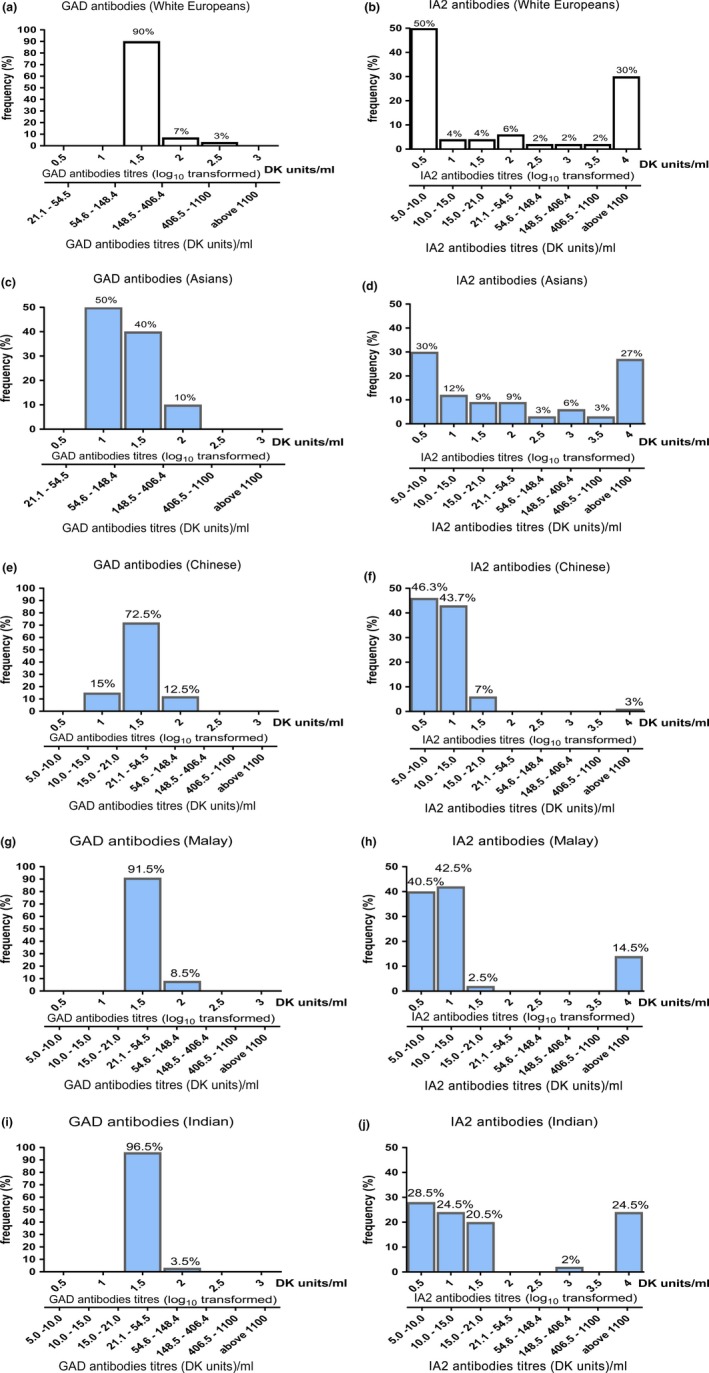
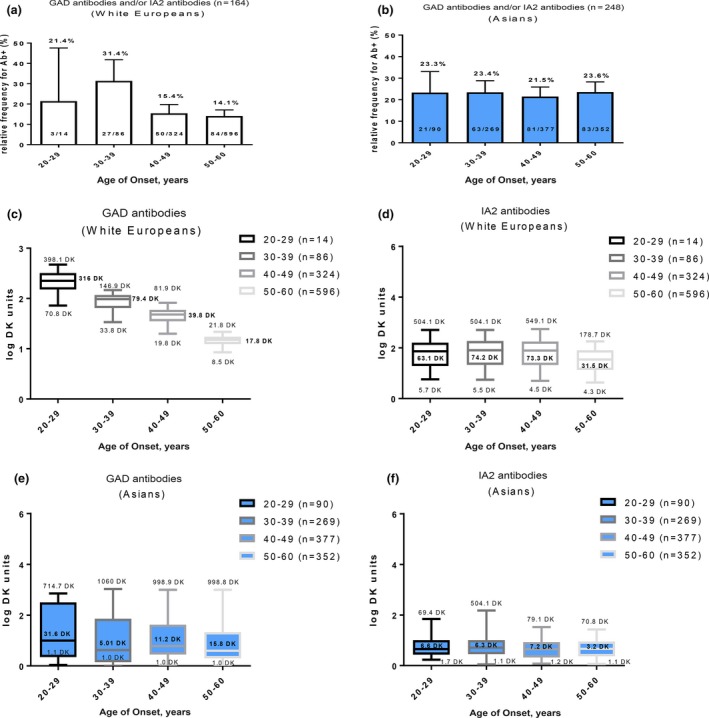
Results: The prevalence of glutamic acid decarboxylase antibody positivity was 13.9% (95% CI 12.1-16.0; P<0.001) in the white European cohort compared with 6.8% (95% CI 5.5-8.4; P<0.001) in the Asian cohort. Glutamic acid decarboxylase antibody positivity was 11.4% (95% CI 7.7-16.6) in Indian, 6.0% (95% CI 3.6-9.9) in Malay and 5.8% (95% CI 4.3-7.7; P<0.001) in Chinese participants. In the white European participants, the prevalence of islet antigen 2 antibody positivity was 7.8% (95% CI 6.4-9.4) compared with 14.8% (95% CI 12.8-17.0; P<0.001) in the Asian cohort as a whole, and among the three ethnicities in the Asian cohort it was 12.4% (95% CI 8.6-17.7) in Indian, 16.8% (95% CI 12.6-22.2) in Malay and 15.7% (95% CI 13.2-18.6) in Chinese participants. Double antibody positivity was seen in 5.7% (95% CI 4.5-7.1) of white European participants compared with 1.6% (95% CI 1.0-2.5; P<0.01) of Asian participants. In the white European cohort, those who were glutamic acid decarboxylase autoantibody-positive had a lower BMI than those who were autoantibody-negative, but this trend was absent in the Asian cohort.
Conclusions: A marked prevalence of islet cell autoimmunity was observed in people with adult-onset diabetes. While glutamic acid decarboxylase antibodies were more frequent in the European cohort, islet antigen 2 antibody positivity was highest in the three ethnic groups in Singapore, suggesting ethnic-specific differences in antibody profiles.
© 2017 The Authors. Diabetic Medicine published by John Wiley & Sons Ltd on behalf of Diabetes UK.
Figures
References
-
- Nanditha A, Ma RC, Ramachandran A, Snehalatha C, Chan JC, Chia KS et al Diabetes in Asia and the Pacific: Implications for the Global Epidemic. Diabetes Care 2016; 39: 472–485. - PubMed
-
- Guglielmi C, Palermo A, Pozzilli P. Latent autoimmune diabetes in the adults (LADA) in Asia: from pathogenesis and epidemiology to therapy. Diabetes Metab Res Rev 2012; 28(Suppl. 2): 40–46. - PubMed
-
- Naik RG, Brooks‐Worrell BM, Palmer JP. Latent autoimmune diabetes in adults. J Clin Endocrinol Metab 2009; 94: 4635–4644. - PubMed
-
- American Diabetes Association . Diagnosis and classification of diabetes mellitus. Diabetes Care 2006; 29(Suppl. 1): S43–48. - PubMed
Publication types
MeSH terms
Substances
LinkOut - more resources
Full Text Sources
Other Literature Sources
Medical
Molecular Biology Databases
