


Clinical presentation and outcomes of patients with type 1 monoclonal cryoglobulinemia
- PMID: 28370486
- PMCID: PMC5579826
- DOI: 10.1002/ajh.24745
Clinical presentation and outcomes of patients with type 1 monoclonal cryoglobulinemia
Abstract
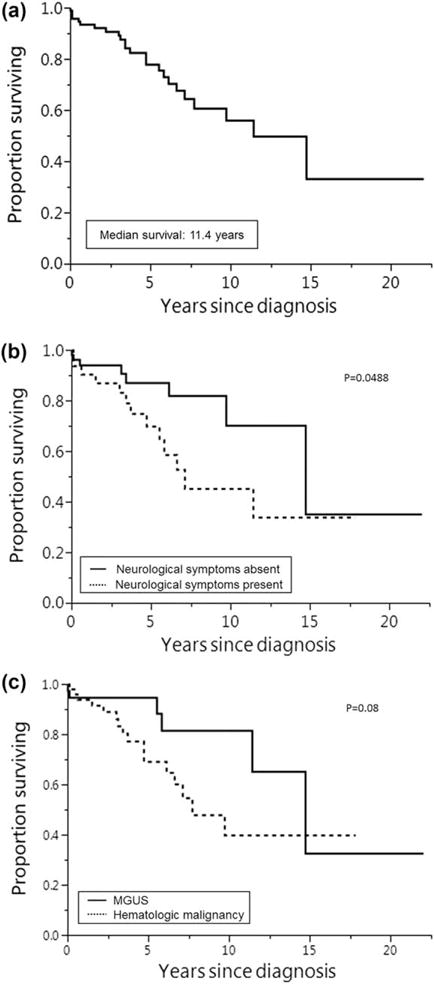
We describe a series of 102 patients diagnosed from January 1, 1990 to December 31, 2015 with Type 1 monoclonal cryoglobulinemia (MoC). Symptoms were seen in 89 (87%) patients, including: cutaneous symptoms in 64 (63%) patients, with purpura (n = 43, 42%) and ulcers/gangrene (n = 35, 34%) being most common; neurological findings in 33 (32%) patients, most frequently sensory neuropathy (n = 24, 24%); vasomotor symptoms, mainly Raynaud's phenomenon in 25 (25%); arthralgias in 24 (24%); and renal manifestations, primarily glomerulonephritis in 14 (14%) patients. An underlying lymphoproliferative disorder was identified in 94 (92%) subjects; MGUS-39, myeloma-20, lymphoplasmacytic lymphoma-21 and others-14. Treatment was initiated in 73 (72%) patients, primarily for cryoglobulinemia-related symptoms in 57. Treatment regimens consisted of: steroids ± alkylating agents in 29 (40%), novel myeloma therapies in 16 (22%), rituximab with alkylating agents in 12 (16%) and rituximab ± steroids in 11 (15%) patients; 22 patients received plasmapheresis. Six patients underwent autologous stem cell transplant. Cryocrit at treatment initiation, change in cryocrit and time to nadir cryocrit were predictive of symptom improvement. Treatment directed toward the underlying clonal disorder resulted in improvement (n = 47) or stabilization (n = 16) of symptoms in the majority of patients and disappearance of cryoglobulin in over one-half.
© 2017 Wiley Periodicals, Inc.
Conflict of interest statement
None
Figures
References
-
- Brouet JC, Clauvel JP, Danon F, Klein M, Seligmann M. Biologic and clinical significance of cryoglobulins. A report of 86 cases. Am J Med. 1974;57(5):775–788. - PubMed
-
- Harel S, Mohr M, Jahn I, et al. Clinico-biological characteristics and treatment of type I monoclonal cryoglobulinaemia: a study of 64 cases. Br J Haematol. 2015;168(5):671–678. - PubMed
-
- Neel A, Perrin F, Decaux O, et al. Long-term outcome of monoclonal (type 1) cryoglobulinemia. Am J Hematol. 2014;89(2):156–161. - PubMed
-
- Bryce AH, Kyle RA, Dispenzieri A, Gertz MA. Natural history and therapy of 66 patients with mixed cryoglobulinemia. Am J Hematol. 2006;81(7):511–518. - PubMed
MeSH terms
Substances
Grants and funding
LinkOut - more resources
Full Text Sources
Other Literature Sources