


Ultra-low-dose radiotherapy for definitive management of ocular adnexal B-cell lymphoma
- PMID: 28370694
- PMCID: PMC6044206
- DOI: 10.1002/hed.24717
Ultra-low-dose radiotherapy for definitive management of ocular adnexal B-cell lymphoma
Erratum in
-
Ultra-low-dose radiotherapy for definitive management of ocular adnexal B-cell lymphoma.Head Neck. 2018 Jun;40(6):1335. doi: 10.1002/hed.25149. Epub 2018 Feb 21. Head Neck. 2018. PMID: 29851218 No abstract available.
-
Ultra-low-dose radiotherapy for definitive management of ocular adnexal B-cell lymphoma.Head Neck. 2019 May;41(5):1546. doi: 10.1002/hed.25738. Epub 2019 Mar 19. Head Neck. 2019. PMID: 30990235 No abstract available.
Abstract
Background: The purpose of this study was to report the response to and toxicity of ultra-low-dose radiotherapy (RT) for B-cell ocular adnexal lymphoma (OAL).
Methods: We conducted a retrospective review of patients with indolent B-cell and mantle cell OAL treated with 4 Gy to the orbit(s) in two 2-Gy fractions. Disease response was assessed clinically and/or radiographically at 2 to 4-month intervals after RT. Data collected included rates of overall response, complete response (CR), partial response (PR), and treatment-related toxic effects.
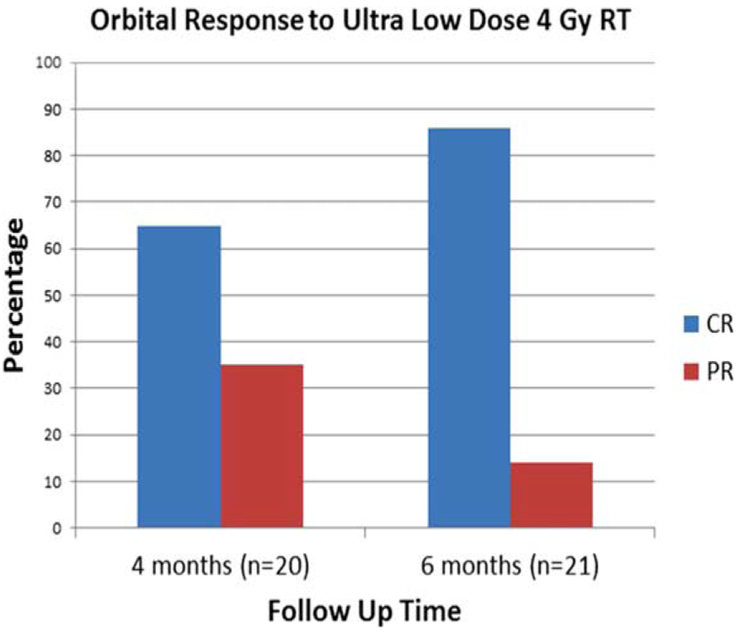
Results: Twenty-two patients (median age, 65 years) had the following histologic subtypes: mucosa-associated lymphoid tissue (MALT; 14 patients; 64%); follicular lymphoma (5 patients; 23%); mantle cell lymphoma (MCL; 2 patients; 9%); and unclassifiable (1 patient, 4%). The overall response rate was 100%; 19 patients (86%) had a CR and 3 patients (14%) had a PR. The only acute toxic effect was grade 1 dry eye syndrome in 1 patient.
Conclusion: Ultra-low-dose RT in patients with OAL is associated with high response rates and minimal toxic effects, and is much shorter in duration and cost. © 2017 Wiley Periodicals, Inc. Head Neck 39: 1095-1100, 2017.
Keywords: mantle cell lymphoma; mucosa-associated lymphoid tumor; ocular adnexal lymphoma; orbital lymphoma; radiotherapy.
© 2017 Wiley Periodicals, Inc.
Figures

References
-
- Freeman C, Berg JW, Cutler SJ. Occurrence and prognosis of extranodal lymphomas. Cancer 1972;29:252–260. - PubMed
-
- Margo CE, Mulla ZD. Malignant tumors of the orbit. Analysis of the Florida Cancer Registry. Ophthalmology 1998;105:185–190. - PubMed
-
- Ferreri AJ, Blay JY, Reni M, et al. Relevance of intraocular involvement in the management of primary central nervous system lymphomas. Ann Oncol 2002;13:531–538. - PubMed
-
- Bolek TW, Moyses HM, Marcus RB Jr, et al. Radiotherapy in the management of orbital lymphoma. Int J Radiat Oncol Biol Phys 1999;44:31–36. - PubMed
MeSH terms
Grants and funding
LinkOut - more resources
Full Text Sources
Other Literature Sources
Medical
Research Materials
