Review
. 2017 Sep 25;56(40):12052-12063.
doi: 10.1002/anie.201701065. Epub 2017 Aug 15.

A Challenging Pie to Splice: Drugging the Spliceosome

Affiliations
Review

A Challenging Pie to Splice: Drugging the Spliceosome

Brian León et al. Angew Chem Int Ed Engl. .

Abstract

Since its discovery in 1977, the study of alternative RNA splicing has revealed a plethora of mechanisms that had never before been documented in nature. Understanding these transitions and their outcome at the level of the cell and organism has become one of the great frontiers of modern chemical biology. Until 2007, this field remained in the hands of RNA biologists. However, the recent identification of natural product and synthetic modulators of RNA splicing has opened new access to this field, allowing for the first time a chemical-based interrogation of RNA splicing processes. Simultaneously, we have begun to understand the vital importance of splicing in disease, which offers a new platform for molecular discovery and therapy. As with many natural systems, gaining clear mechanistic detail at the molecular level is key towards understanding the operation of any biological machine. This minireview presents recent lessons learned in this emerging field of RNA splicing chemistry and chemical biology.

Keywords: RNA splicing; chemical biology; drug discovery; inhibitors; spliceosome.


Conflict of interest statement

Conflict of interest

The authors declare no conflict of interest.

Figures
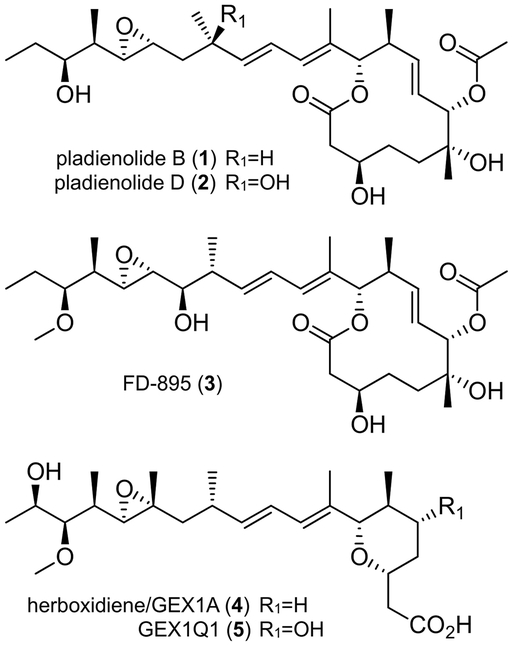
Figure 1
Figure 1
Structures of selected examples of the 12-membered macrolide and 6-membered cyclic ether families of polyketide SPLMs.
Figure 2
Figure 2
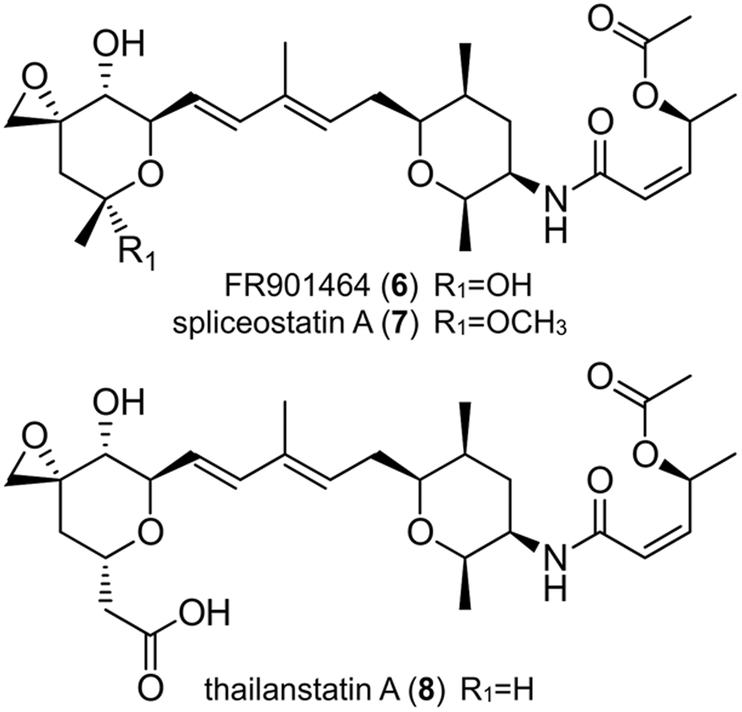
Structures of members of a third family of polyketide SPLMs.
Figure 3
Figure 3
Synthetic disconnections implemented in the total syntheses of a--b) pladienolide B (1) or c) FD-895 (3). Bond disconnections for component coupling steps (blue) and key steps in component syntheses (red) are shown.
Figure 4
Figure 4
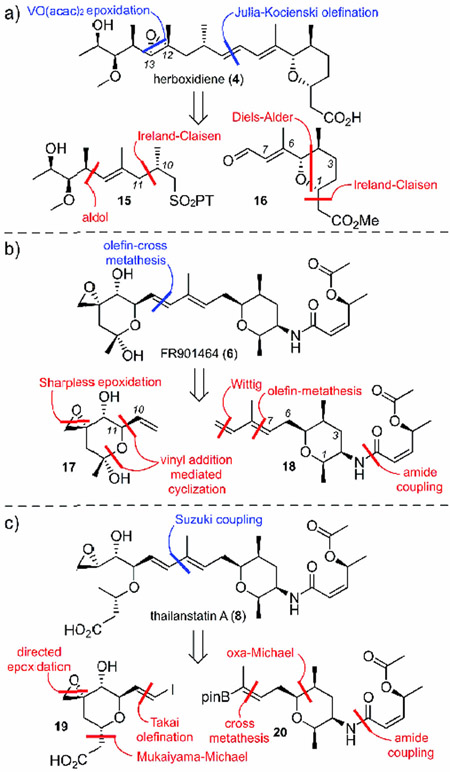
Synthetic disconnections implemented in the total syntheses of a) herboxidiene (4), b) FR901464 (6), and c) thailanstatin A (8). Bond disconnections for component coupling steps (blue) and key steps in component syntheses (red) are shown.
Figure 5
Figure 5
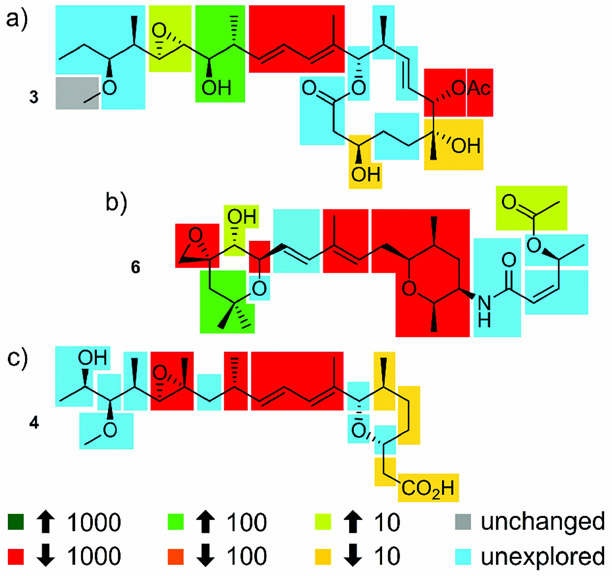
Structure--activity relationships (SARs) identified through synthetic and semisynthetic studies. These maps were developed using data published up to January 2017 and represent findings from in vitro cytotoxicity assays, not direct comparisons of the effect on RNA splicing. Data has been presented to show the optimal analogues for each position, as given by fold increase (up arrow) or decrease (down arrow) in activity. Unchanged denotes substitutions that have been shown to have little effect, while unexplored represents regions that lack sufficient data for assignment.
Figure 6
Figure 6
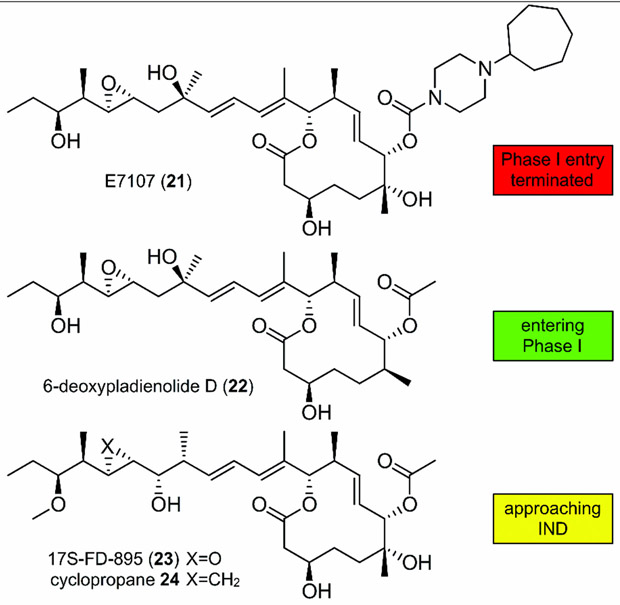
Structure of the first clinical entry, E7107 (21), which entered Phase 1 clinical trials for patients with solid tumors. The next-generation analogues 6-deoxypladienolide D (H3B-8800, 22), 17S-FD-895 (23), and cyclopropane 24 are currently being examined for clinical translation for hematologic malignancies. IND=investigational new drug application.
Figure 7
Figure 7
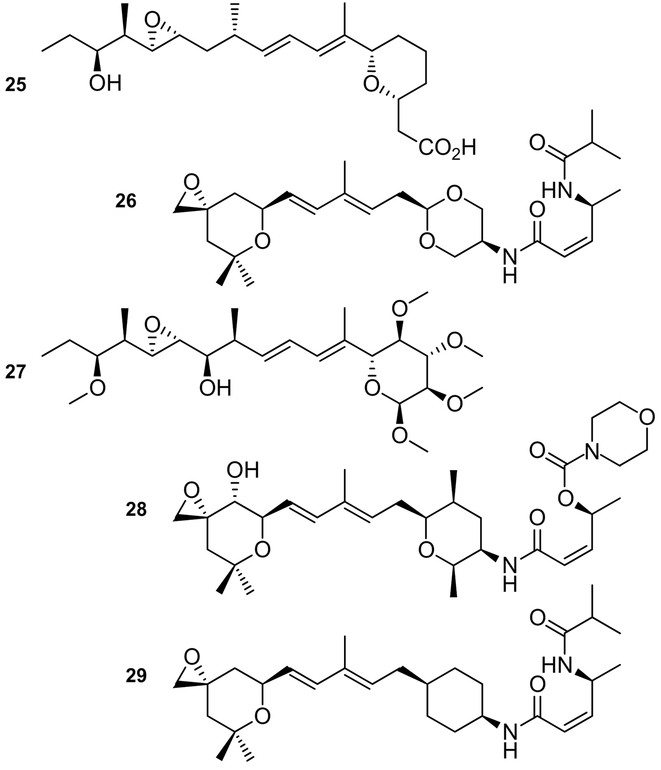
Exemplary structures of synthetic analogues of natural products developed from the SAR profiles. These include analogues that offer increased stability (27 or 29), provide improved synthetic access (25−−29), or serve as fusions between the pladienolide and herboxadiene families (25).
Figure 8
Figure 8
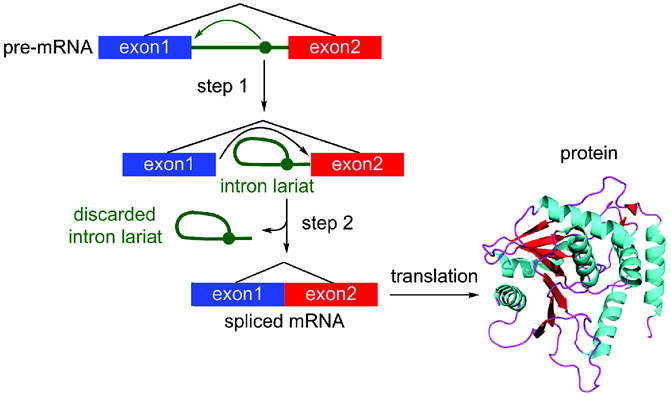
Overview of the splicing process, depicting the conversion of pre-mRNA into spliced mRNA followed by translation into a functional protein.
Figure 9
Figure 9
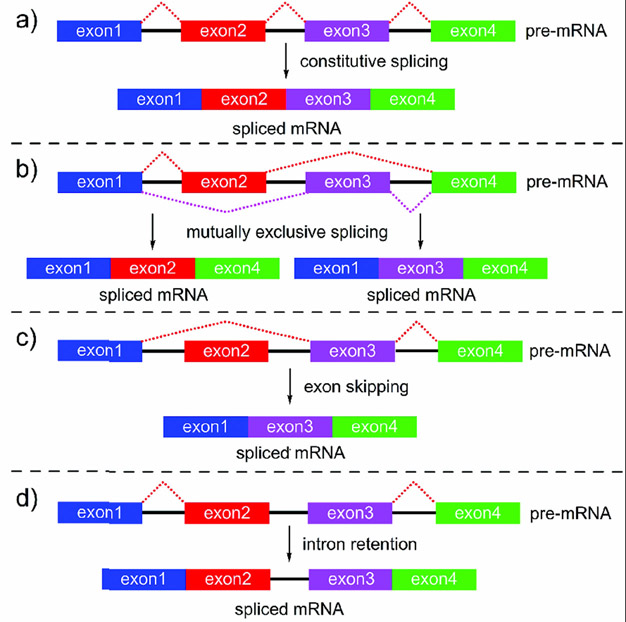
Different modes of RNA splicing. a) Constitutive splicing is most common, where, as part of the normal processing of transcription, the spliceosome removes intronic (non-coding) portions of pre-mRNA. b) In diseased or abnormal cells, other pathways, such as aberrant splicing machinery could, lead to mutually exclusive splicing. c) Exon skipping or d) intron retention can also occur as part of normal splicing or in malignant cells treated with SPLMs.
Figure 10
Figure 10
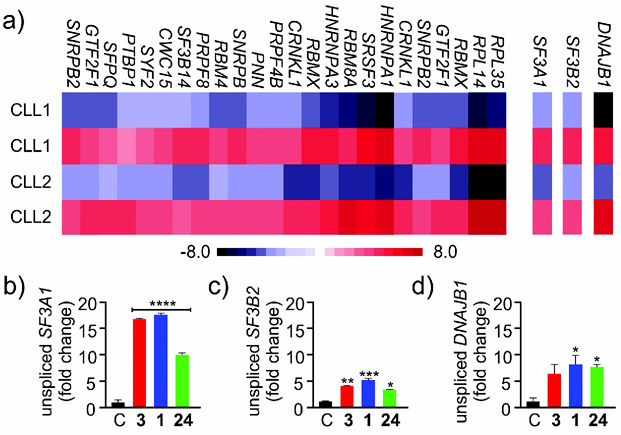
a) Examples of gene selectivity identified by RNAseq analysis. b) Examples of gene selectivity identified by qRT-PCR analysis. Three selected genes (SF3A1, SF3B2, and DNAJB1) are shown as representative examples. The level of splicing in these genes was not identical for FD-895 (3), pladienolide B (1), and cyclopropane 24, as shown in (b--d), respectively.
Figure 11
Figure 11
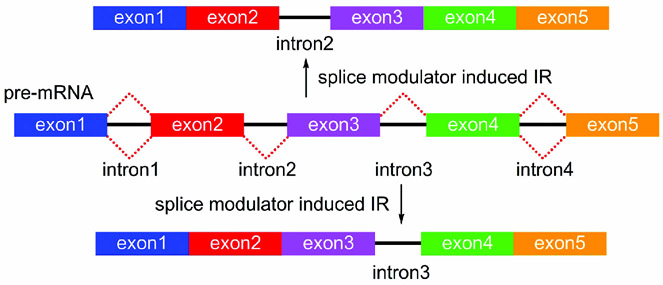
A schematic representation of intron/exon selectivity. In this example, two different IR products bearing either intron2 (top) or intron3 (bottom) can arise from the same pre-mRNA.
Figure 12
Figure 12
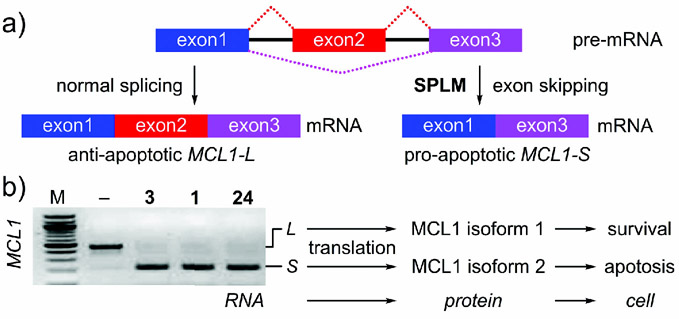
Example of splicing selectivity at the protein level. a) Mechanism of splicing modulation in MCL1. b) MCL1 splicing in mantel cell lymphoma (MCL-B) cells after treatment with control (<M->) or 100 nm 1, 3, or 24 for 4 h. The levels of spliced (S) and unspliced (L) transcripts were evaluated by RT-PCR analysis. Without splicing modulation, MCL1 undergoes normal splicing leaving the longer form. Treatment with 1, 3, or 24 results in exon skipping as noted by the formation of the shorter form.
Figure 13
Figure 13
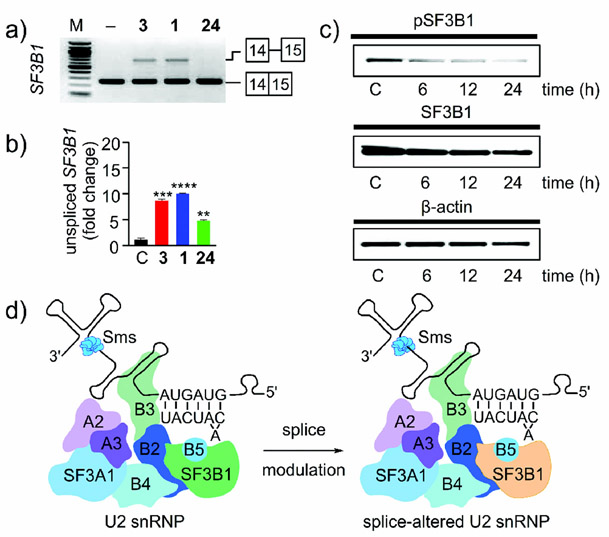
Feedback in splicing modulation. a) RT-PCR and b) qRT-PCR analysis of MCL-B cells treated with 100 nm 1, 3, or 24, or a DMSO control for 4 h. c) Pladienolide B (1) regulates the level of SF3B1 phosphorylation. JeKo-1 cells were treated with 100 nm 1 for 6 h, 12 h or 24 h. Untreated cells grown for 24 h were used as a control (C). d) Schematic representation of the feedback modulation of SF3B1. Inhibition of SF3B1 (green) results in IR in SF3B1 and leads to a reduction in the amount of SF3B1 protein (orange) within the U2 snRNP. The net effect is a reduction in SF3B1 levels and the formation of a compromised splice-altered U2 snRNP.
Figure 14
Figure 14
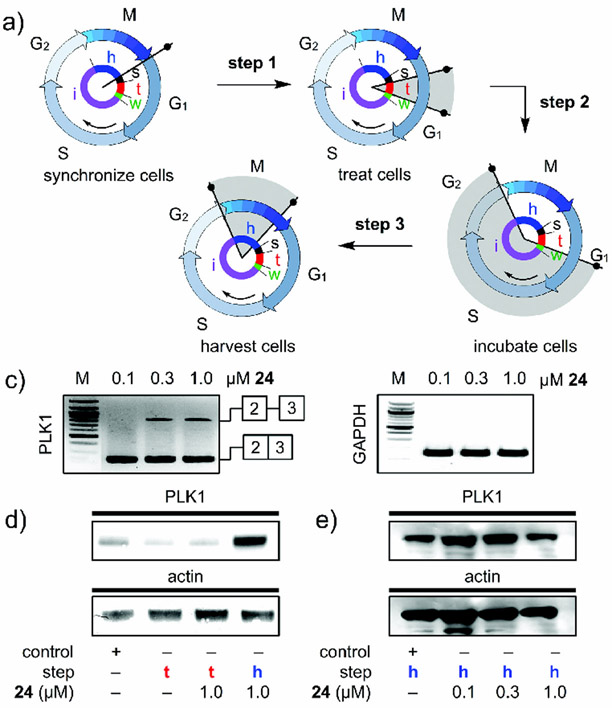
A study on timing in splicing modulation. a) Clock diagrams denote the experimental timing as given by: Step 1: synchronized JeKo-1 cells were treated 1 h after release from starvation (start, s) with 24. Step 2: after incubation (treatment, t, red), the media was removed, the cells were washed with media lacking 24 and the cells were cultured (incubation, i, purple) for an additional 12 h without 24. Step 3: the cells were collected (harvest, h, blue) and evaluated. b) RT-PCR analysis was used to evaluate the levels of PLK1 in JeKo-1 cells treated (t) with 24, washed, and harvested (h). IR was observed for PLK1 after treatment with 24. c) Western blot analyses of lysates from cells treated with 24 and collected either after treatment (t) or at harvest (h). PLK1 expression arises as cells enter the G2/M transition during harvest and not at G1 during treatment. This blot confirms the increase in protein at the state of harvest (h), thus indicating that the cells were at G2/M. d) Western blot analyses of cells treated with 24 and collected at harvest (h). This blot confirms a dose-dependent reduction in the levels of PLK1 protein in cells exposed to 24 relative to controls. See Ref. [15] for further details.
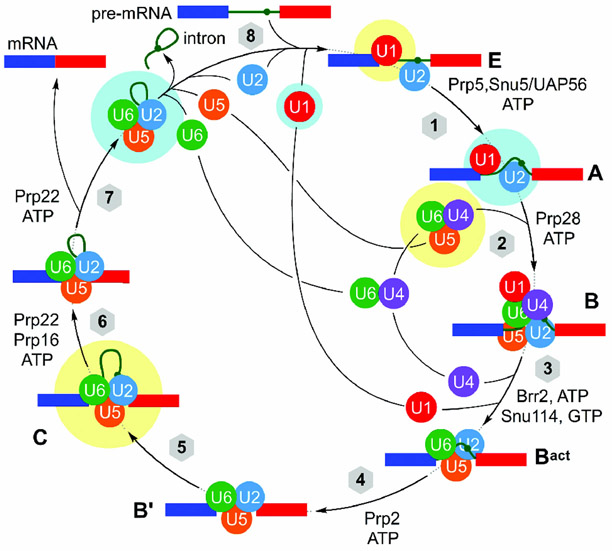
Figure 15
Figure 15
The mechanism of splicing, depicting complexes A, B, Bact, B’, C, and E. A detailed structural understanding of each of the eight steps in this process is slowly being revealed using a combination of cryo-EM and X-ray crystallography with recent human or yeast structures, as noted by highlighting in yellow (human) and cyan (yeast).
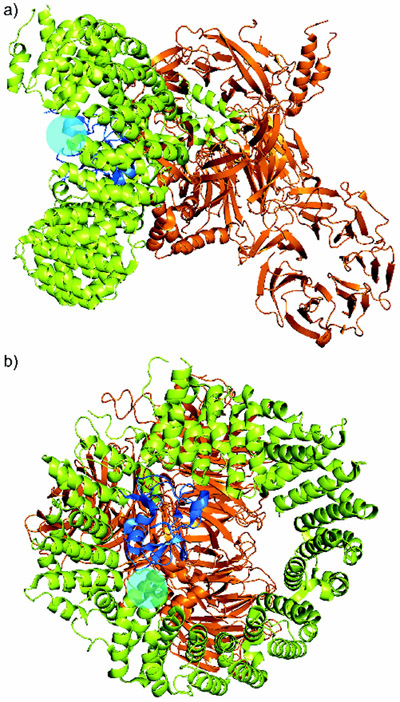
Figure 16
Figure 16
Structure of the human SF3b core complex with a cyan sphere showing the position of the R1074 mutation found in cells resistant to pladienolide B (1). Two views are provided: a) front view, b) rotation 90° into the page.
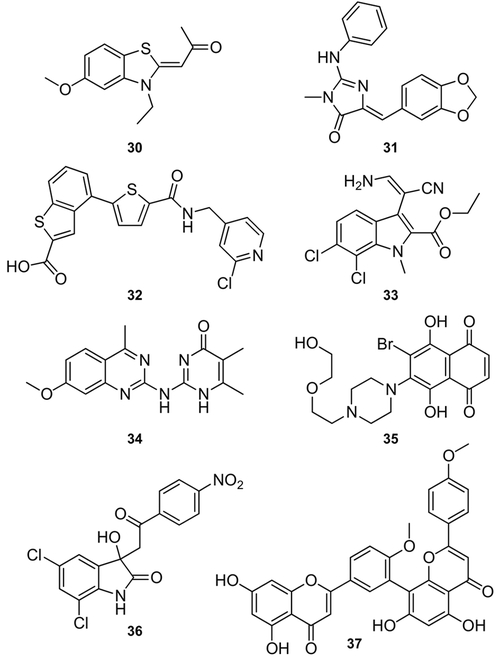
Figure 17
Figure 17
Structures of SPLMs that do not target SF3b. These include TG003 (30), leucettine L41 (31), the PRP4 inhibitor 32, KH-CB20 (33), madrasin (34), NSC659999 (35), NSC635326 (36), and isoginkgetin (37).

References

    1. Matera AG, Wang Z, Nat. Rev. Mol. Cell Biol. 2014, 15, 108.; - PMC - PubMed
    2. Papasaikas P, Valcárcel J, Trends Biochem. Sci. 2016, 41, 33. - PubMed
    1. Kaida D.,Motoyoshi H, Tashiro E, Nojima T, Hagiwara M, Ishigami K, Watanabe H, Kitahara T, Yoshida T, Nakajima H, Tani T, Horinouchi S, Yoshida M, Nat. Chem. Biol. 2007, 3, 576.; - PubMed
    2. Kotake Y., Sagane K, Owa T, Mimori-Kiyosue Y, Shimizu H, Uesugi M, Ishihama Y, Iwata M, Mizui Y, Nat. Chem. Biol. 2007, 3, 570. - PubMed
    1. Sakai T., Sameshima T, Matsufuji M, Kawamura N, Dobashi K, Mizui Y, J. Antibiot. 2004, 57, 173.; - PubMed
    2. Seki-Asano M., Okazaki T, Yamagishi M, Sakai N, Takayama Y, Hanada K, Morimoto S, Takatsuki A, Mizoue K, J. Antibiot. 1994, 47, 1395. - PubMed
    1. Isaac BG., Ayer SW, Elliott RC, Stonard RJ, J. Org. Chem. 1992, 57, 7220.;
    2. Sakai Y, Yoshida T, Ochiai K, Uosaki Y, Saitoh Y, Tanaka F, Akiyama T, Akinaga S, Mizukami T, J. Antibiot. 2002, 55, 855. - PubMed
    1. Nakajima H, Sato B, Fujita T, Takase S, Terano H, Okuhara M, J. Antibiot. 1996, 49, 1196.; - PubMed
    2. Liu X, Biswas S, Berg MG, Antapli CM, Xie F, Wang Q, Tang MC, Tang GL, Zhang L, Dreyfuss G, Cheng YQ, J. Nat. Prod. 2013, 76, 685. - PMC - PubMed

Publication types

MeSH terms

Substances