


An analysis of patient-provider secure messaging at two Veterans Health Administration medical centers: message content and resolution through secure messaging
- PMID: 28371896
- PMCID: PMC7651909
- DOI: 10.1093/jamia/ocx021
An analysis of patient-provider secure messaging at two Veterans Health Administration medical centers: message content and resolution through secure messaging
Abstract
Objective: We sought to understand how patients and primary care teams use secure messaging (SM) to communicate with one another by analyzing secure message threads from 2 Department of Veterans Affairs facilities.
Methods: We coded 1000 threads of SM communication sampled from 40 primary care teams.
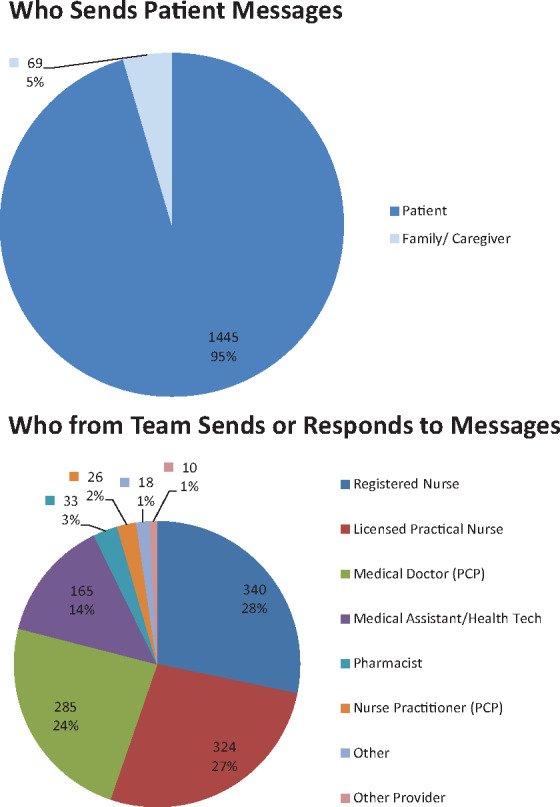
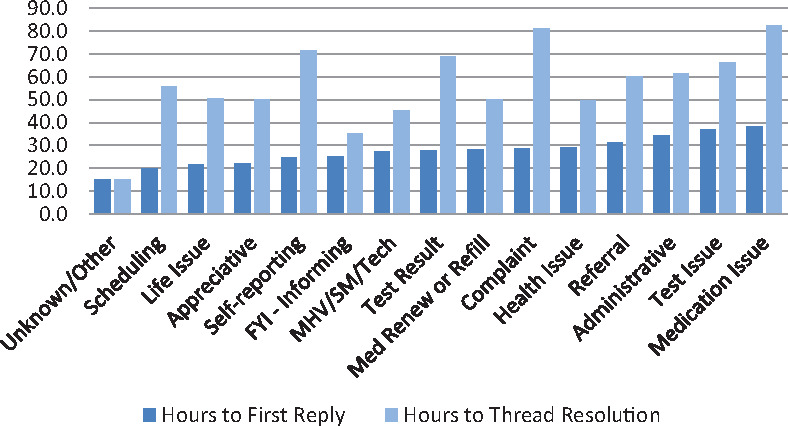
Results: Most threads (94.5%) were initiated by patients (90.4%) or caregivers (4.1%); only 5.5% were initiated by primary care team members proactively reaching out to patients. Medication renewals and refills (47.2%), scheduling requests (17.6%), medication issues (12.9%), and health issues (12.7%) were the most common patient-initiated requests, followed by referrals (7.0%), administrative issues (6.5%), test results (5.4%), test issues (5.2%), informing messages (4.9%), comments about the patient portal or SM (4.1%), appreciation (3.9%), self-reported data (2.8%), life issues (1.5%), and complaints (1.5%). Very few messages were clinically urgent (0.7%) or contained other potentially challenging content. Message threads were mostly short (2.7 messages), comprising an average of 1.35 discrete content types. A substantial proportion of issues (24.2%) did not show any evidence of being resolved through SM. Time to response and extent of resolution via SM varied by message content. Proactive SM use by teams varied, but was most often for test results (32.7%), medication-related issues (21.8%), medication renewals (16.4%), or scheduling issues (18.2%).
Conclusions: The majority of messages were transactional and initiated by patients or caregivers. Not all content categories were fully addressed over SM. Further education and training for both patients and clinical teams could improve the quality and efficiency of SM communication.
Keywords: message content; patient-doctor communication; personal health records; primary health care; secure messaging.
Published by Oxford University Press on behalf of the American Medical Informatics Association 2017. This work is written by US Government employees and is in the public domain in the United States.
Figures
References
-
- Roter DL, Larson S, Sands DZ, Ford DE, Houston T. Can e-mail messages between patients and physicians be patient-centered? Health Commun. 2008;231:80–86. - PubMed
-
- Ralston JD, Martin DP, Anderson ML et al. Group health cooperative's transformation toward patient-centered access. Med Care Res Rev. 2009;666:703–24. - PubMed
-
- Chen C, Garrido T, Chock D, Okawa G, Liang L. The Kaiser Permanente Electronic Health Record: transforming and streamlining modalities of care. Health Aff (Millwood). 2009;282:323–33. - PubMed
MeSH terms
Grants and funding
LinkOut - more resources
Full Text Sources
Other Literature Sources
Medical
