


Orphan medicinal products in Europe and United States to cover needs of patients with rare diseases: an increased common effort is to be foreseen
- PMID: 28372595
- PMCID: PMC5376695
- DOI: 10.1186/s13023-017-0617-1
Orphan medicinal products in Europe and United States to cover needs of patients with rare diseases: an increased common effort is to be foreseen
Abstract
Background: In the European Union (EU) and United States (US), specific regulations have been released to provide incentives to develop and sell orphan medicinal products. We analysed the status of orphan drugs designated that not yet received a marketing authorisation or already marketed for patients affected by rare diseases in the EU and US up to December 2015. For each drug, the following data were extracted: designation date, active substance(s), orphan condition and indication, trade name, approved therapeutic indication, approved ages, genetic nature of disease and if affects children.
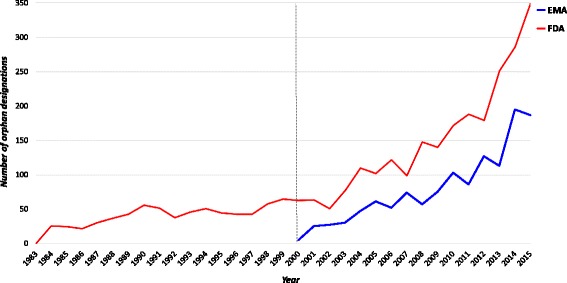
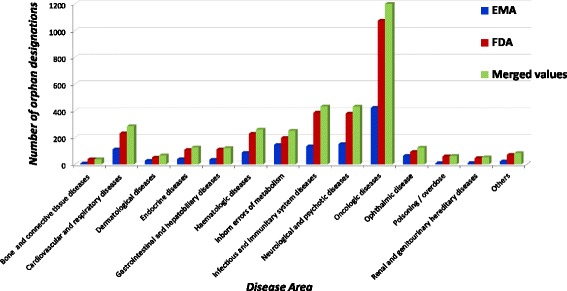
Results: In the EU, 1264 Orphan Drug Designations have been granted and 133 medicinal products were approved covering a total of 179 indications and 122 rare conditions. Among these, 79 were approved under Regulation (EC)141/2000 (65 still listed in the Orphan Medicinal Products Register and 14 lost the orphan designation but still authorised) and 23 were approved centrally by the European Agency before the Orphan Regulation entered into force. On the other hand, in the US 3082 designations and 415 orphan products, covering a total of 521 indications and 300 rare conditions, were granted. As a result, the mean of designations per year is 79 in the EU and 93.4 in the US, while the mean of approved indications per year is 8.5 in the EU and 15.8 in the US. No orphan product is marketed in the EU for bone and connective tissue, ophthalmic, poisoning/overdose, renal, urinary and reproductive rare diseases. Among the marketed medicinal products, only 46.6% in the EU and 35.2% in the US are approved for children. If all the existing market approvals were merged, 362 additional therapeutic indications in the EU and 72 in the US would be covered.
Conclusions: Our data show that notwithstanding the incentives issued, the number of medicines for rare diseases is still limited, and this is more evident in certain therapeutic areas. However, by merging all the existing approvals, patients would benefit of substantial advantages in both geographic areas. Efforts and cooperation between EU and US seem the only way to speed up the development and marketing of drugs for rare diseases.
Keywords: Medicinal products for rare diseases; Orphan designations; Orphan drugs; Register; Therapeutic needs.
Figures



References
-
- European Parliament and of the Council Regulation (EC) 141/2000 of 16 December 1999 on Orphan Medicinal Products. OJL 018/1, 22.01.2000.
-
- Orphan Drugs Act of 1983. Public law 97-414. 97th Congress. Jan.4, 1983.
MeSH terms
Substances
LinkOut - more resources
Full Text Sources
Other Literature Sources
Medical
Research Materials
Miscellaneous
