


Clumping Factor B Promotes Adherence of Staphylococcus aureus to Corneocytes in Atopic Dermatitis
- PMID: 28373353
- PMCID: PMC5442637
- DOI: 10.1128/IAI.00994-16
Clumping Factor B Promotes Adherence of Staphylococcus aureus to Corneocytes in Atopic Dermatitis
Abstract
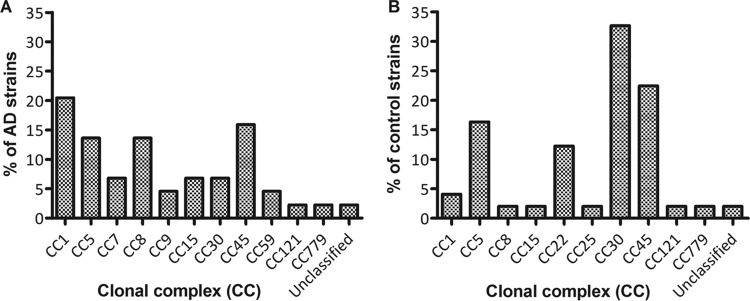
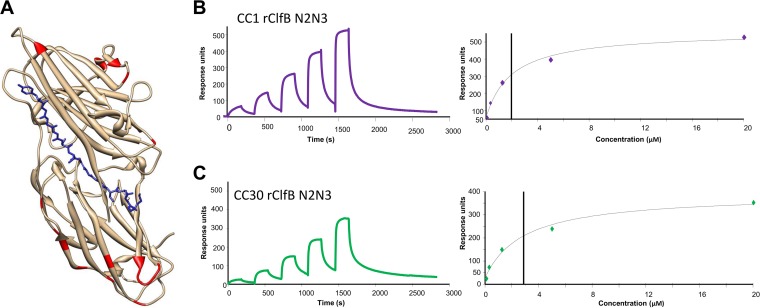
Staphylococcus aureus skin infection is a frequent and recurrent problem in children with the common inflammatory skin disease atopic dermatitis (AD). S. aureus colonizes the skin of the majority of children with AD and exacerbates the disease. The first step during colonization and infection is bacterial adhesion to the cornified envelope of corneocytes in the outer layer, the stratum corneum. Corneocytes from AD skin are structurally different from corneocytes from normal healthy skin. The objective of this study was to identify bacterial proteins that promote the adherence of S. aureus to AD corneocytes. S. aureus strains from clonal complexes 1 and 8 were more frequently isolated from infected AD skin than from the nasal cavity of healthy children. AD strains had increased ClfB ligand binding activity compared to normal nasal carriage strains. Adherence of single S. aureus bacteria to corneocytes from AD patients ex vivo was studied using atomic force microscopy. Bacteria expressing ClfB recognized ligands distributed over the entire corneocyte surface. The ability of an isogenic ClfB-deficient mutant to adhere to AD corneocytes compared to that of its parent clonal complex 1 clinical strain was greatly reduced. ClfB from clonal complex 1 strains had a slightly higher binding affinity for its ligand than ClfB from strains from other clonal complexes. Our results provide new insights into the first step in the establishment of S. aureus colonization in AD patients. ClfB is a key adhesion molecule for the interaction of S. aureus with AD corneocytes and represents a target for intervention.
Keywords: Staphylococcus aureus; atomic force microscopy; atopic dermatitis; corneocytes; filaggrin.
Copyright © 2017 American Society for Microbiology.
Figures


References
-
- Kennedy EA, Connolly J, Hourihane JO, Fallon PG, McLean WH, Murray D, Jo JH, Segre JA, Kong HH, Irvine AD. 2017. Skin microbiome before development of atopic dermatitis: early colonization with commensal staphylococci at 2 months is associated with a lower risk of atopic dermatitis at 1 year. J Allergy Clin Immunol 139:166–172. doi:10.1016/j.jaci.2016.07.029. - DOI - PMC - PubMed
-
- Tauber M, Balica S, Hsu CY, Jean-Decoster C, Lauze C, Redoules D, Viode C, Schmitt AM, Serre G, Simon M, Paul CF. 2016. Staphylococcus aureus density on lesional and nonlesional skin is strongly associated with disease severity in atopic dermatitis. J Allergy Clin Immunol 137:1272–1274.e1–3. doi:10.1016/j.jaci.2015.07.052. - DOI - PubMed
-
- Palmer CN, Irvine AD, Terron-Kwiatkowski A, Zhao Y, Liao H, Lee SP, Goudie DR, Sandilands A, Campbell LE, Smith FJ, O'Regan GM, Watson RM, Cecil JE, Bale SJ, Compton JG, DiGiovanna JJ, Fleckman P, Lewis-Jones S, Arseculeratne G, Sergeant A, Munro CS, El Houate B, McElreavey K, Halkjaer LB, Bisgaard H, Mukhopadhyay S, McLean WH. 2006. Common loss-of-function variants of the epidermal barrier protein filaggrin are a major predisposing factor for atopic dermatitis. Nat Genet 38:441–446. doi:10.1038/ng1767. - DOI - PubMed
MeSH terms
Substances
Grants and funding
LinkOut - more resources
Full Text Sources
Other Literature Sources
