Review
. 2017 Apr 1:39:13.
doi: 10.1186/s41021-017-0074-z. eCollection 2017.

New insight for metformin against bladder cancer

Affiliations
Review

New insight for metformin against bladder cancer

Amr Ahmed El-Arabey. Genes Environ. .

Erratum in

Abstract

International Agency for Research on Cancer (IARC) estimated that bladder cancer is the ninth most common cancer in the world, with 430,000 new cases and 165,000 deaths in 2012. Bladder cancer represents the fourth most common cancer in men and ninth most common cancer in women. It is the second most prevalent cancer in men 60 years of age or older in United States. Looking further down, continuing advancements in cancer research could potentially offer more choices for clinician and patient with longer survival and better quality of life. Although, bladder cancer represents an ideal tumor model to test and apply cancer prevention strategies; there are limited studies about application of metformin in the management of bladder cancer. Here, I will shed light on the proposed mechanisms of anti-carcinogenic effects of metformin and cohort of these mechanisms with the novel application of metformin as therapy of bladder cancer.

Keywords: Bladder; Cancer; Insight; Metformin; New; Therapy.


Figures
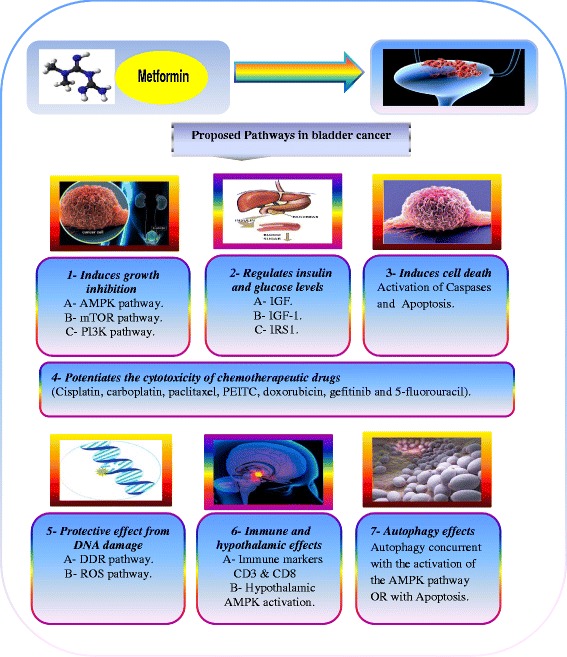
Fig. 1
Fig. 1
Proposed mechanisms of anti-carcinogenic effects of metformin against bladder cancer: (1) metformin induces growth inhibition, (2) metformin regulates insulin and glucose levels, (3) metformin induce cell death, (4) metformin potentiates the cytotoxicity of chemotherapeutic drugs, (5) metformin’s association with oxidative stress, DNA Damage Response (DDR), (6) immune and hypothalamic effects of metformin and (7) autophagy effects of metformin

References

    1. Ferlay J, Soerjomataram I, Dikshit R, Eser S, Mathers C, Rebelo M, Parkin DM, Forman D, Bray F. Cancer incidence and mortality worldwide: sources, methods and major patterns in GLOBOCAN 2012. Int J Cancer. 2015;136(5):E359–86. doi: 10.1002/ijc.29210. - DOI - PubMed
    1. Babjuk M, Burger M, Zigeuner R, Shariat SF, van Rhijn BW, Compérat E, et al. EAU guidelines on non-muscle-invasive urothelial carcinoma of the bladder: update. Eur Urol. 2013;64:639–653. doi: 10.1016/j.eururo.2013.06.003. - DOI - PubMed
    1. van Rhijn BW, Burger M, Lotan Y, Solsona E, Stief CG, Sylvester RJ, et al. Recurrence and progression of disease in non-muscle-invasive bladder cancer: from epidemiology to treatment strategy. Eur Urol. 2009;56:430–442. doi: 10.1016/j.eururo.2009.06.028. - DOI - PubMed
    1. Pan Q, Yang G-L, Yang J-H, et al. Metformin can block precancerous progression to invasive tumors of bladder through inhibiting STAT3-mediated signaling pathways. J Exp Clin Cancer Res. 2015;34(1):77. doi: 10.1186/s13046-015-0183-0. - DOI - PMC - PubMed
    1. Sun J-W, Zhao L-G, Yang Y, Ma X, Wang Y-Y, Xiang Y-B. Obesity and Risk of Bladder Cancer: A Dose–response Meta-Analysis of 15 Cohort Studies. Koul HK, ed. PLoS ONE. 2015;10(3):e0119313. - PMC - PubMed

LinkOut - more resources
