


Lifestyle interventions are feasible in patients with colorectal cancer with potential short-term health benefits: a systematic review
- PMID: 28374148
- PMCID: PMC5432596
- DOI: 10.1007/s00384-017-2797-5
Lifestyle interventions are feasible in patients with colorectal cancer with potential short-term health benefits: a systematic review
Abstract
Purpose: Lifestyle interventions have been proposed to improve cancer survivorship in patients with colorectal cancer (CRC), but with treatment pathways becoming increasingly multi-modal and prolonged, opportunities for interventions may be limited. This systematic review assessed the evidence for the feasibility of performing lifestyle interventions in CRC patients and evaluated any short- and long-term health benefits.
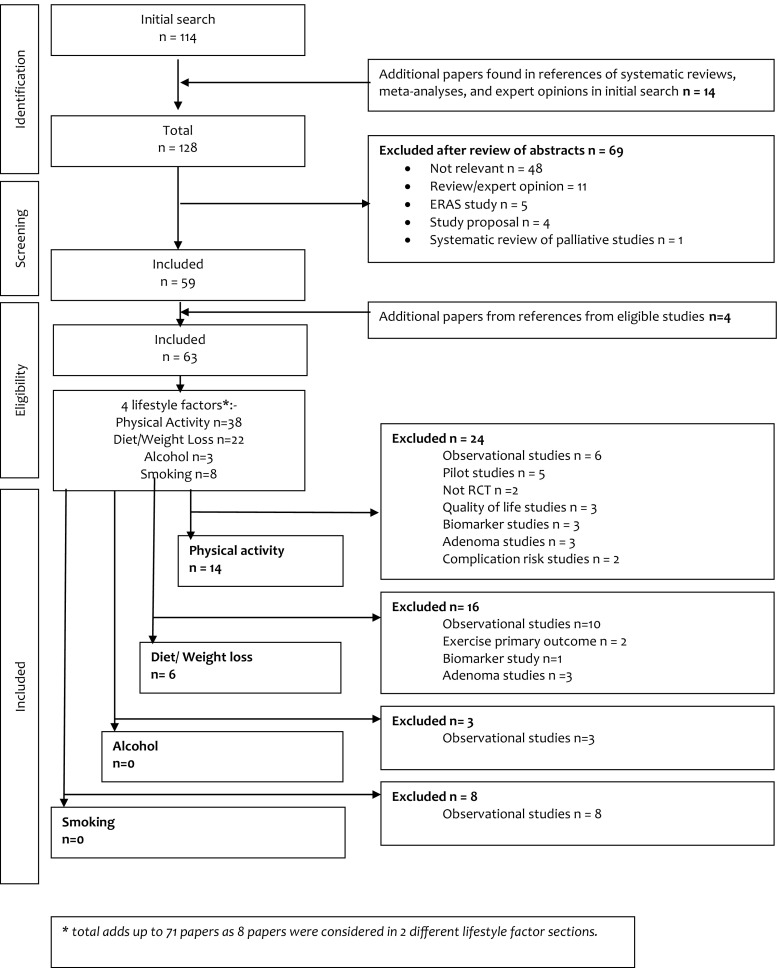
Methods: Using PRISMA Guidelines, selected keywords identified randomised controlled studies (RCTs) of lifestyle interventions [smoking, alcohol, physical activity (PA) and diet/excess body weight] in CRC patients. These electronic databases were searched in June 2015: Dynamed, Cochrane Database, OVID MEDLINE, OVID EMBASE, and PEDro.
Results: Fourteen RCTs were identified: PA RCTs (n = 10) consisted mainly of telephone-prompted walking or cycling interventions of varied durations, predominately in adjuvant setting; dietary/excess weight interventions RCTs (n = 4) focused on low-fat and/or high-fibre diets within a multi-modal lifestyle intervention. There were no reported RCTs in smoking or alcohol cessation/reduction. PA and/or dietary/excess weight interventions reported variable recruitment rates, but good adherence and retention/follow-up rates, leading to short-term improvements in dietary quality, physical, psychological and quality-of-life parameters. Only one study assessed long-term follow-up, finding significantly improved cancer-specific survival after dietary intervention.
Conclusions: This is the first systematic review on lifestyle interventions in patients with CRC finding these interventions to be feasible with improvements in short-term health. Future work should focus on defining the optimal type of intervention (type, duration, timing and intensity) that not only leads to improved short-term outcomes but also assesses long-term survival.
Keywords: Colorectal cancer; Lifestyle interventions; Patient outcomes.
Conflict of interest statement
The authors declare no conflicting interests nor was any funding required for this work.
Figures
Similar articles
-
Interventions for weight reduction in obesity to improve survival in women with endometrial cancer.Cochrane Database Syst Rev. 2018 Feb 1;2(2):CD012513. doi: 10.1002/14651858.CD012513.pub2. Cochrane Database Syst Rev. 2018. Update in: Cochrane Database Syst Rev. 2023 Mar 27;3:CD012513. doi: 10.1002/14651858.CD012513.pub3. PMID: 29388687 Free PMC article. Updated.
-
Dietary interventions for recurrent abdominal pain in childhood.Cochrane Database Syst Rev. 2017 Mar 23;3(3):CD010972. doi: 10.1002/14651858.CD010972.pub2. Cochrane Database Syst Rev. 2017. PMID: 28334433 Free PMC article.
-
Dietary fibre for the prevention of recurrent colorectal adenomas and carcinomas.Cochrane Database Syst Rev. 2017 Jan 8;1(1):CD003430. doi: 10.1002/14651858.CD003430.pub2. Cochrane Database Syst Rev. 2017. PMID: 28064440 Free PMC article.
-
Systemic pharmacological treatments for chronic plaque psoriasis: a network meta-analysis.Cochrane Database Syst Rev. 2021 Apr 19;4(4):CD011535. doi: 10.1002/14651858.CD011535.pub4. Cochrane Database Syst Rev. 2021. Update in: Cochrane Database Syst Rev. 2022 May 23;5:CD011535. doi: 10.1002/14651858.CD011535.pub5. PMID: 33871055 Free PMC article. Updated.
-
Interventions for promoting habitual exercise in people living with and beyond cancer.Cochrane Database Syst Rev. 2018 Sep 19;9(9):CD010192. doi: 10.1002/14651858.CD010192.pub3. Cochrane Database Syst Rev. 2018. PMID: 30229557 Free PMC article.
Cited by
-
Lifestyle after Colorectal Cancer Diagnosis in Relation to Survival and Recurrence: A Review of the Literature.Curr Colorectal Cancer Rep. 2017;13(5):370-401. doi: 10.1007/s11888-017-0386-1. Epub 2017 Sep 14. Curr Colorectal Cancer Rep. 2017. PMID: 29104517 Free PMC article. Review.
-
Exercise improves survival of some people with colon cancer, clinical trial shows.Nature. 2025 Aug 19. doi: 10.1038/d41586-025-02591-x. Online ahead of print. Nature. 2025. PMID: 40830251 No abstract available.
-
Development and internal validation of prediction models for colorectal cancer survivors to estimate the 1-year risk of low health-related quality of life in multiple domains.BMC Med Inform Decis Mak. 2020 Mar 12;20(1):54. doi: 10.1186/s12911-020-1064-9. BMC Med Inform Decis Mak. 2020. PMID: 32164641 Free PMC article.
-
Aerobic exercise and cardiopulmonary fitness in childhood cancer survivors treated with a cardiotoxic agent: a meta-analysis.Support Care Cancer. 2018 Jul;26(7):2113-2123. doi: 10.1007/s00520-018-4208-z. Epub 2018 Apr 18. Support Care Cancer. 2018. PMID: 29671063 Review.
-
An exercise trial for adults undergoing neoadjuvant chemoradiotherapy for rectal cancer proves not feasible: recommendations for future trials.Trials. 2021 Jan 6;22(1):26. doi: 10.1186/s13063-020-04958-z. Trials. 2021. PMID: 33407782 Free PMC article. Clinical Trial.
References
-
- Cancer Statistics (2016) Cancer Research UK. http://www.cancerresearchuk.org/health-professional/cancer-statistics/st...
-
- World Cancer Research Fund International (2016) Continuous Update Project Report. Our Cancer Prevention Recommendations. http://www.wcrf.org/int/research-we-fund/our-cancer-prevention-recommend...
-
- Leitzmann M, Powers H, Anderson AS, Scoccianti C, Berrino F, Boultron-Ruault MC, Cecchini M, Espina C, Ket TJ, Norat T, Wiseman M, Romieu I. European Code against Cancer 4th Edition: physical activity and cancer. Cancer Epidemiol. 2015;39(suppl 1):S46–S55. doi: 10.1016/j.canep.2015.03.009. - DOI - PubMed
-
- Anderson AS, Key TJ, Norat T, Scoccianti C, Cecchini M, Berrino F, Boutron-Ruault M-C, Espina C, Leitzmann M, Powers H, Wiseman M, Romieu European Code against Cancer 4th Edition: obesity, body fatness and cancer. Cancer Epidemiol. 2015;39(suppl 1):S34–S45. doi: 10.1016/j.canep.2015.01.017. - DOI - PubMed
Publication types
MeSH terms
Grants and funding
LinkOut - more resources
Full Text Sources
Other Literature Sources
Medical
