. 2017 Apr 4:8:45907.
doi: 10.1038/srep45907.

Effect of agomelatine on memory deficits and hippocampal gene expression induced by chronic social defeat stress in mice

Affiliations

Effect of agomelatine on memory deficits and hippocampal gene expression induced by chronic social defeat stress in mice

Vincent Martin et al. Sci Rep. .

Abstract

Chronic stress is known to induce not only anxiety and depressive-like phenotypes in mice but also cognitive impairments, for which the action of classical antidepressant compounds remains unsatisfactory. In this context, we investigated the effects of chronic social defeat stress (CSDS) on anxiety-, social- and cognitive-related behaviors, as well as hippocampal Bdnf, synaptic plasticity markers (PSD-95, Synaptophysin, Spinophilin, Synapsin I and MAP-2), and epigenetic modifying enzymes (MYST2, HDAC2, HDAC6, MLL3, KDM5B, DNMT3B, GADD45B) gene expression in C57BL/6J mice. CSDS for 10 days provoked long-lasting anxious-like phenotype in the open field and episodic memory deficits in the novel object recognition test. While total Bdnf mRNA level was unchanged, Bdnf exon IV, MAP-2, HDAC2, HDAC6 and MLL3 gene expression was significantly decreased in the CSDS mouse hippocampus. In CSDS mice treated 3 weeks with 50 mg/kg/d agomelatine, an antidepressant with melatonergic receptor agonist and 5-HT2C receptor antagonist properties, the anxious-like phenotype was not reversed, but the treatment successfully prevented the cognitive impairments and hippocampal gene expression modifications. Altogether, these data evidenced that, in mice, agomelatine was effective in alleviating stress-induced altered cognitive functions, possibly through a mechanism involving BDNF signaling, synaptic plasticity and epigenetic remodeling.


Conflict of interest statement

E.M. and C.G. are employed by IRIS, Suresnes, France. The other authors declare no potential conflict of interest.

Figures
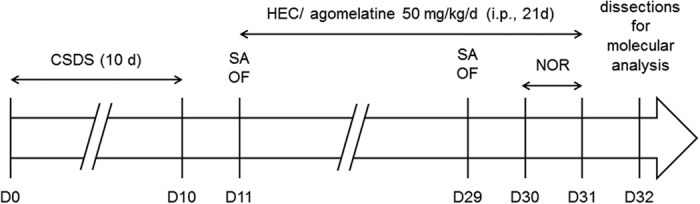
Figure 1
Figure 1. Study design.
Mice were submitted to CSDS for 10 days and then treated 21 days with either agomelatine or its vehicle HEC i.p. Anxiety- and depressive-like phenotypes were assessed at day 11 and day 29 using the social avoidance and open field test, and memory was tested using the novel object recognition test at days 30 and 31. Finally, animals were sacrificed at day 32 for molecular analysis. CSDS, chronic social defeat stress; HEC, hydroxyethylcellulose; NOR, novel object recognition test; OF, open field; SA, social avoidance test.
Figure 2
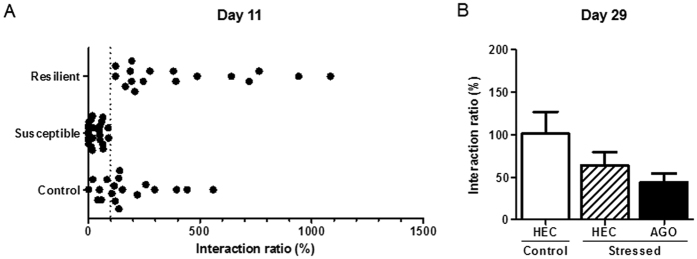
Figure 2. Effect of chronic social defeat stress and chronic agomelatine (50 mg/kg/day i.p.) on social interaction in the social avoidance test.
(A) The day after the last defeat session (Day 11), mice subjected to CSDS can be split into two groups: the susceptible mice, which display a significant reduction in the interaction ratio compared to control mice, and the resilient mice, which do not behave differently from non-stressed group and display a significant higher interaction ratio than the susceptible mice. (B) On Day 29, no significant difference was found between control-, stressed mice treated with HEC and stressed mice treated with agomelatine. Each bar is the mean ± S.E.M. of n = 19 (control mice), 11 (stressed HEC mice) and 11 (stressed AGO mice). AGO, agomelatine; HEC, hydroxyethylcellulose.
Figure 3
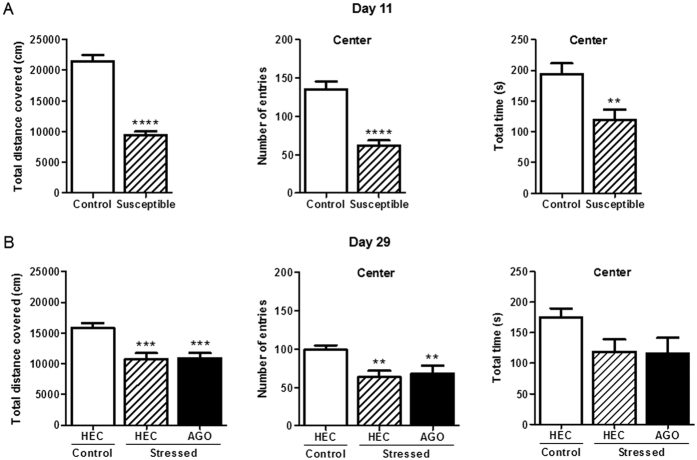
Figure 3. Effect of chronic social defeat stress and chronic agomelatine (50 mg/kg/day i.p.) on anxiety-related behavior in the open field.
(A) The day after the last defeat session (Day 11), susceptible mice showed a significant hypolocomotion (A, left), as well as a reduced exploration in the center of the open field (A, middle and right) compared to control mice. **p < 0.01, ****p < 0.0001, “Stressed” vs “Control”, unpaired Student’s t-test with Welch’s correction when needed. Each bar is the mean ± S.E.M. of n = 19 control and 22 susceptible mice. (B) On Day 29, stressed mice chronically treated with the vehicle HEC still displayed less exploration in the entire open field and at the center (B, left and middle). However, no significant difference was found between the three conditions for the time spent at the center (B, right). Chronic agomelatine did not block the effects of stress on the reduced exploratory behavior in the open field (B, left and middle). **p < 0.01, ***p < 0.001, “Stressed HEC” or “Stressed AGO” vs “Control HEC”, one-way ANOVA followed by Newman-Keuls multiple comparisons test. Each bar is the mean ± S.E.M. of n = 19 (control mice), 11 (stressed HEC mice) and 11 (stressed AGO mice). AGO, agomelatine; HEC, hydroxyethylcellulose.
Figure 4
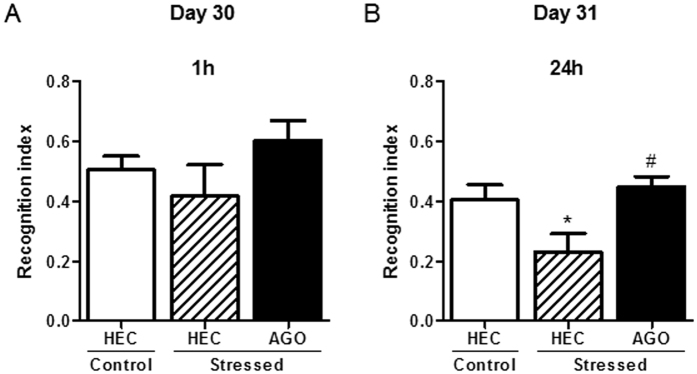
Figure 4. Long-lasting effect of chronic social defeat stress and chronic agomelatine (50 mg/kg/day i.p.) on episodic memory in the novel object recognition test.
Mice were tested in the novel object recognition on D30 (A, ITI1) and D31 (B, ITI24). Memory performances were represented by the recognition index. No significant differences were found between the three groups during the recognition phase 1 that occurred 1 h after the acquisition phase (A). However, after a 24 h-ITI, stressed-HEC mice discriminated the novel object less than control-HEC mice and the deficit was prevented by chronic agomelatine treatment in stressed-AGO mice (B). *p < 0.05 “Stressed HEC” vs “Control HEC”, #p < 0.05 “Stressed AGO” vs “Stressed HEC”, Kruskal-Wallis test followed by Dunn’s multiple comparisons test. Each bar is the mean ± S.E.M. of n = 16 (control mice), 8 (stressed HEC mice) and 10 (stressed AGO mice). AGO, agomelatine; HEC, hydroxyethylcellulose.
Figure 5
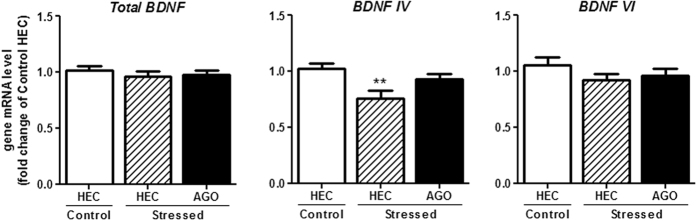
Figure 5. Long-lasting effect of chronic social defeat stress and chronic agomelatine on total Bdnf and Bdnf exons IV and VI mRNA expression in the hippocampus.
The effects of CSDS and agomelatine treatment on hippocampal Bdnf gene expression were determined after 3 weeks of agomelatine (50 mg/kg/day, i.p.) treatment following 10 days of CSDS. CSDS and chronic agomelatine treatment did not induce any change in total Bdnf and Bdnf exon VI mRNA expression. However, Bdnf exon IV gene expression was significantly reduced in stressed-HEC mice, but the level of Bdnf exon IV mRNA was not different between control-HEC and stressed-AGO mice. *p < 0.05, one-way ANOVA followed by Newman-Keuls multiple comparisons test. Each result is expressed as the mean ± S.E.M. of n = 21 (control mice), 12 (stressed HEC mice) and 12 (stressed AGO mice). AGO, agomelatine; HEC, hydroxyethylcellulose.

References

    1. Wood A. M., Boyce C. J., Moore S. C. & Brown G. D. An evolutionary based social rank explanation of why low income predicts mental distress: a 17 year cohort study of 30,000 people. J. Affect. Disord. 136, 882–888 (2012). - PubMed
    1. Bjorkqvist K. Social defeat as a stressor in humans. Physiol. Behav. 73, 435–442 (2001). - PubMed
    1. Chaouloff F. Social stress models in depression research: what do they tell us? Cell Tissue Res. 354, 179–190 (2013). - PMC - PubMed
    1. Nurius P. S., Uehara E. & Zatzick D. F. Intersection of Stress, Social Disadvantage, and Life Course Processes: Reframing Trauma and Mental Health. Am. J. Psychiatr. Rehabil. 16, 91–114 (2013). - PMC - PubMed
    1. Pehrson A. L. et al.. Treatment of cognitive dysfunction in major depressive disorder–a review of the preclinical evidence for efficacy of selective serotonin reuptake inhibitors, serotonin-norepinephrine reuptake inhibitors and the multimodal-acting antidepressant vortioxetine. Eur. J. Pharmacol. 753, 19–31 (2015). - PubMed

Publication types

MeSH terms