


HLA Mismatching Favoring Host-Versus-Graft NK Cell Activity Via KIR3DL1 Is Associated With Improved Outcomes Following Lung Transplantation
- PMID: 28375571
- PMCID: PMC5519429
- DOI: 10.1111/ajt.14295
HLA Mismatching Favoring Host-Versus-Graft NK Cell Activity Via KIR3DL1 Is Associated With Improved Outcomes Following Lung Transplantation
Abstract
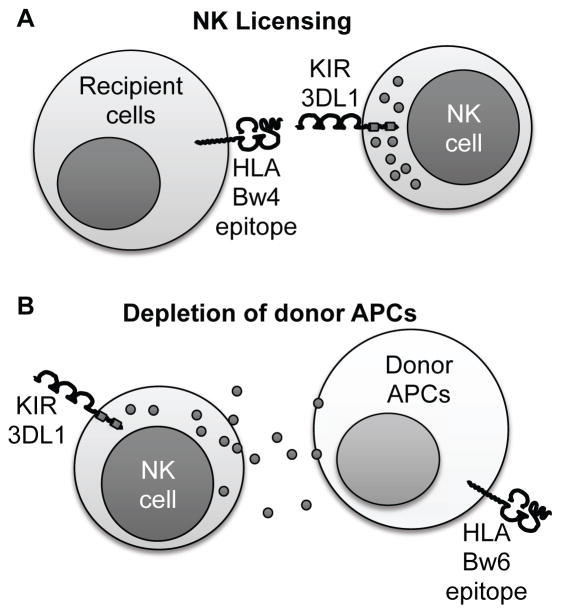
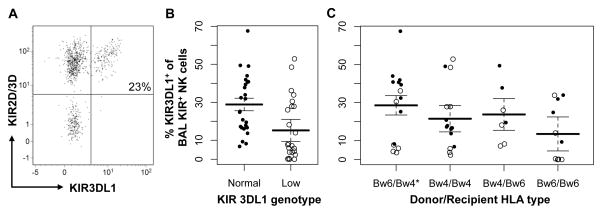
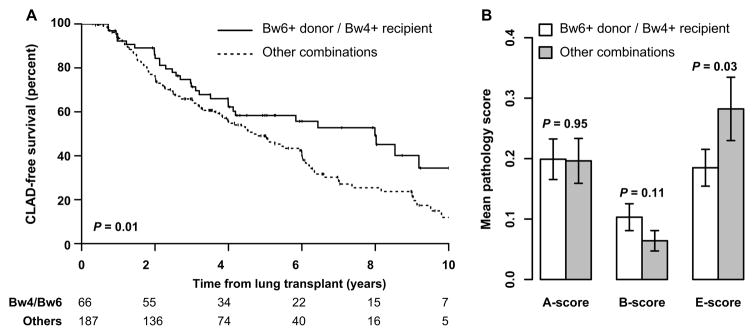
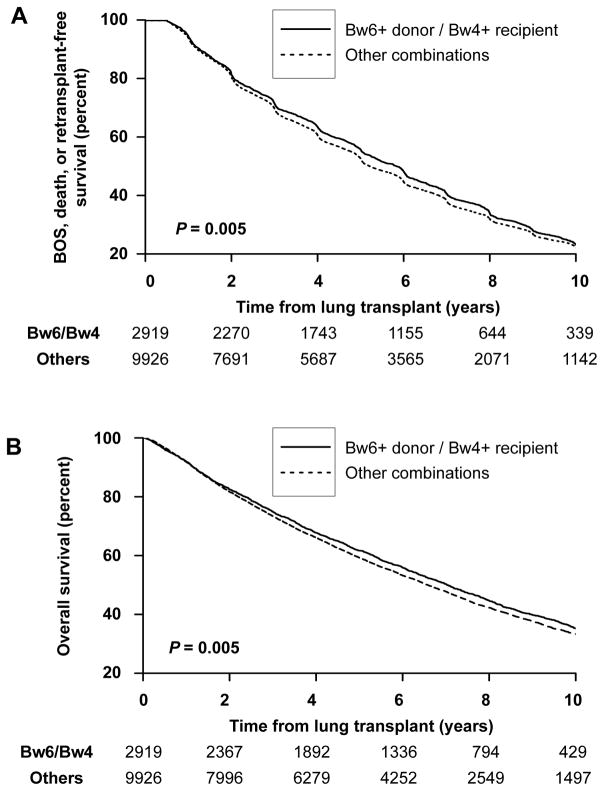
Chronic lung allograft dysfunction (CLAD) is linked to rejection and limits survival following lung transplantation. HLA-Bw4 recipients of HLA-Bw6 grafts have enhanced host-versus-graft (HVG) natural killer (NK) cell activity mediated by killer cell immunoglobulin-like receptor (KIR)3DL1 ligand. Because NK cells may promote tolerance by depleting antigen-presenting cells, we hypothesized improved outcomes for HLA-Bw4 recipients of HLA-Bw6 grafts. We evaluated differences in acute cellular rejection and CLAD-free survival across 252 KIR3DL1+ recipients from University of California, San Francisco (UCSF). For validation, we assessed survival and freedom from bronchiolitis obliterans syndrome (BOS), retransplantation, or death in 12 845 non-KIR typed recipients from the United Network for Organ Sharing (UNOS) registry. Cox proportional hazards models were adjusted for age, gender, ethnicity, transplant type, and HLA mismatching. HVG-capable subjects in the UCSF cohort had a decreased risk of CLAD or death (hazard ratio [HR] 0.57, 95% confidence interval [CI] 0.36-0.88) and decreased early lymphocytic bronchitis. The HVG effect was not significant in subjects with genotypes predicting low KIR3DL1 expression. In the UNOS cohort, HVG-capable subjects had a decreased risk of BOS, retransplant, or death (HR 0.95, 95% CI 0.91-0.99). Survival improved with the higher-affinity Bw4-80I ligand and in Bw4 homozygotes. Improved outcomes in HVG-capable recipients are consistent with a protective NK cell role. Augmentation of NK activity could supplement current immunosuppression techniques.
Keywords: immunobiology; lung (allograft) function/dysfunction; lung transplantation/pulmonology; major histocompatibility complex (MHC); natural killer (NK) cells/NK receptors; translational research/science.
© 2017 The American Society of Transplantation and the American Society of Transplant Surgeons.
Conflict of interest statement
The authors of this manuscript have no conflicts of interest to disclose as described by the American Journal of Transplantation.
Figures
References
-
- HHS/HRSA. OPTN/SRTR 2012 Annual Data Report. 2014.
-
- Yusen RD, Edwards LB, Kucheryavaya AY, Benden C, Dipchand AI, Dobbels F, et al. The registry of the International Society for Heart and Lung Transplantation: thirty-first adult lung and heart-lung transplant report--2014; focus theme: retransplantation. J Heart Lung Transplant. 2014;33(10):1009–24. - PubMed
-
- Verleden GM, Raghu G, Meyer KC, Glanville AR, Corris P. A new classification system for chronic lung allograft dysfunction. J Heart Lung Transplant. 2014;33(2):127–33. - PubMed
-
- Todd JL, Palmer SM. Bronchiolitis obliterans syndrome: the final frontier for lung transplantation. Chest. 2011;140(2):502–8. - PubMed
-
- Rajalingam R. Polymorphic KIR-HLA System Regulates Natural Killer Cell Response. In: Ratcliffe M, editor. Encyclopedia of Immunology. Elsevier; 2016. pp. 369–80.
MeSH terms
Substances
Grants and funding
LinkOut - more resources
Full Text Sources
Other Literature Sources
Medical
Research Materials
