Predictive Processing, Source Monitoring, and Psychosis
- PMID: 28375719
- PMCID: PMC5424073
- DOI: 10.1146/annurev-clinpsy-032816-045145
Predictive Processing, Source Monitoring, and Psychosis
Abstract
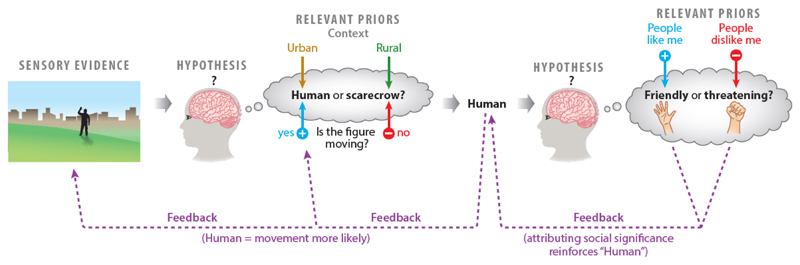
A comprehensive understanding of psychosis requires models that link multiple levels of explanation: the neurobiological, the cognitive, the subjective, and the social. Until we can bridge several explanatory gaps, it is difficult to explain how neurobiological perturbations can manifest in bizarre beliefs or hallucinations, or how trauma or social adversity can perturb lower-level brain processes. We propose that the predictive processing framework has much to offer in this respect. We show how this framework may underpin and complement source monitoring theories of delusions and hallucinations and how, when considered in terms of a dynamic and hierarchical system, it may provide a compelling model of several key clinical features of psychosis. We see little conflict between source monitoring theories and predictive coding. The former act as a higher-level description of a set of capacities, and the latter aims to provide a deeper account of how these and other capacities may emerge.
Keywords: predictive coding; psychosis; schizophrenia; source monitoring.
Figures
References
-
- Achim AM, Weiss AP. No evidence for a differential deficit of reality monitoring in schizophrenia: a meta-analysis of the associative memory literature. Cogn Neuropsychiatry. 2008;13(5):369–84. - PubMed
-
- Andreasen NC. Thought, language, and communication disorders: I. Clinical assessment, definition of terms, and evaluation of their reliability. Arch Gen Psychiatry. 1979;36:1315–21. - PubMed
-
- Arguedas D, Stevenson RJ, Langdon R. Source monitoring and olfactory hallucinations in schizophrenia. J Abnorm Psychol. 2012;121(4):936–43. - PubMed
Publication types
MeSH terms
Grants and funding
LinkOut - more resources
Full Text Sources
Other Literature Sources
Medical