Increased Health Information Technology Adoption and Use Among Small Primary Care Physician Practices Over Time: A National Cohort Study
- PMID: 28376461
- PMCID: PMC5217844
- DOI: 10.1370/afm.1992
Increased Health Information Technology Adoption and Use Among Small Primary Care Physician Practices Over Time: A National Cohort Study
Abstract
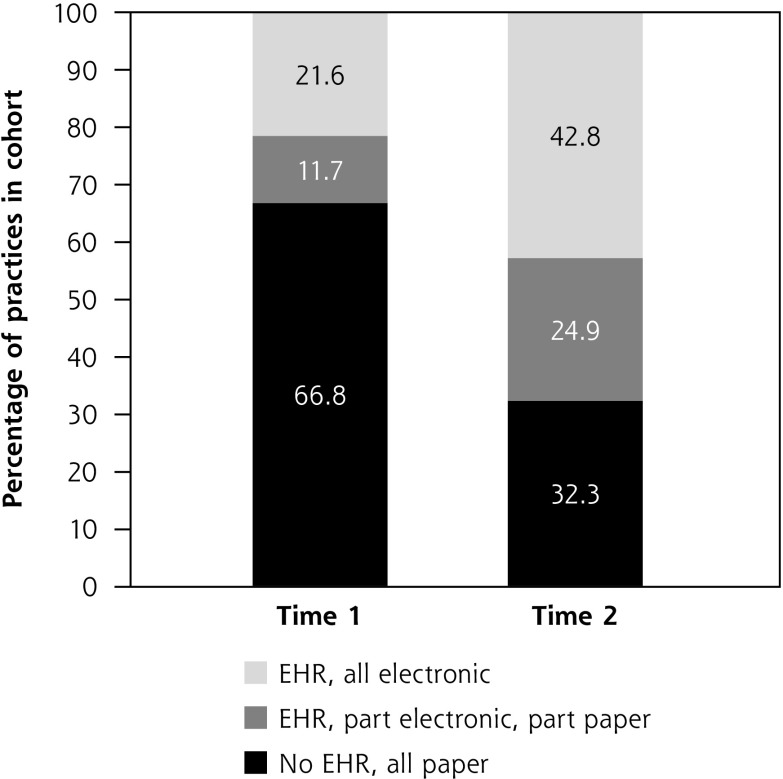
Purpose: Implementation and meaningful use of health information technology (HIT) has been shown to facilitate delivery system transformation, yet implementation is far from universal. This study examined correlates of greater HIT implementation over time among a national cohort of small primary care practices in the United States.
Methods: We used data from a 40-minute telephone panel survey of 566 small primary care practices having 8 or fewer physicians to investigate adoption and use of HIT in 2007-2010 and 2012-2013. We used generalized estimating equations (GEE) to estimate the association of practice characteristics and external incentives with the adoption and use of HIT. We studied 18 measures of HIT functionalities, including record keeping, clinical decision support, patient communication, and health information exchange with hospitals and pharmacies.
Results: Overall, use of 16 HIT functionalities increased significantly over time, whereas use of 2 decreased significantly. On average, compared with physician-owned practices, hospital-owned practices used 1.48 (95% CI, 1.07-1.88; P <.001) more HIT processes. And relative to smaller practices, practices with 3 to 8 physicians used 2.49 (95% CI, 2.26-2.72; P <.001) more HIT processes. Participation in pay-for-performance programs, participation in public reporting of clinical quality data, and a larger proportion of revenue from Medicare were also associated with greater adoption and use of HIT.
Conclusions: The new Medicare Access and CHIP Reauthorization Act (MACRA) will provide payment incentives and technical support to speed HIT adoption and use by small practices. We found that external incentives were, indeed, positively associated with greater adoption and use of HIT. Our findings also support a strategy of targeting assistance to smaller physician practices and those that are physician owned.
Keywords: health information technology; physician practice; practice-based research; primary care.
© 2017 Annals of Family Medicine, Inc.
Conflict of interest statement
Conflicts of interest: authors report none.
Figures
References
-
- Rittenhouse DR, Shortell SM. The patient-centered medical home: will it stand the test of health reform? JAMA. 2009; 301(19): 2038–2040. - PubMed
-
- Finkelstein J, Barr MS, Kothari PP, Nace DK, Quinn M. Patientcentered medical home cyberinfrastructure current and future landscape. Am J Prev Med. 2011; 40(5)(Suppl 2): S225–S233. - PubMed
Publication types
MeSH terms
LinkOut - more resources
Full Text Sources
Other Literature Sources
Medical