


Antimicrobial activity of Buchenavia tetraphylla against Candida albicans strains isolated from vaginal secretions
- PMID: 28376640
- PMCID: PMC7011787
- DOI: 10.1080/13880209.2017.1304427
Antimicrobial activity of Buchenavia tetraphylla against Candida albicans strains isolated from vaginal secretions
Abstract
Context: Buchenavia tetraphylla (Aubl.) RA Howard (Combretaceae: Combretoideae) is an ethnomedicinal plant with reported antifungal action.
Objective: This study evaluates the antimicrobial activity of B. tetraphylla leaf extracts against clinical isolates of Candida albicans. The morphological alterations, combinatory effects with fluconazole and the cytotoxicity of the active extract were analyzed.
Materials and methods: Extracts were obtained using different solvents (hexane: BTHE; chloroform: BTCE; ethyl acetate: BTEE; and methanol: BTME). Antimicrobial activity was determined by the broth microdilution method using nine strains of C. albicans isolated from vaginal secretions and one standard strain (UFPEDA 1007).
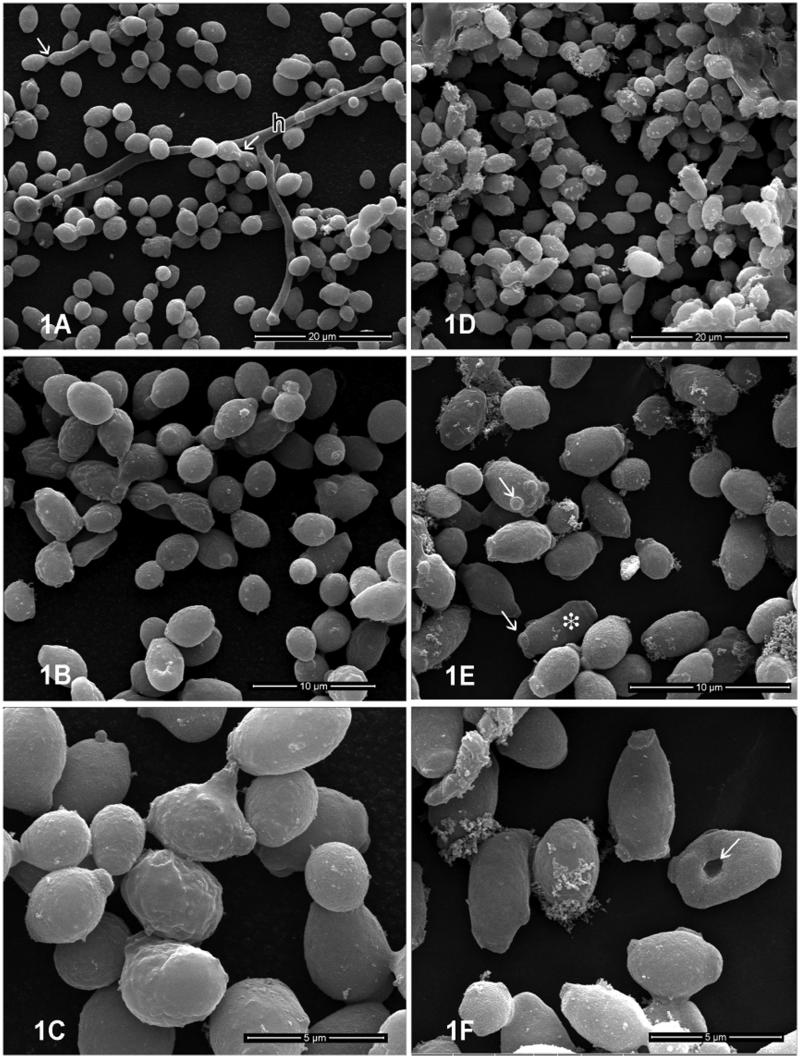
Results: All extracts showed anti-C. albicans activity, including against the azole-resistant strains. The MIC values ranged from 156 to 2500 μg/mL for the BTHE; 156 to 1250 μg/mL for the BTCE; 625 to 1250 μg/mL for the BTME and 625 μg/mL to 2500 μg/mL for the BTEE. BTME showed the best anti-C. albicans activity. This extract demonstrated additive/synergistic interactions with fluconazole. Scanning electron microscopy analysis suggested that the BTME interferes with the cell division and development of C. albicans. BTME showed IC50 values of 981 and 3935 μg/mL, against J774 macrophages and human erythrocytes, respectively. This extract also enhanced the production of nitric oxide by J774 macrophages.
Discussion and conclusion: Buchenavia tetraphylla methanolic extract (BTME) is a great source of antimicrobial compounds that are able to enhance the action of fluconazole against different C. albicans strains; this action seems related to inhibition of cell division.
Keywords: Antifungal agents; Caatinga biome; natural products.
Figures


References
-
- Agra MF, Baracho GS, Silva KN, Basílio IJLD, Coelho VPM.. 2007. Medicinal and poisonous diversity of the flora of Cariri Paraibano, Brazil. J Ethnopharmacol. 111:383–395. - PubMed
-
- Agra MF, Silva KN, Basílio IJLD Freitas PF, Barbosa-Filho JM.. 2008. Survey of medicinal plants used in the region northeast of Brazil. Braz J Pharmacog. 18:472–508.
-
- Avijgan M, Mahboubi M, Nasab MM, Nia EA, Yousefi H.. 2014. Synergistic activity between Echinophora platyloba DC ethanolic extract and azole drugs against clinical isolates of Candida albicans from women suffering chronic recurrent vaginitis. J Mycol Med. 24:112–116. - PubMed
-
- Berman J, Sudbery PE.. 2002. Candida albicans: a molecular revolution built on lessons from budding yeast. Nat Rev Genet. 3:918–932. - PubMed
-
- Blanco MT, Sacristán B, Lucio L, Blanco J, Pérez-Giraldo C, Gómez-García AC.. 2009. Cell surface hydrophobicity as an indicator of other virulence factors in Candida albicans. Rev Iberoam Micol. 27:195–199. - PubMed
MeSH terms
Substances
LinkOut - more resources
Full Text Sources
Other Literature Sources
