. 2017 Apr 4;17(1):11.
doi: 10.1186/s12898-017-0121-4.

Cold spell en route delays spring arrival and decreases apparent survival in a long-distance migratory songbird

Affiliations

Cold spell en route delays spring arrival and decreases apparent survival in a long-distance migratory songbird

Martins Briedis et al. BMC Ecol. .

Abstract

Background: Adjusting the timing of annual events to gradual changes in environmental conditions is necessary for population viability. However, adaptations to weather extremes are poorly documented in migratory species. Due to their vast seasonal movements, long-distance migrants face unique challenges in responding to changes as they rely on an endogenous circannual rhythm to cue the timing of their migration. Furthermore, the exact mechanisms that explain how environmental factors shape the migration schedules of long-distance migrants are often unknown.

Results: Here we show that long-distance migrating semi-collared flycatchers Ficedula semitorquata delayed the last phase of their spring migration and the population suffered low return rates to breeding sites while enduring a severe cold spell en route. We found that the onset of spring migration in Africa and the timing of Sahara crossing were consistent between early and late springs while the arrival at the breeding site depended on spring phenology at stopover areas in each particular year.

Conclusion: Understanding how environmental stimuli and endogenous circannual rhythms interact can improve predictions of the consequences of climate changes on migratory animals.

Keywords: Circannual rhythm; Climate change; Geolocator; Long-distance migrant; Phenology; Weather extremes.


Figures
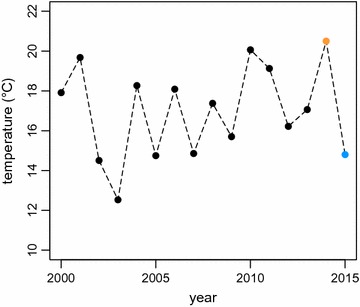
Fig. 1
Fig. 1
Average land surface temperature in Bulgaria, Greece and Turkey from 22 March to 7 April from 2000 to 2015 [Data available from the U.S. Geological Survey (http://www.usgs.gov/)]
Fig. 2
Fig. 2
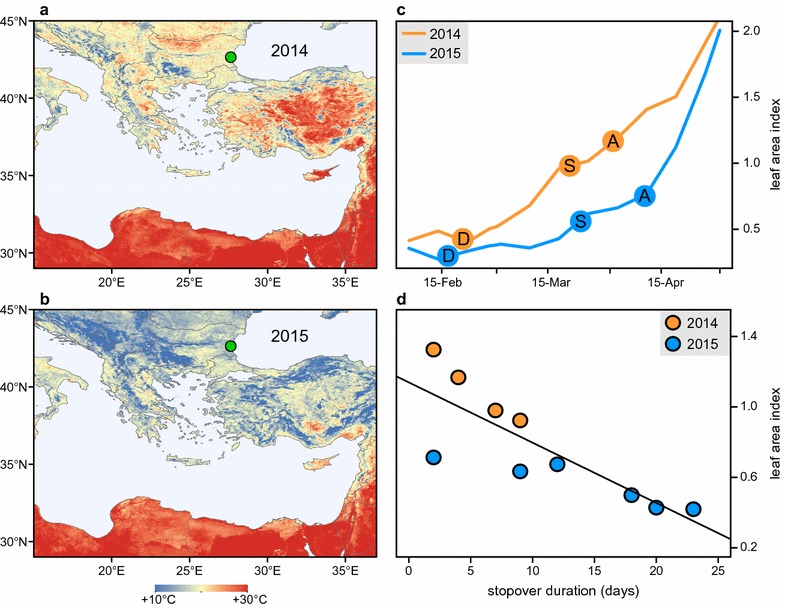
Annual differences in weather conditions and the corresponding migration phenology of semi-collared flycatchers. Land surface temperatures (°C) from 22 March–7 April in a 2014 and b 2015. c Leaf area index (m2 of leaf area per m2 ground area) progression from 6 February–1 May at the flycatcher’s breeding site in 2014 (orange) and 2015 (blue) and the related flycatcher migration phenology in each year, including (D) departure from the non-breeding site, (S) Sahara crossing, and (A) arrival at the breeding site. d Stopover duration north of the Sahara in relation to leaf area index at the breeding site at the time of Sahara crossing [The background maps in a and b made were made from data available from the U.S. Geological Survey (http://www.usgs.gov/); maps were created in ArcMap 10.1 (http://www.esri.com/)]
Fig. 3
Fig. 3
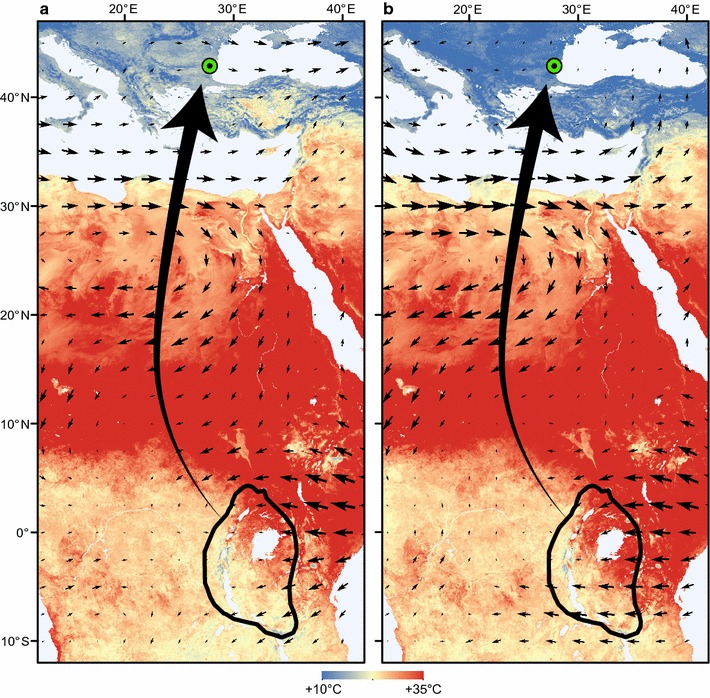
Average land surface temperature (background map) and wind patterns at 850 kPa pressure level (small arrows) during semi-collared flycatcher spring migration from 10 February to 7 April in a 2014 and b 2015. Black shape outlines semi-collared flycatcher non-breeding range (BirdLife International and NatureServe 2011) and large arrows indicate spring migration routes [Temperature data available from the U.S. Geological Survey (http://www.usgs.gov/); wind data available from National Oceanic and Atmospheric Administration (http://www.noaa.gov/). Maps were created in ArcMap 10.1 (http://www.esri.com/)]
Fig. 4
Fig. 4
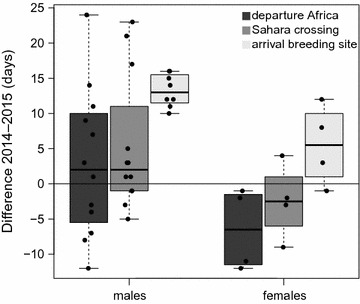
Sex-specific difference in individual migration schedules between a cold (2015) and a warm spring (2014). The delay in arrival is larger for the earlier migrating males than for later migrating females. Individual data points represent difference between every possible pair of two individuals tracked in different years

References

    1. Easterling DR, Karl TR, Gallo KP, Robinson DA, Trenberth KE, Dai A. Observed climate variability and change of relevance to the biosphere. J Geophys Res. 2000;105:101–114. doi: 10.1029/2000JD900166. - DOI
    1. Walther G, Post E, Convey P, Menzel A, Parmesan C, Beebee TJC, et al. Ecological responses to recent climate change. Nature. 2002;416:389–395. doi: 10.1038/416389a. - DOI - PubMed
    1. Parmesan C. Ecological and evolutionary responses to recent climate change. Annu Rev Ecol Syst. 2006;37:637–669. doi: 10.1146/annurev.ecolsys.37.091305.110100. - DOI
    1. Pearce-Higgins JW, Green RE. Birds and climate change: impacts and conservation responses. Cambridge: Cambridge University Press; 2014.
    1. Knudsen E, Lindén A, Both C, Jonzén N, Pulido F, Saino N, et al. Challenging claims in the study of migratory birds and climate change. Biol Rev. 2011;86:928–946. doi: 10.1111/j.1469-185X.2011.00179.x. - DOI - PubMed

Publication types

LinkOut - more resources