


Predictors of hearing recovery in patients with severe sudden sensorineural hearing loss
- PMID: 28376930
- PMCID: PMC5379569
- DOI: 10.1186/s40463-017-0207-1
Predictors of hearing recovery in patients with severe sudden sensorineural hearing loss
Abstract
Background: Sudden sensorineural hearing loss (SSHL) is a disease, which severely affects the patient's social and relational life. The underlying pathomechanisms have not been finally clarified yet and outcome is not predictable.
Methods: We conducted a retrospective study in order to identify parameters that influence hearing recovery. The data base contains results of basic otoneurological tests and clinical parameters of 198 patients with idiopathic SSHL of at least 60 dB in at least four frequencies, diagnosed and treated at the University Hospital of Münster, Germany, between 1999 and 2015. Hearing recovery was measured by pure tone audiometry.
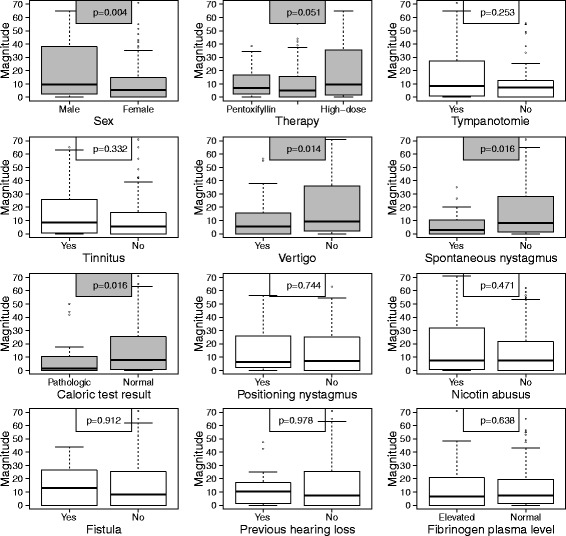
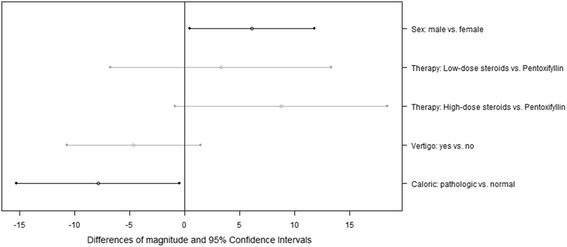
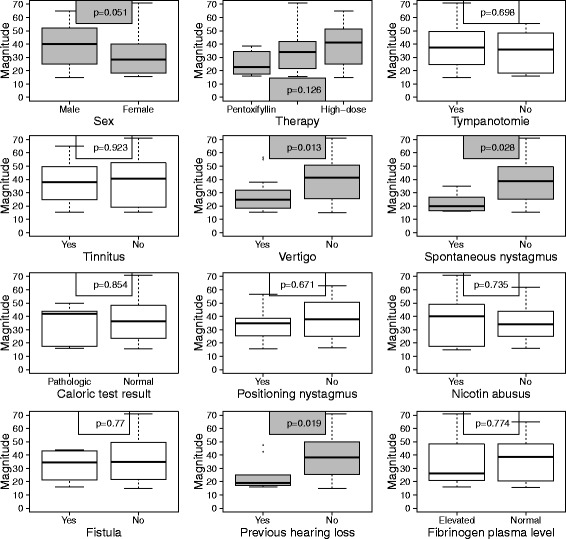
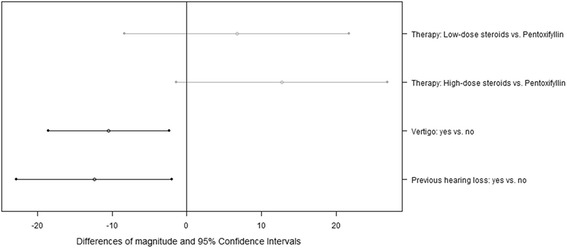
Results: Multivariate linear and logistic regression analyses indicate that the chance as well as the magnitude of hearing recovery is higher for patients with normal caloric testing than for patients with pathological caloric testing. However, for the subgroup of patients who attained a hearing recovery, the caloric testing result was not found to influence the magnitude. Instead, the magnitude was noticeably lower for patients within this subgroup who had a previous hearing loss. Furthermore, we found indications that the magnitude is higher for men than for women and that receiving a high-dose steroid therapy is associated with a higher chance and magnitude of a hearing recovery.
Conclusions: We conclude that SSHL associated with disorders of the vestibular system or previous hearing loss represent special sub-entities of SSHL that may be caused by unique pathophysiological mechanisms and are associated with worse outcome. Furthermore, our data support the importance of elevated dosage of steroids in SSHL therapy.
Keywords: Prognosis; Risk factors; Sensorineural hearing loss.
Figures
References
-
- Klemm E, Schaarschmidt W. Epidemiological survey on sudden deafness, vestibular dysfunction and Meniere’s Disease. HNO-Praxis. 1989;14:295–9.
MeSH terms
Substances
LinkOut - more resources
Full Text Sources
Other Literature Sources
Medical
Miscellaneous
