


Impact of baseline BMI and weight change in CCTG adjuvant breast cancer trials
- PMID: 28379421
- PMCID: PMC5834037
- DOI: 10.1093/annonc/mdx152
Impact of baseline BMI and weight change in CCTG adjuvant breast cancer trials
Abstract
Background: We hypothesized that increased baseline BMI and BMI change would negatively impact clinical outcomes with adjuvant breast cancer systemic therapy.
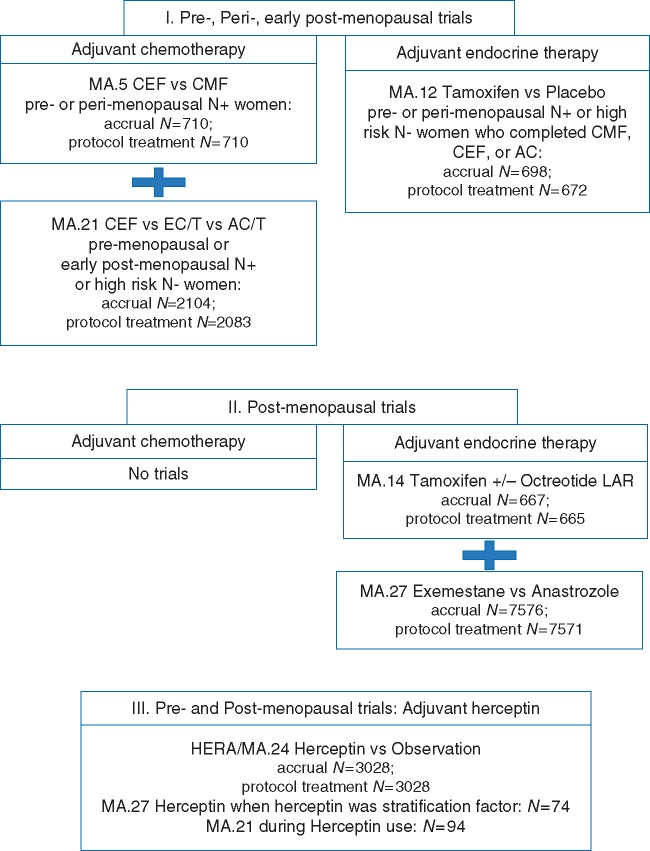
Methods: Data from chemotherapy trials MA.5 and MA.21; endocrine therapy MA.12, MA.14 and MA.27; and trastuzumab HERA/MA.24 were analyzed. The primary objective was to examine the effect of BMI change on breast cancer-free interval (BCFI) landmarked at 5 years; secondary objectives included BMI changes at 1 and 3 years; BMI changes on disease-specific survival (DSS) and overall survival (OS); and effects of baseline BMI. Stratified analyses included trial therapy and composite trial stratification factors.
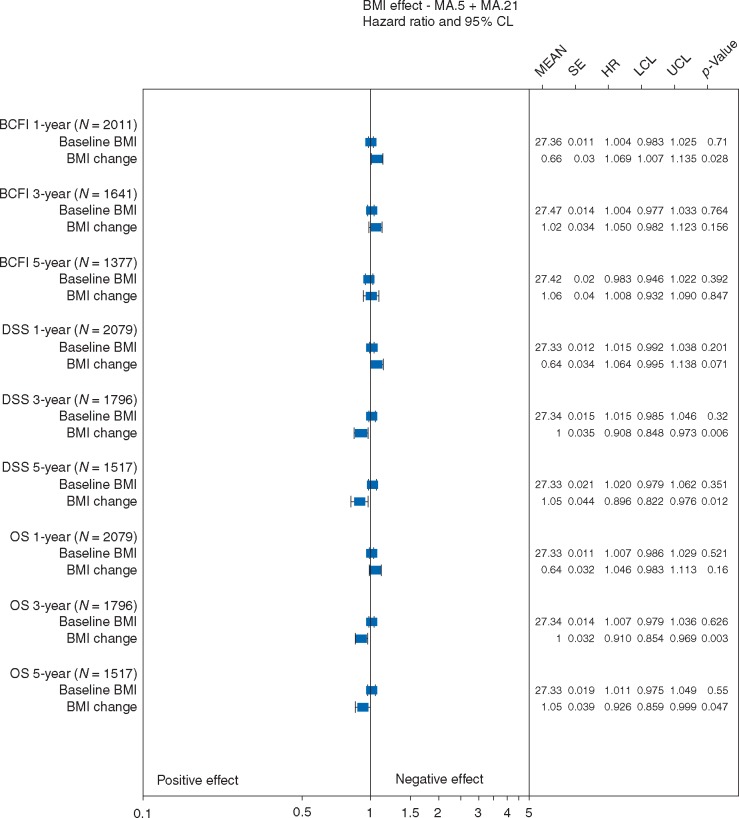
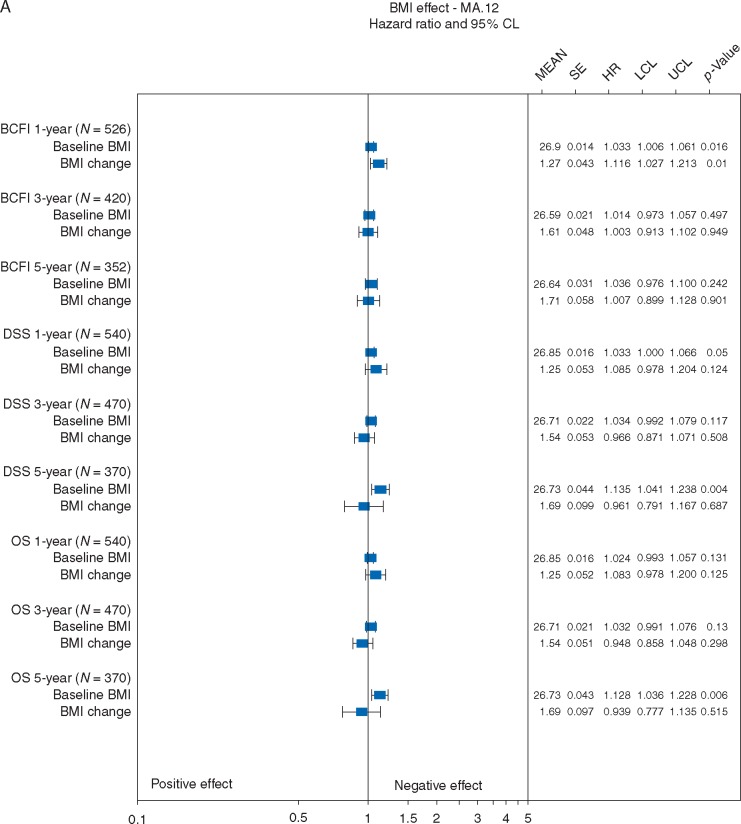
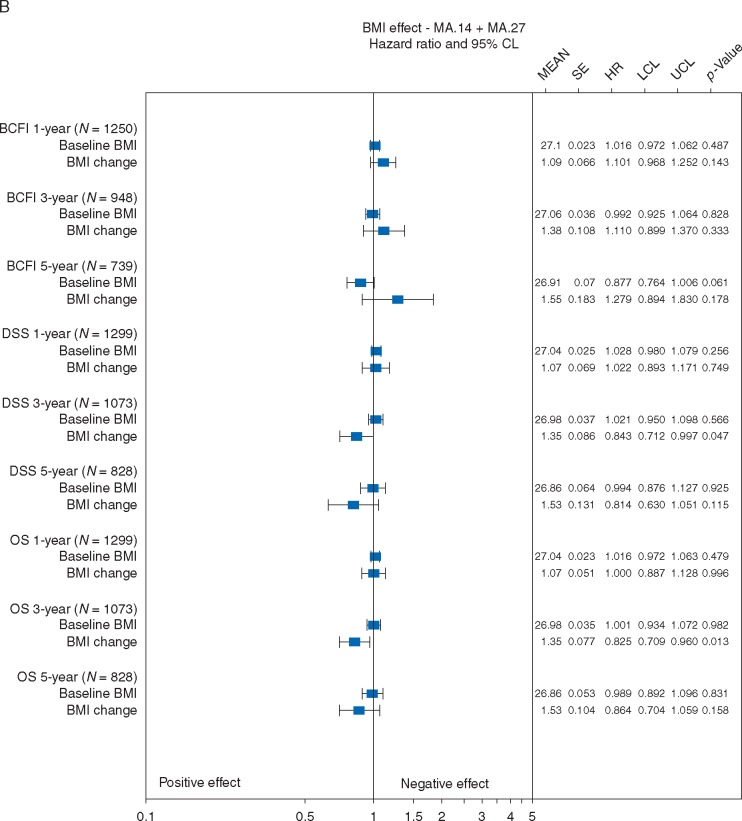
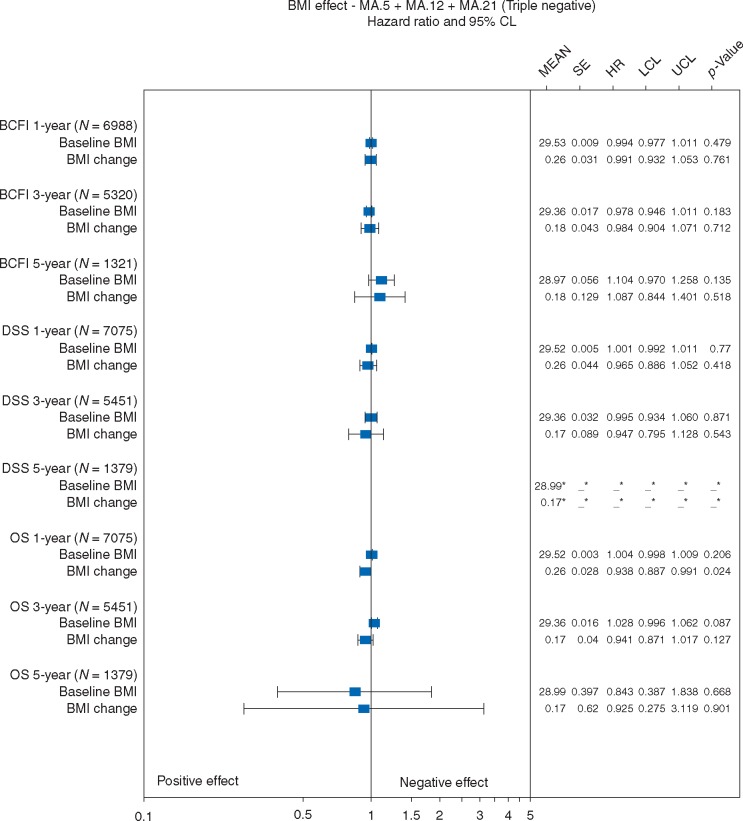
Results: In pre-/peri-/early post-menopausal chemotherapy trials (N = 2793), baseline BMI did not impact any endpoint and increased BMI from baseline did not significantly affect BCFI (P = 0.85) after 5 years although it was associated with worse BCFI (P = 0.03) and DSS (P = 0.07) after 1 year. BMI increase by 3 and 5 years was associated with better DSS (P = 0.01; 0.01) and OS (P = 0.003; 0.05). In pre-menopausal endocrine therapy trial MA.12 (N = 672), patients with higher baseline BMI had worse BCFI (P = 0.02) after 1 year, worse DSS (P = 0.05; 0.004) after 1 and 5 years and worse OS (P = 0.01) after 5 years. Increased BMI did not impact BCFI (P = 0.90) after 5 years, although it was associated with worse BCFI (P = 0.01) after 1 year. In post-menopausal endocrine therapy trials MA.14 and MA.27 (N = 8236), baseline BMI did not significantly impact outcome for any endpoint. BMI change did not impact BCFI or DSS after 1 or 3 years, although a mean increased BMI of 0.3 was associated with better OS (P = 0.02) after 1 year. With the administration of trastuzumab (N = 1395) baseline BMI and BMI change did not significantly impact outcomes.
Conclusions: Higher baseline BMI and BMI increases negatively affected outcomes only in pre-/peri-/early post-menopausal trial patients. Otherwise, BMI increases similar to those expected in healthy women either did not impact outcome or were associated with better outcomes.
Clinical trials numbers: CAN-NCIC-MA5; National Cancer Institute (NCI)-V90-0027; MA.12-NCT00002542; MA.14-NCT00002864; MA.21-NCT00014222; HERA, NCT00045032;CAN-NCIC-MA24; MA-27-NCT00066573.
Keywords: BMI; disease specific survival; overall survival; triple negative; weight change.
© The Author 2017. Published by Oxford University Press on behalf of the European Society for Medical Oncology. All rights reserved. For Permissions, please email: journals.permissions@oup.com.
Figures
References
-
- Rock CL, Doyle C, Demark-Wahnefried W. et al. Nutrition and physical activity guidelines for cancer survivors. CA Cancer J Clin 2012; 62: 243–274. - PubMed
-
- Kushi LH, Doyle C, McCullough M. et al. American cancer society guidelines on nutrition and physical activity for cancer prevention: reducing the risk of cancer with healthy food choices and physical activity. CA Cancer J Clin 2012; 62: 30–67. - PubMed
-
- Schmitz KH, Courneya KS, Matthews C. et al. American college of sports medicine roundtable on exercise guidelines for cancer survivors. Med Sci Sports Exerc 2010; 42: 1409–1426. - PubMed
-
- National Comprehensive Cancer Network: NCCN guidelines for supportive care, survivorship. http://www.nccn.org/professionals/physician_gls/f_guidelines.asp#supportive (27 February 2015, date last accessed).
MeSH terms
Substances
Associated data
Grants and funding
LinkOut - more resources
Full Text Sources
Other Literature Sources
Medical
Miscellaneous
