


Are the 1990 American College of Rheumatology vasculitis classification criteria still valid?
- PMID: 28379475
- PMCID: PMC6251621
- DOI: 10.1093/rheumatology/kex075
Are the 1990 American College of Rheumatology vasculitis classification criteria still valid?
Abstract
Objectives: Advances in diagnostic techniques have led to better distinction between types of vasculitis, potentially affecting the utility of the 1990 ACR classification criteria for vasculitis. This study tested the performance of these criteria in a contemporary vasculitis cohort.
Methods: The Diagnosis and Classification in Vasculitis Study provided detailed clinical, serological, pathological and radiological data from patients with primary systemic vasculitis and clinical context-specific comparator conditions. Fulfilment of six ACR criteria sets and their diagnostic performance was evaluated in patients with a given type of vasculitis and its comparator conditions.
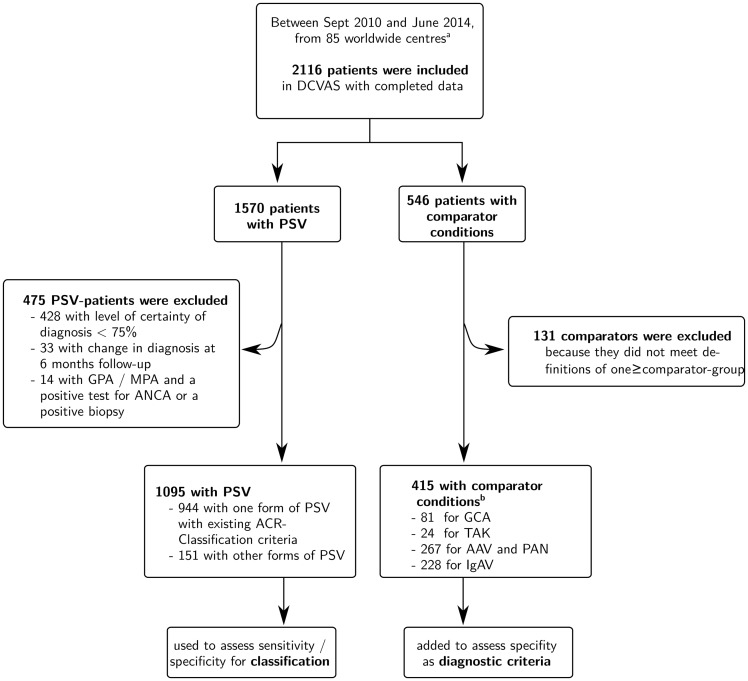
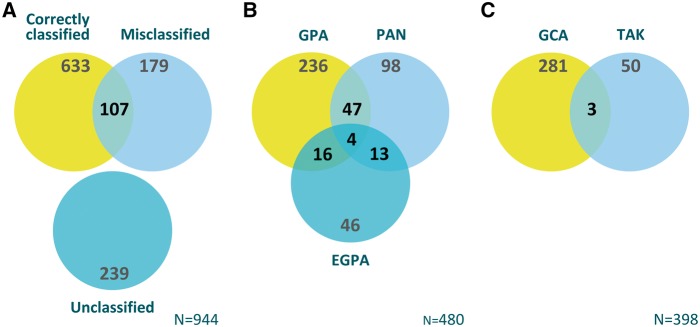
Results: Data from 1095 patients with primary systemic vasculitis and 415 with comparator conditions were available. For classification, sensitivities and specificities for ACR classification criteria were, respectively, 81.1% and 94.9% for GCA; 73.6% and 98.3% for Takayasu's arteritis; 65.6% and 88.7% for granulomatosis with polyangiitis; 57.0% and 99.8% for eosinophilic granulomatosis with polyangiitis; 40.6% and 87.8% for polyarteritis nodosa; 28.9% and 88.5% for microscopic polyangiitis; and 72.7% and 96.3% for IgA-vasculitis. Overall sensitivity was 67.1%. Of cases identified by their respective criteria, 16.9% also met criteria for other vasculitides. Diagnostic specificity ranged from 64.2 to 98.9%; overall, 113/415 comparators (27.2%) fulfilled at least one of the ACR classification criteria sets.
Conclusion: Since publication of the ACR criteria for vasculitis, the sensitivity for each type of vasculitis, except GCA, has diminished, although the specificities have remained high, highlighting the need for updated classification criteria.
Keywords: Churg–Strauss syndrome; Takayasu’s disease; anti-neutrophil cytoplasm antibody; giant cell arteritis; microscopic polyangiitis; polyarteritis nodosa; vasculitis.
© The Author 2017. Published by Oxford University Press on behalf of the British Society for Rheumatology. All rights reserved. For Permissions, please email: journals.permissions@oup.com
Figures
References
-
- Fries JF, Hunder GG, Bloch DA. et al. The American College of Rheumatology 1990 criteria for the classification of vasculitis. Summary. Arthritis Rheum 1990;33:1135–6. - PubMed
-
- Basu N, Watts R, Bajema I. et al. EULAR points to consider in the development of classification and diagnostic criteria in systemic vasculitis. Ann Rheum Dis 2010;69:1744–50. - PubMed
-
- van der Woude FJ, Rasmussen N, Lobatto S. et al. Autoantibodies against neutrophils and monocytes: tool for diagnosis and marker of disease activity in Wegener's granulomatosis. Lancet 1985;1:425–9. - PubMed
-
- Watts RA, Suppiah R, Merkel PA, Luqmani R.. Systemic vasculitis—is it time to reclassify? Rheumatology 2011;50:643–5. - PubMed
-
- Jennette JC, Falk RJ, Bacon PA. et al. 2012 revised International Chapel Hill Consensus Conference Nomenclature of Vasculitides. Arthritis Rheum 2013;65:1–11. - PubMed
Publication types
MeSH terms
Grants and funding
LinkOut - more resources
Full Text Sources
Other Literature Sources
Miscellaneous
