


Opportunities for exercise during pullet rearing, Part I: Effect on the musculoskeletal characteristics of pullets
- PMID: 28379533
- PMCID: PMC5850348
- DOI: 10.3382/ps/pex059
Opportunities for exercise during pullet rearing, Part I: Effect on the musculoskeletal characteristics of pullets
Abstract
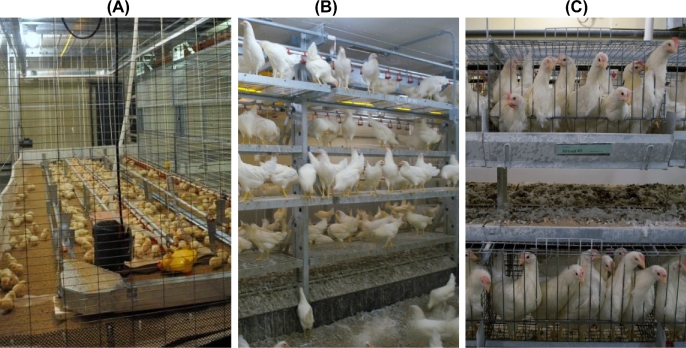
Increased load-bearing exercise improves bone quality characteristics in a variety of species, including laying hens. Providing increased opportunities for exercise during the pullet rearing phase, a period of substantial musculoskeletal growth, offers a proactive approach to reducing osteoporosis by improving bone composition. The main objective of this study was to determine whether differing opportunities for exercise during rearing influences pullet musculoskeletal characteristics. Two flock replicates of 588 Lohmann Selected Leghorn-Lite pullets were reared in either standard, conventional cages (Conv) or an aviary rearing system (Avi) from day-old chicks until 16 wk of age. The keel bone and the muscles and long bones of the wings and legs were collected at 16 wk to measure muscle growth differences between rearing treatments and quantify bone quality characteristics using quantitative computed tomography (QCT) and bone breaking strength (BBS) assessment. Keel bone characteristics and muscle weights were adjusted for BW and analyses for QCT and BBS included BW as a covariate. At 16 wk of age, rearing system had an effect on the majority of keel bone characteristics (P < 0.05). The length of the keel metasternum, caudal tip cartilage length, and the overall percentage of cartilage present on the keel at 16 wk was greater in the Avi pullets compared to the Conv pullets (P < 0.01). Wing and breast muscle weights of the Avi pullets were greater than the Conv pullets (P < 0.001), but leg muscle weights were greater in the Conv pullets (P = 0.026). Avi pullets had greater total bone density, total cross-sectional area, cortical cross-sectional area, total bone mineral content, and cortical bone mineral content than Conv pullets for the radius, humerus, and tibia (P < 0.001). Avi pullets had greater BBS compared to the Conv pullets for the radius, humerus, and tibia (P < 0.01). Increased opportunities for exercise offered by the aviary rearing system increased muscle and bone growth characteristics in pullets at 16 wk of age.
Keywords: Exercise; Keel bone; Musculoskeletal growth; Pullet; Rearing system.
© The Author 2017. Published by Oxford University Press on behalf of Poultry Science Association.
Figures
References
-
- Abrahamsson P., Tauson R.. 1995. Aviary systems and conventional cages for laying hens. Effects on production, egg quality, health and bird location in three hybrids. Acta Agri. Scand. Section A. Anim. Sci. 45:191–203.
-
- Bailey D. A., McKay H. A., Mirwald R. L., Crocker P. R. E., Faulkner R. A. 1999. A six year longitudinal study of the relationship of physical activity to bone mineral accrual in growing children: the University of Saskatchewan bone mineral accrual study. J. Bone Min. Res. 14:1672–1679. - PubMed
-
- Beck M. M., Hansen K. K. 2004. Role of estrogen in avian osteoporosis. Poult. Sci. 83:200–206. - PubMed
-
- Biewener A. A., Bertram J. E. A.. 1994. Structural response of growing bone to exercise and disuse. J. Appl. Physiol. 76:946–955. - PubMed
-
- Buckner G. D., Insko W. M., Henry A. H., Wachs E. F., Maclaury D. W.. 1949. Rates of growth and calcification of the sternum of male and female New Hampshire chickens. Poult. Sci. 26:533–534.
MeSH terms
LinkOut - more resources
Full Text Sources
Other Literature Sources
Medical
