Review
. 2017 Aug;23(9):1179-1187.
doi: 10.1177/1352458517703193. Epub 2017 Apr 6.

"No evident disease activity": The use of combined assessments in the management of patients with multiple sclerosis

Affiliations
Review

"No evident disease activity": The use of combined assessments in the management of patients with multiple sclerosis

Gavin Giovannoni et al. Mult Scler. 2017 Aug.

Abstract

Using combined endpoints to define no evident disease activity (NEDA) is becoming increasingly common when setting targets for treatment outcomes in multiple sclerosis (MS). Historically, NEDA has taken account of the occurrence of relapses, brain magnetic resonance imaging (MRI) lesions and disability worsening, but this approach places emphasis on inflammatory activity in the brain and mostly overlooks ongoing neurodegenerative damage. Combined assessments of NEDA which take account of changes in brain volume or neuropsychological outcomes such as cognitive function may begin to address this imbalance, and such assessments may also consider blood or spinal-fluid neurofilament levels or patient-reported outcomes and quality of life measures. If a combined NEDA assessment can be validated in prospective studies as indicative of long-term disease remission at the individual patient level, treating to achieve NEDA could become the goal of clinical practice and achieving NEDA may become the "new normal" state of disease control for patients with MS.

Keywords: Brain volume loss; NEDA-4; cognition; combined assessments; no evident disease activity; treatment algorithms.


Conflict of interest statement

Declaration of Conflicting Interests: The author(s) declared the following potential conflicts of interest with respect to the research, authorship, and/or publication of this article: G.G. serves on the scientific advisory board for Abbvie, Biogen Idec, Canbex, Fiveprime, Genzyme, GW Pharma, Ironwood, Merck-Serono, Novartis, Roche, Sanofi-Aventis, Synthon BV, Teva, and Vertex Pharmaceutical; has received speaker honoraria from Biogen Idec, Genzyme, GW Pharma, Merck-Serono, Novartis, Roche, and Teva; is an editor for Multiple Sclerosis and Related Disorders; has consulted for Abbvie, Biogen Idec, Canbex, Fiveprime, Genzyme, GW Pharma, Ironwood, Merck-Serono, Novartis, Roche, Sanofi-Aventis, Synthon BV, Teva, and Vertex Pharmaceuticals; is on the speaker’s bureau for Novartis and Teva; and has received research support from Genzyme and Merck. D.T. is an employee of Novartis Pharma AG. J.R.B. is an employee of Oxford PharmaGenesis, which was funded by Novartis Pharma AG to provide medical writing support. E.H. serves on scientific advisory boards for Actelion, Biogen, Celgene, Genzyme, and Novartis; has received funding for travel or speaker honoraria from Actelion, Biogen, Celgene, Genzyme, Novartis, and Roche; serves as a consultant for Actelion, Biogen, Celgene, Genzyme, Novartis, and Roche; and receives research support from Biogen, Merck-Serono, the Czech Ministry of Education (PRVOUK P-26/LF1/4), and the European Commission.

Figures

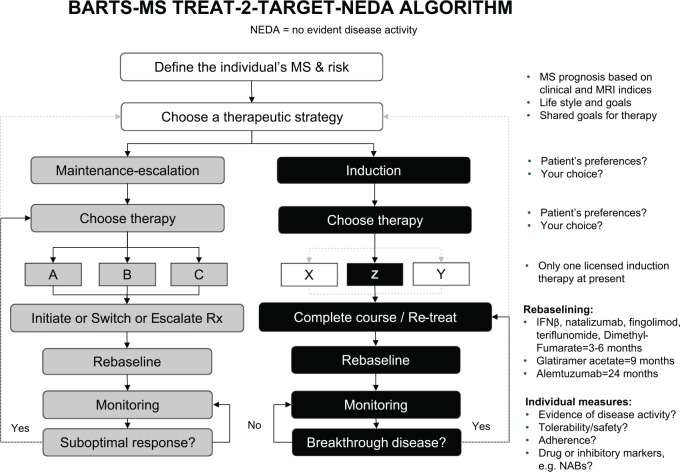
Figure 1.
Figure 1.
An example of a treat-to-target algorithm, based on NEDA, for the treatment of patients with active MS. Source: Reproduced with permission from Giovannoni et al. MRI: magnetic resonance activity; MS: multiple sclerosis; NABs: neutralizing antibodies; NEDA: no evident disease activity; Rx: treatment; IFNβ: interferon-beta.

References

    1. Bevan CJ, Cree BA. Disease activity free status: A new end point for a new era in multiple sclerosis clinical research? JAMA Neurol 2014; 71: 269–270. - PubMed
    1. Giovannoni G, Turner B, Gnanapavan S, et al. Is it time to target no evident disease activity (NEDA) in multiple sclerosis? Mult Scler Relat Disord 2015; 4: 329–333. - PubMed
    1. Smolen JS, Landewe R, Breedveld FC, et al. EULAR recommendations for the management of rheumatoid arthritis with synthetic and biological disease-modifying antirheumatic drugs: 2013 update. Ann Rheum Dis 2014; 73: 492–509. - PMC - PubMed
    1. Stangel M, Penner IK, Kallmann BA, et al. Towards the implementation of “no evidence of disease activity” in multiple sclerosis treatment: The multiple sclerosis decision model. Ther Adv Neurol Disord 2015; 8: 3–13. - PMC - PubMed
    1. Banwell B, Giovannoni G, Hawkes C, et al. Editors’ welcome and a working definition for a multiple sclerosis cure. Mult Scler Relat Disord 2013; 2: 65–67. - PubMed

MeSH terms

LinkOut - more resources