Review
. 2017 Apr 6;15(1):75.
doi: 10.1186/s12916-017-0840-6.

Emerging concepts in liquid biopsies

Affiliations
Review

Emerging concepts in liquid biopsies

Samantha Perakis et al. BMC Med. .

Abstract

Characterizing and monitoring tumor genomes with blood samples could achieve significant improvements in precision medicine. As tumors shed parts of themselves into the circulation, analyses of circulating tumor cells, circulating tumor DNA, and tumor-derived exosomes, often referred to as "liquid biopsies", may enable tumor genome characterization by minimally invasive means. Indeed, multiple studies have described how molecular information about parent tumors can be extracted from these components. Here, we briefly summarize current technologies and then elaborate on emerging novel concepts that may further propel the field. We address normal and detectable mutation levels in the context of our current knowledge regarding the gradual accumulation of mutations during aging and in light of technological limitations. Finally, we discuss whether liquid biopsies are ready to be used in routine clinical practice.

Keywords: Cell-free DNA; Circulating tumor DNA; Circulating tumor cells; Disease monitoring; Liquid biopsy; Precision medicine.


Figures
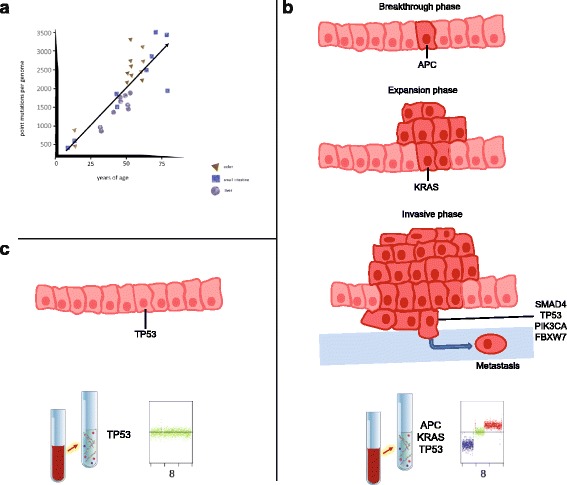
Fig. 1
Fig. 1
Mutation rate in adult stem cells and their potential consequences. a Correlation of the number of somatic point mutations in adult stem cells derived from colon, small intestine, and liver with age of the donor (adapted from [66]); there is an increase of ~36 mutations/adult stem cell/year. b Summary of the “Three strikes to cancer model” [68] for colorectal cancer, where mutations occur in specific driver genes. In the breakthrough phase, a mutation occurs in APC and results in abnormal division of the respective cell. Subsequently, a mutation in KRAS may follow in the expansion phase and may give rise to a benign tumor. Occurrence of a further mutation in a driver gene in at least one of the listed pathways SMAD4, TP53, PIK3CA, or FBXW7 may enable the tumor to invade surrounding tissues and to initiate the invasive phase with dissemination of tumor cells and formation of metastases [68]. The mutations may be detectable in cfDNA; furthermore, depending on the ctDNA allele frequency and tumor stage, somatic copy number alterations may become visible (shown exemplarily for chromosome 8: blue: lost; green: balanced; and red: gained region). c As the order of driver gene mutations is important, the consequences differ if a TP53 mutation occurs in a colon stem cell before the initiating mutations have taken place. Such a TP53 mutation alone will not be sufficient to cause increased proliferation or even to transform the cell into a tumor cell. However, due to the stem cell’s capacity of self-renewal, cells with this mutation may be propagated in the respective part of the colon. Depending on how many of these cells are removed by apoptosis or other events, ultra-sensitive ctDNA assays may then detect this mutation in the blood; this will usually not be accompanied by copy number alterations (as indicated by the green scatter-plot for chromosome 8)
Fig. 2
Fig. 2
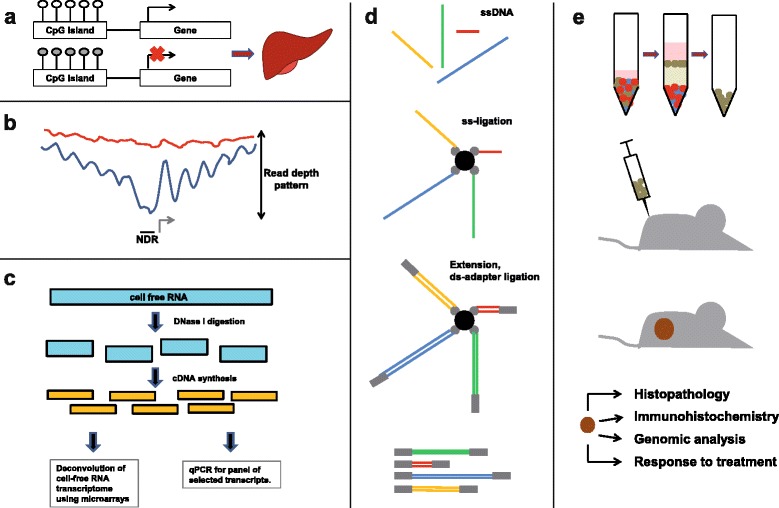
Summary of some emerging technologies in the liquid biopsy field. a Plasma DNA tissue mapping: Plasma DNA tissue mapping is an approach employing genome-wide bisulfite sequencing of plasma DNA and methylation deconvolution of the sequencing data to trace the tissue of origin of plasma DNA in a genome-wide manner (here shown exemplarily for liver-specific markers). The signal-to-noise ratio of such assays can be increased by the analysis of stretches of several CpG sites adjacent to the tissue-specific methylation marker. b Nucleosome mapping: analysis of the genomic sequencing coverage of plasma DNA fragments reveals the position of nucleosomes because plasma DNA is nucleosome-protected DNA. At transcription start sites (TSSs; indicated by a gray arrow), in particular at the nucleosome depleted region, the read depth is lower and has distinct coverage patterns around the TSSs of highly expressed genes (shown in blue), which differs from coverage patterns of unexpressed genes (red). c Plasma RNA-seq: After extraction of cell-free RNA from plasma and DNase I digestion, cDNA is synthesized and amplified from cell-free RNA. Deconvolution of the cell-free transcriptome using microarrays is conducted to determine the relative RNA contributions of certain tissues in a sample based on known tissue-specific expression profiles. In parallel, selected transcripts are quantified by qPCR (procedure based on [81]). d Single-stranded DNA (ssDNA) library preparation: the scheme illustrates the key steps in the ssDNA ligation procedure. The ssDNA (top panel), which is not size-selected to avoid elimination of shorter fragments, is ligated to biotinylated probes (second panel), and after ligation of double stranded primers, extended to double-stranded DNA (third panel). DNA molecules of different lengths with a lower limit of efficient capture of approximately 40–60 bp can be obtained (adapted from [86]). e CTC-derived explants (CDXs): The patients’ blood is enriched for CTCs (green cells in top panel) and injected into one or both flanks in mice (second panel). The obtained CDXs (brown tumor in third panel) are then analyzed by histopathology, immunohistochemistry, and genomic analyses to confirm that characteristics of the original tumor were maintained. Mice bearing CDXs can be treated to evaluate response to various agents

References

    1. Ashley EA. Towards precision medicine. Nat Rev Genet. 2016;17(9):507–22. doi: 10.1038/nrg.2016.86. - DOI - PubMed
    1. Prasad V, Fojo T, Brada M. Precision oncology: origins, optimism, and potential. Lancet Oncol. 2016;17(2):e81–86. doi: 10.1016/S1470-2045(15)00620-8. - DOI - PubMed
    1. McGranahan N, Swanton C. Biological and therapeutic impact of intratumor heterogeneity in cancer evolution. Cancer Cell. 2015;27(1):15–26. doi: 10.1016/j.ccell.2014.12.001. - DOI - PubMed
    1. Gerlinger M, Rowan AJ, Horswell S, Larkin J, Endesfelder D, Gronroos E, Martinez P, Matthews N, Stewart A, Tarpey P, et al. Intratumor heterogeneity and branched evolution revealed by multiregion sequencing. N Engl J Med. 2012;366(10):883–92. doi: 10.1056/NEJMoa1113205. - DOI - PMC - PubMed
    1. Campbell PJ, Yachida S, Mudie LJ, Stephens PJ, Pleasance ED, Stebbings LA, Morsberger LA, Latimer C, McLaren S, Lin ML, et al. The patterns and dynamics of genomic instability in metastatic pancreatic cancer. Nature. 2010;467(7319):1109–13. doi: 10.1038/nature09460. - DOI - PMC - PubMed