


Blood Pressure and Arterial Stiffness in Kenyan Adolescents With α+Thalassemia
- PMID: 28381468
- PMCID: PMC5533038
- DOI: 10.1161/JAHA.117.005613
Blood Pressure and Arterial Stiffness in Kenyan Adolescents With α+Thalassemia
Abstract
Background: Recent studies have discovered that α-globin is expressed in blood vessel walls where it plays a role in regulating vascular tone. We tested the hypothesis that blood pressure (BP) might differ between normal individuals and those with α+thalassemia, in whom the production of α-globin is reduced.
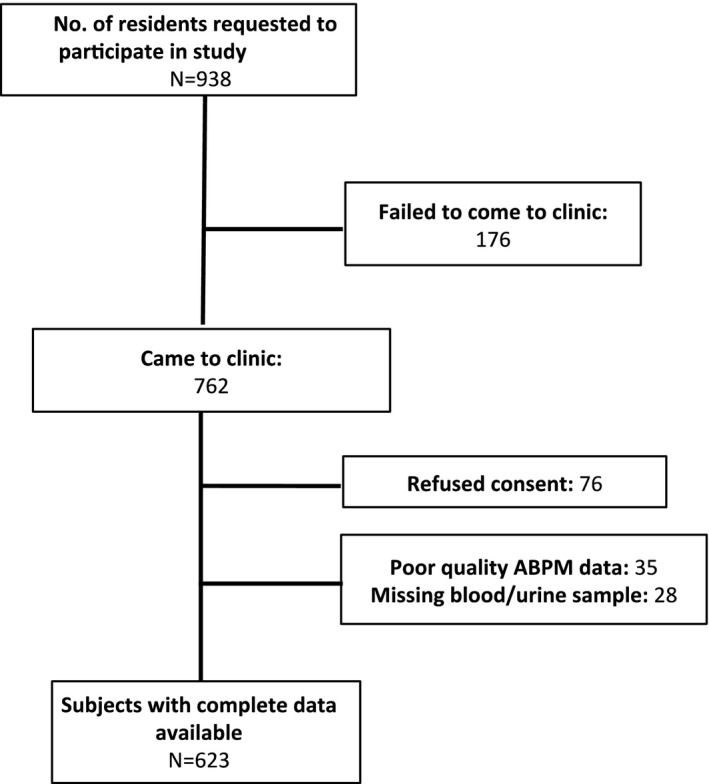
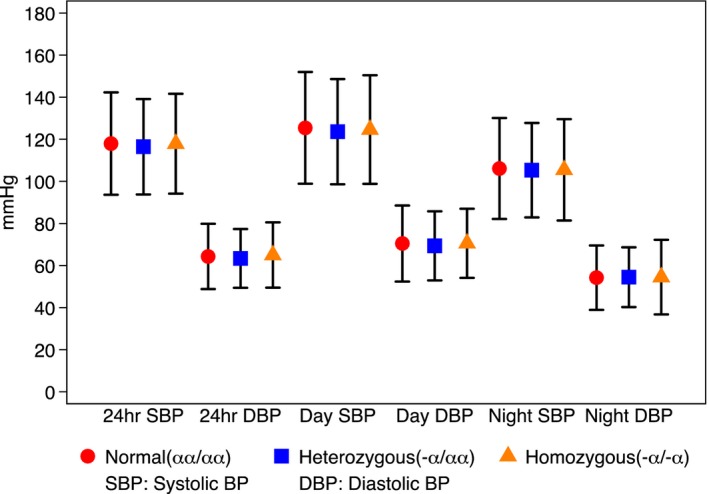
Methods and results: The study was conducted in Nairobi, Kenya, among 938 adolescents aged 11 to 17 years. Twenty-four-hour ambulatory BP monitoring and arterial stiffness measurements were performed using an arteriograph device. We genotyped for α+thalassemia by polymerase chain reaction. Complete data for analysis were available for 623 subjects; 223 (36%) were heterozygous (-α/αα) and 47 (8%) were homozygous (-α/-α) for α+thalassemia whereas the remaining 353 (55%) were normal (αα/αα). Mean 24-hour systolic BP ±SD was 118±12 mm Hg in αα/αα, 117±11 mm Hg in -α/αα, and 118±11 mm Hg in -α/-α subjects, respectively. Mean 24-hour diastolic BP ±SD in these groups was 64±8, 63±7, and 65±8 mm Hg, respectively. Mean pulse wave velocity (PWV)±SD was 7±0.8, 7±0.8, and 7±0.7 ms-1, respectively. No differences were observed in PWV and any of the 24-hour ambulatory BP monitoring-derived measures between those with and without α+thalassemia.
Conclusions: These data suggest that the presence of α+thalassemia does not affect BP and/or arterial stiffness in Kenyan adolescents.
Keywords: adolescence; ambulatory blood pressure monitoring; α+thalassemia.
© 2017 The Authors. Published on behalf of the American Heart Association, Inc., by Wiley.
Figures
References
-
- Piel FB, Weatherall DJ. The alpha‐thalassemias. N Engl J Med. 2014;371:1908–1916. - PubMed
-
- Flint J, Hill AV, Bowden DK, Oppenheimer SJ, Sill PR, Serjeantson SW, Bana‐Koiri J, Bhatia K, Alpers MP, Boyce AJ. High frequencies of alpha‐thalassaemia are the result of natural selection by malaria. Nature. 1986;321:744–750. - PubMed
-
- Enevold A, Lusingu JP, Mmbando B, Alifrangis M, Lemnge MM, Bygbjerg IC, Theander TG, Vestergaard LS. Reduced risk of uncomplicated malaria episodes in children with alpha+‐thalassemia in northeastern Tanzania. Am J Trop Med Hyg. 2008;78:714–720. - PubMed
-
- Mockenhaupt FP, Ehrhardt S, Gellert S, Otchwemah RN, Dietz E, Anemana SD, Bienzle U. Alpha(+)‐thalassemia protects African children from severe malaria. Blood. 2004;104:2003–2006. - PubMed
MeSH terms
Grants and funding
LinkOut - more resources
Full Text Sources
Other Literature Sources
