


Functional Diversification of Kaurene Synthase-Like Genes in Isodon rubescens
- PMID: 28381502
- PMCID: PMC5462038
- DOI: 10.1104/pp.17.00202
Functional Diversification of Kaurene Synthase-Like Genes in Isodon rubescens
Abstract
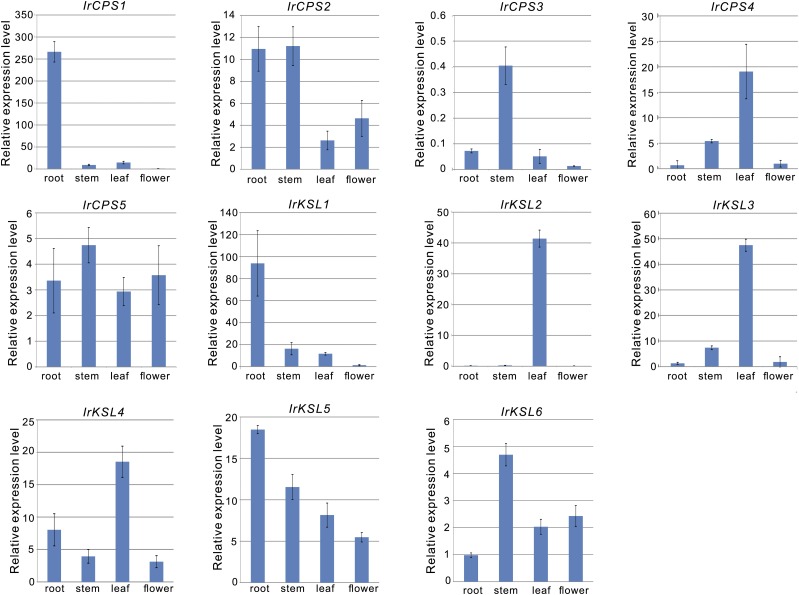
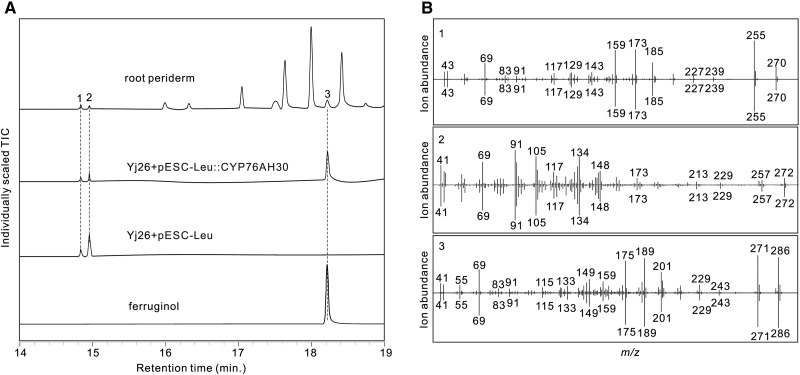
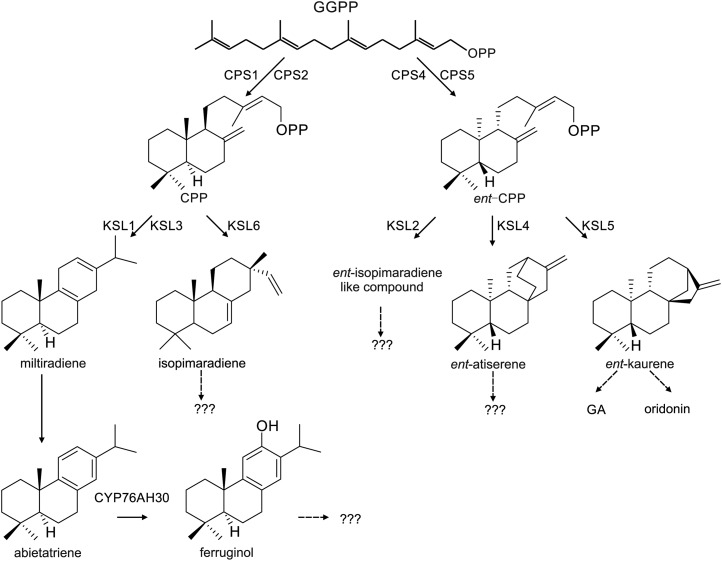
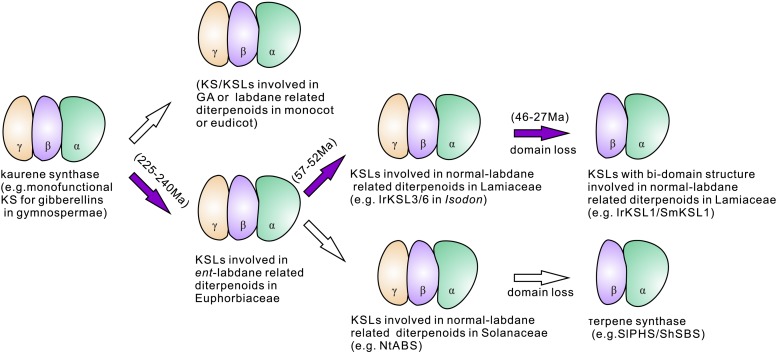
Ent-kaurene diterpenoids are the largest group of known Isodon diterpenoids. Among them, oridonin is accumulated in the leaves, and is the most frequently studied compound because of its antitumor and antibacterial activities. We have identified five copalyl diphosphate synthase (CPS) and six kaurene synthase-like (KSL) genes by transcriptome profiling of Isodon rubescens leaves. An in vitro assay assigns ten of them to five different diterpene biosynthesis pathways, except IrCPS3 that has a mutation in the catalytic motif. The Lamiaceae-specific clade genes (IrCPS1 and IrCPS2) synthesize the intermediate copalyl diphosphate (normal-CPP), while IrCPS4 and IrCPS5 synthesize the intermediate ent-copalyl diphosphate (ent-CPP). IrKSL2, IrKSL4, and IrKSL5 react with ent-CPP to produce an ent-isopimaradiene-like compound, ent-atiserene and ent-kaurene, respectively. Correspondingly, the Lamiaceae-specific clade genes IrKSL1 or IrKSL3 combined with normal-CPP led to the formation of miltiradiene. The compound then underwent aromatization and oxidization with a cytochrome P450 forming two related compounds, abietatriene and ferruginol, which were detected in the root bark. IrKSL6 reacts with normal-CPP to produce isopimaradiene. IrKSL3 and IrKSL6 have the γβα tridomain structure, as these proteins tend to possess the bidomain structure of IrKSL1, highlighting the evolutionary history of KSL gene domain loss and further elucidating chemical diversity evolution from a macroevolutionary stance in Lamiaceae.
© 2017 American Society of Plant Biologists. All Rights Reserved.
Figures
References
-
- Andersen-Ranberg J, Kongstad KT, Nielsen MT, Jensen NB, Pateraki I, Bach SS, Hamberger B, Zerbe P, Staerk D, Bohlmann J, Møller BL, Hamberger B (2016) Expanding the landscape of diterpene structural diversity through stereochemically controlled combinatorial biosynthesis. Angew Chem Int Ed Engl 55: 2142–2146 - PMC - PubMed
-
- Božić D, Papaefthimiou D, Brückner K, de Vos RC, Tsoleridis CA, Katsarou D, Papanikolaou A, Pateraki I, Chatzopoulou FM, Dimitriadou E, et al. (2015) Towards elucidating carnosic acid biosynthesis in Lamiaceae: functional characterization of the three first steps of the pathway in Salvia fruticosa and Rosmarinus officinalis. PLoS One 10: e0124106. - PMC - PubMed
-
- Brückner K, Božić D, Manzano D, Papaefthimiou D, Pateraki I, Scheler U, Ferrer A, de Vos RC, Kanellis AK, Tissier A (2014) Characterization of two genes for the biosynthesis of abietane-type diterpenes in rosemary (Rosmarinus officinalis) glandular trichomes. Phytochemistry 101: 52–64 - PubMed
-
- Chamy MC, Piovano M, Garbarino JA, Gambaro V, Miranda C (1989) Foliosate, a bis-diterpene and 9-epi-ent-7,15-isopimaradiene derivatives from Calceolaria foliosa. Phytochemistry 28: 571–574
MeSH terms
Substances
LinkOut - more resources
Full Text Sources
Other Literature Sources
Molecular Biology Databases
Research Materials
Miscellaneous
