. 2017 May 19;292(20):8459-8471.
doi: 10.1074/jbc.M117.778183. Epub 2017 Apr 5.

The chromatin-remodeling subunit Baf200 promotes homology-directed DNA repair and regulates distinct chromatin-remodeling complexes

Affiliations

The chromatin-remodeling subunit Baf200 promotes homology-directed DNA repair and regulates distinct chromatin-remodeling complexes

Rodrigo O de Castro et al. J Biol Chem. .

Abstract

The efficiency and type of pathway chosen to repair DNA double-strand breaks (DSBs) are critically influenced by the nucleosome packaging and the chromatin architecture surrounding the DSBs. The Swi/Snf (PBAF and BAF) chromatin-remodeling complexes contribute to DNA damage-induced nucleosome remodeling, but the mechanism by which it contributes to this function is poorly understood. Herein, we report how the Baf200 (Arid2) PBAF-defining subunit regulates DSB repair. We used cytological and biochemical approaches to show that Baf200 plays an important function by facilitating homologous recombination-dependent processes, such as recruitment of Rad51 (a key component of homologous recombination) to DSBs, homology-directed repair, and cell survival after DNA damage. Furthermore, we observed that Baf200 and Rad51 are present in the same complex and that this interaction is mediated by C-terminal sequences in both proteins. It has been recognized previously that the interplay between distinct forms of Swi/Snf has profound functional consequences, but we understand little about the composition of complexes formed by PBAF protein subunits. Our biochemical analyses reveal that Baf200 forms at least two distinct complexes. One is a canonical form of PBAF including the Swi/Snf-associated Brg1 catalytic subunit, and the other contains Baf180 but not Brg1. This distinction of PBAF complexes based on their unique composition provides the foundation for future studies on the specific contributions of the PBAF forms to the regulation of DNA repair.

Keywords: Baf200; DNA damage; DNA recombination; DNA repair; PBAF; Rad51; chromatin remodeling; homologous recombination.


Conflict of interest statement

The authors declare that they have no conflicts of interest with the content of this article

Figures
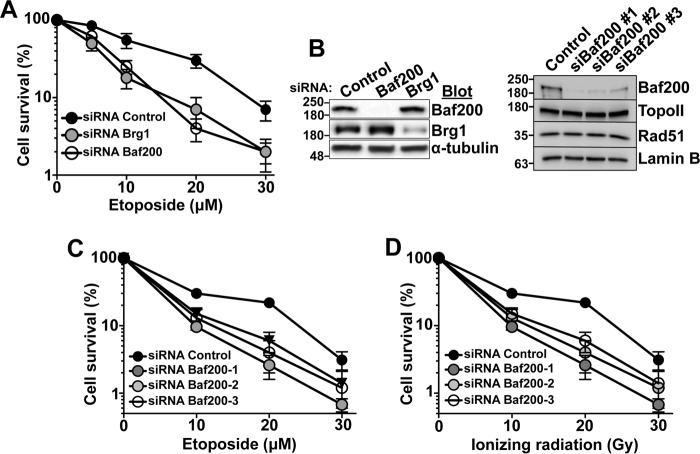
Figure 1.
Figure 1.
Baf200 depletion sensitizes cells to DNA damage. A, U2OS transfected with the indicated siRNA and treated with etoposide was analyzed 10 days later to measure the number of surviving cells by flow cytometry. B, Western blot showing knockdown of Brg1 or Baf200. Shown is a comparison of three different siRNA targeting Baf200 in U2OS cells corresponding to experiments in C and D. Note that no changes in topoisomerase II or Rad51 are observed after depletion of Baf200. Molecular weights for each blot are indicated. C and D, U2OS cells transfected with the indicated siRNA against Baf200 were treated with etoposide (C) or ionizing radiation (D) and analyzed 10 days later to measure the number of surviving cells by flow cytometry. The mean ± S.D. is shown.
Figure 2.
Figure 2.
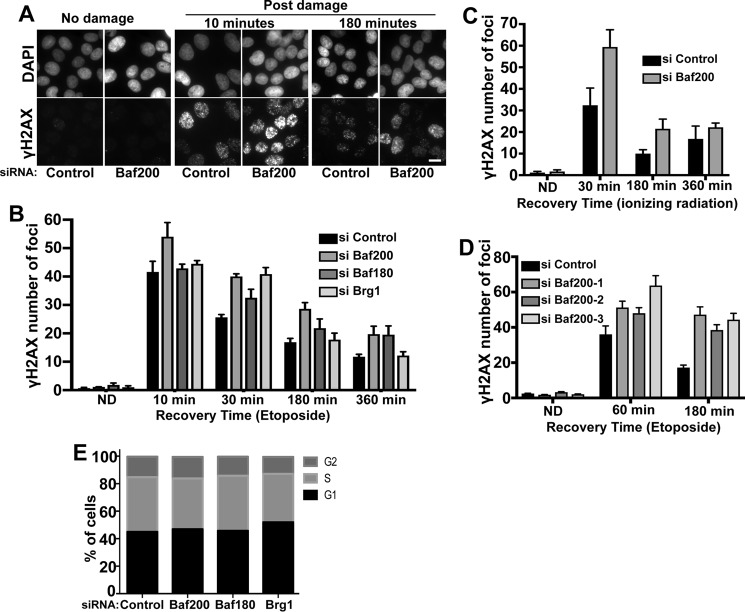
Effect of Baf200 depletion on the DNA damage response. A, U2OS cells were treated with the indicated siRNA, followed by treatment with 10 μm etoposide for 20 min to induce damage, and allowed to repair DSBs for the indicated times. Representative images of cells immunostained with DAPI (nuclei) and γH2AX antibodies (DSBs) are shown. The scale bar represents 10 μm in all images. B, quantitative analysis of γH2AX foci formation and resolution after etoposide exposure from three independent experiments is shown. C, quantitative analysis of γH2AX foci formation and resolution after cells were treated with siRNA control and siRNA Baf200 and exposed to ionizing radiation from three independent experiments is shown. D, quantitative analysis of γH2AX foci formation and resolution after cells were treated with different siRNAs targeting Baf200 and exposed to etoposide to induce DNA damage. E, cell cycle distribution of U2OS cells before and after siRNA treatment. U2OS cells were transfected with the indicated siRNAs. After 72 h, cells were stained with propidium iodide, and the percentage of total U2OS cells at G2, S, and G1 cell cycle stages was measured by ArrayScan quantification. The data shown are from a single representative experiment out of three repeats; n = 10,000 cells analyzed from a single experiment. The mean ± S.D. is shown.
Figure 3.
Figure 3.
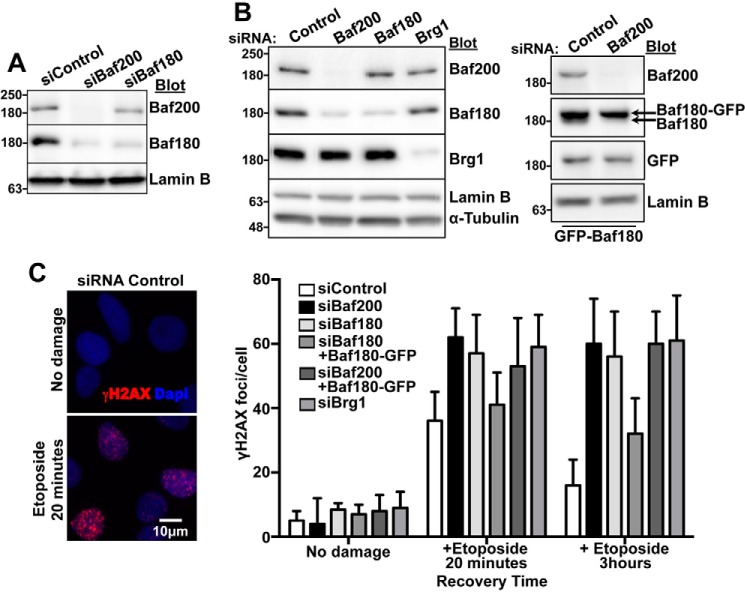
Baf200 plays an important role in DNA DSB repair. A, Western blot showing Baf200 and Baf180 levels in whole U2OS lysates after treatment with the indicated siRNA. Molecular weights for each blot are indicated. B, Western blot showing expression of Baf180-GFP in U2OS cells treated with the indicated siRNAs. Molecular weights for each blot are indicated. C, U2OS cells treated with the indicated siRNAs were transfected with Baf180-GFP, treated with 10 μm etoposide for 20 min, and allowed to repair DSBs. Immunofluorescence analysis and quantitative analysis of γH2AX foci formation from three independent biological replicates (utilizing different sets of cultured and treated cells). n = 150 cells each; mean ± S.D. is shown.
Figure 4.
Figure 4.
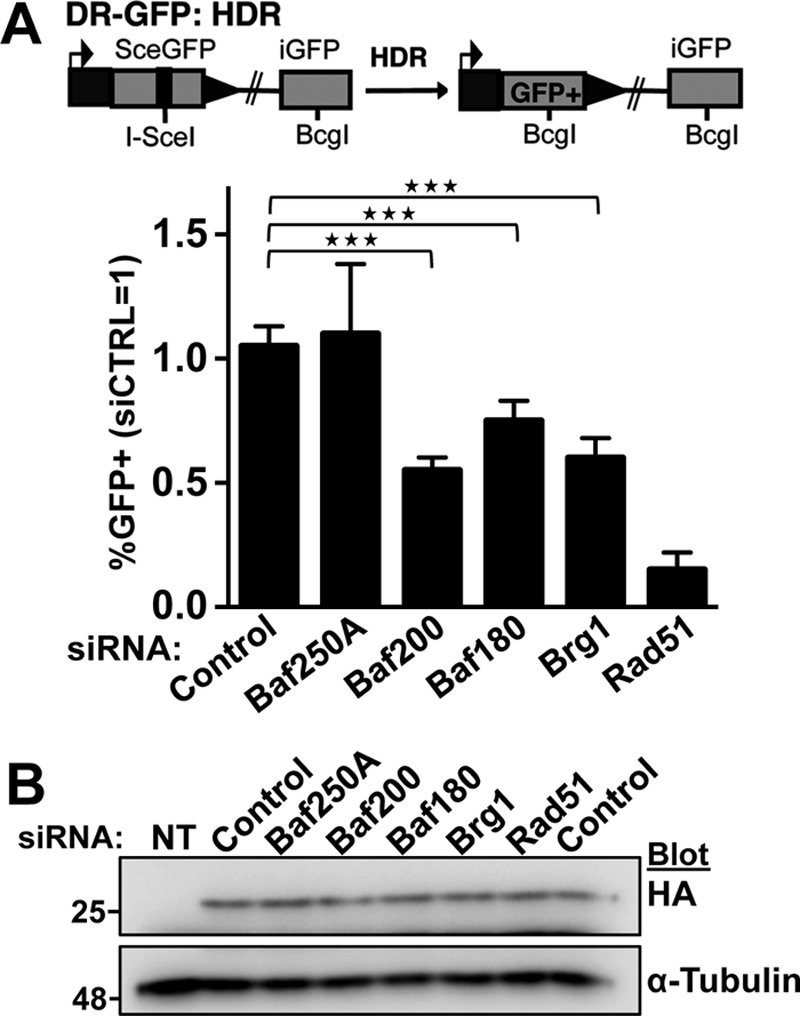
Baf200 and Baf180 expression is important for homologous recombination. A, a U2OS cell line with an integrated split-GFP transgene was used to report the efficiency of DSB repair through homologous recombination. The cell line was transfected with the indicated siRNA. After 24 h, cells were transfected with a plasmid expressing I-SceI to induce a DSB per cell, and 24 h later, GFP-positive cells indicative of DSB repair were quantified by FACS. Schematic of the GFP-HDR reporter used to monitor homologous recombination and quantitative analysis of GFP-positive cells is shown. For all experiments, the mean ± S.D. from three independent biological replicates (experiments that utilized independently cultured and treated sets of cells) is plotted. Shown are the frequencies of GFP-positive cells relative to parallel transfections with siControl. Statistical differences were examined using paired two-tailed Student's t test. Comparison of control siRNA treatment with Baf200, Baf180, Brg1, and Rad51 siRNA treatments resulted in p < 0.0001. Comparison of control siRNA treatment with Baf250A treatment resulted in a non-significant difference; ***, p < 0.001. B, a Western blot analyzing expression of I-Sce1-HA is shown. Molecular weights for each blot are indicated.
Figure 5.
Figure 5.
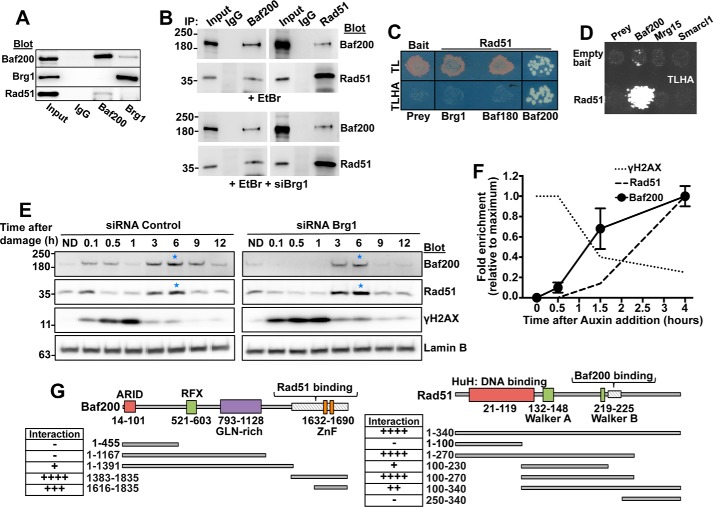
Baf200 interacts with Rad51. A–D, an interaction between Baf200 and Rad51 is supported by co-IP using U2OS cell total extract in the presence of DNA damage agent (etoposide) or ethidium bromide (A and B), and a direct yeast two-hybrid assay (C and D). For yeast two-hybrid assays, growth of control yeast was monitored on medium lacking tryptophan and leucine (TL). Positive interactions were monitored by growth on medium lacking tryptophan, leucine, histidine, and adenine (TLHA). C, Baf200, but not Baf180 or Brg1, shows a strong interaction with Rad51. D, the specificity of Rad51 interaction with Baf200 is also supported by the strong growth in TLHA plates of Baf200-Rad51 mating products, but not other chromatin remodeling factors. E, U2OS cells were transfected with control or Brg1 siRNA and treated with etoposide for 20 min. After removal of etoposide, cells were lysed at the indicated times, and the chromatin-associated fraction was evaluated by Western blotting with the indicated antibodies. ND represents a sample where cells were not exposed to etoposide (no DNA damage) and collected 30 min after DNA damage induction. Chromatin fractions were probed with the indicated antibodies. Laminin B was used as loading control, γH2AX was used to indicate an early stage of the DNA damage response, and the Rad51 protein was used as a marker for a later stage of the homologous recombination-directed DNA repair pathway. Blue stars mark strong events of Baf200 and Rad51 association with chromatin. The figure shows representative results obtained in one of three independent biological replicates (experiments that begin from a different set of cultured cells). F, AID-AsiSI-ER U2OS cells were used to analyze time course of protein binding to chromatin using Baf200-, Rad51-, and γH2AX-specific antibodies at a DSB specifically repaired by the HDR pathway (site A: Chr9 129732985). Auxin addition was considered time 0. ChIP signals were normalized to the maximum signal obtained for each antibody. Time course for each ChIP (antibody) at the indicated times (experiments initiated with a different set of cultured cells) was repeated three times. The mean ± S.D. is shown. G, schematic of Baf200 and Rad51 functional domains and truncation mutants created to map sites of Baf200-Rad51 interaction. The negative (−) and positive (+) symbols represent absence or presence of interaction. Four positive symbols represent maximum interaction strength.
Figure 6.
Figure 6.
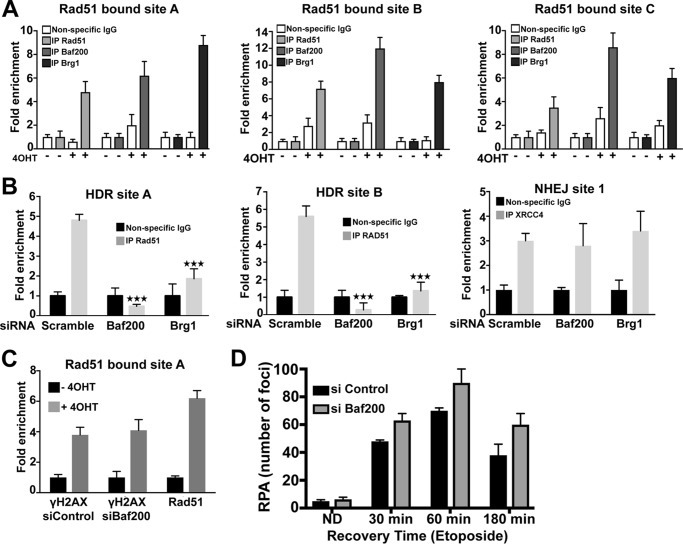
Baf200 is enriched on the chromatin at DSB sites and is required for Rad51 recruitment to DSBs. A, DSBs were induced by tamoxifen (4OHT) treatment of AsiSI-U2OS cells containing estrogen receptor-tagged AsiSI. DSB sites, known to be preferentially repaired by homologous recombination, were evaluated for Rad51, Brg1, and Baf200 recruitment by ChIP followed by qPCR. HDR site A: Chr9 129732985, HDR site B: Chr22 37194040, and HDR site C: Chr22 19180307. B, AsiSI-expressing U2OS cells were transfected with the indicated siRNA, and DSBs were induced by 4OHT treatment. ChIP-qPCR was used to evaluate Rad51 and XRCC4 recruitment to the same two AsiSI sites preferentially repaired by homologous recombination (sites A and B) shown in A and one site preferentially repaired by NHEJ (site 1: Chr18 7556705). A and B, for all experiments, the mean ± S.D. from three independent biological replicates (experiments that utilized different sets of cultures and siRNA-treated cells) is plotted. Statistical differences noted in B were examined using paired two-tailed Student's t test. Comparison of control siRNA treatment with Baf200 siRNA and Brg1 siRNA treatments resulted in ***, p < 0.001. C, DSB-dependent phosphorylation of H2AX (γH2AX) and recruitment of Rad51 to HDR site A. D, quantitative analysis of RPA foci formation and resolution after cells were treated with control siRNA and siRNA targeting Baf200 and exposed to etoposide to induce DNA damage. The mean ± S.D. is shown.
Figure 7.
Figure 7.
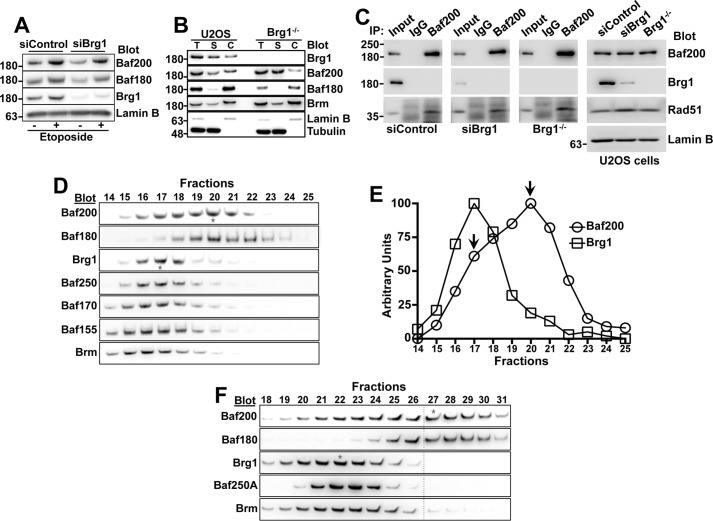
Biochemically distinct complexes composed by Baf200 and Baf180 coexist in U2OS cells. A, Western blot of chromatin fractions showing Baf200, Baf180, Brg1, and Lamin B levels after treatment of U2OS cells with the indicated siRNA and etoposide (10 μm for 20 min). B, Western blot showing Baf200 and Baf180 levels in etoposide-treated Brg1 knock-out U2OS cells generated using CRISPR/Cas. Total (T), soluble (S), and chromatin-bound (C) cell lysate fractions were analyzed with the indicated antibodies. C, co-IP was performed using cell total extract from U2OS cells transfected with siRNA control, siRNA Brg1, and a Brg1−/− U2OS cell line. Molecular weights for each blot are indicated. D, U2OS nuclear cell lysates were subjected to sucrose gradient fractionation (5–20%) and analyzed by Western blotting with the indicated antibodies. Only fractions 14–25 of a total of 30 fractions are shown. Stars mark the peaks of Baf200 and Brg1. One representative experiment of three independent replicates (utilizing independently cultured cells, processed and resolved in sucrose gradients) is shown. E, quantitative analysis of results in D. F, 293T nuclear cells lysates were subjected to sucrose gradient fractionation (5–20%) and analyzed by Western blotting with the indicated antibodies. Only fractions 14–31 of a total of 38 fractions are shown.
Figure 8.
Figure 8.
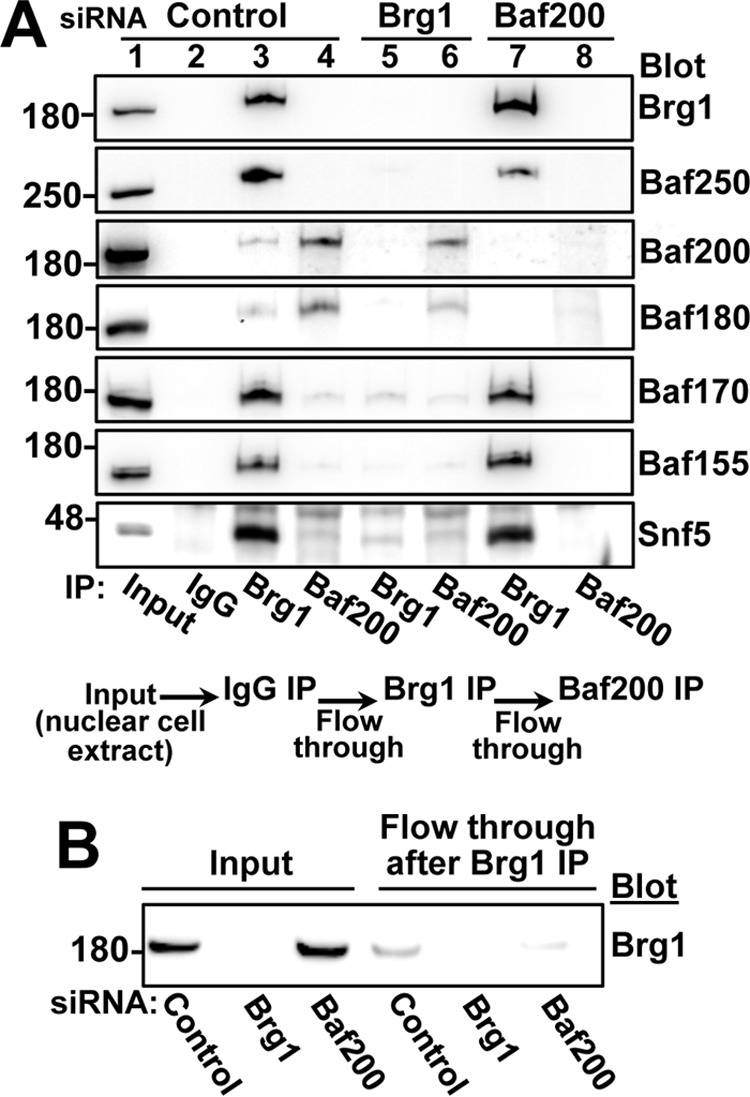
Distinct complexes composed by Baf200 and Baf180 coexist in 293T and U2OS cells. A, immunoprecipitation followed by Western blotting analysis of U2OS cells transfected with the indicated siRNAs. The schematic at the bottom of the panel summarizes the procedure: for each siRNA-treated condition, cell lysates were sequentially immunoprecipitated with unspecific IgG, followed by anti-Brg1 and then anti-Baf200 antibodies. Molecular weights for each blot are indicated. B, Western blot showing residual Brg1 protein after U2OS nuclear extract were immunoprecipitated (immunodepleted) with Brg1-specific antibodies.
Figure 9.
Figure 9.
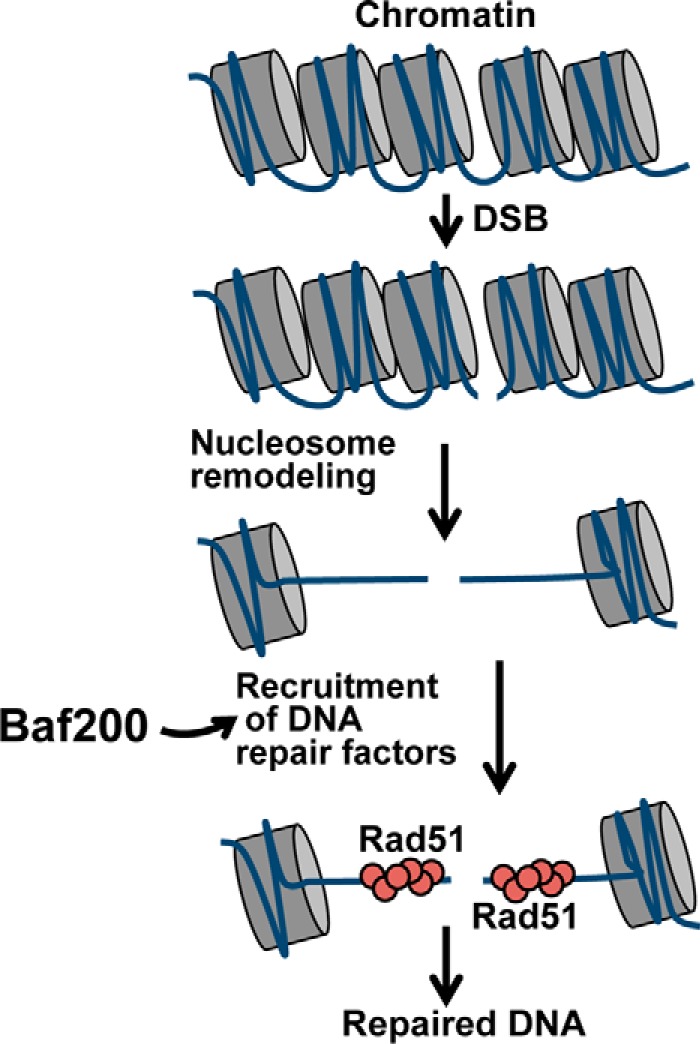
A model for the role of Baf200 in regulating DNA DSB repair. We propose that Baf200 acts at a critical step of the DNA repair progress by recruiting DNA repair factors to promote homologous recombination-dependent repair of DSBs.

References

    1. Price B. D., and D'Andrea A. D. (2013) Chromatin remodeling at DNA double-strand breaks. Cell 152, 1344–1354 - PMC - PubMed
    1. Jeggo P. A., and Downs J. A. (2014) Roles of chromatin remodellers in DNA double strand break repair. Exp. Cell Res. 329, 69–77 - PubMed
    1. Seeber A., Hauer M., and Gasser S. M. (2013) Nucleosome remodelers in double-strand break repair. Curr. Opin. Genet. Dev. 23, 174–184 - PubMed
    1. Papamichos-Chronakis M., and Peterson C. L. (2013) Chromatin and the genome integrity network. Nat. Rev. Genet. 14, 62–75 - PMC - PubMed
    1. Goodarzi A. A., Jeggo P., and Lobrich M. (2010) The influence of heterochromatin on DNA double strand break repair: getting the strong, silent type to relax. DNA Repair 9, 1273–1282 - PubMed

Publication types

MeSH terms

LinkOut - more resources