. 2017 May 26;91(12):e00487-17.
doi: 10.1128/JVI.00487-17. Print 2017 Jun 15.

Understanding the Mechanism of the Broad-Spectrum Antiviral Activity of Favipiravir (T-705): Key Role of the F1 Motif of the Viral Polymerase

Affiliations

Understanding the Mechanism of the Broad-Spectrum Antiviral Activity of Favipiravir (T-705): Key Role of the F1 Motif of the Viral Polymerase

Rana Abdelnabi et al. J Virol. .

Abstract

Favipiravir (T-705) is a broad-spectrum antiviral agent that has been approved in Japan for the treatment of influenza virus infections. T-705 also inhibits the replication of various RNA viruses, including chikungunya virus (CHIKV). We demonstrated earlier that the K291R mutation in the F1 motif of the RNA-dependent RNA polymerase (RdRp) of CHIKV is responsible for low-level resistance to T-705. Interestingly, this lysine is highly conserved in the RdRp of positive-sense single-stranded RNA (+ssRNA) viruses. To obtain insights into the unique broad-spectrum antiviral activity of T-705, we explored the role of this lysine using another +ssRNA virus, namely, coxsackievirus B3 (CVB3). Introduction of the corresponding K-to-R substitution in the CVB3 RdRp (K159R) resulted in a nonviable virus. Replication competence of the K159R variant was restored by spontaneous acquisition of an A239G substitution in the RdRp. A mutagenesis analysis at position K159 identified the K159M variant as the only other viable variant which had also acquired the A239G substitution. The K159 substitutions markedly decreased the processivity of the purified viral RdRp, which was restored by the introduction of the A239G mutation. The K159R A239G and K159M A239G variants proved, surprisingly, more susceptible than the wild-type virus to T-705 and exhibited lower fidelity in polymerase assays. Furthermore, the K159R A239G variant was found to be highly attenuated in mice. We thus demonstrate that the conserved lysine in the F1 motif of the RdRp of +ssRNA viruses is involved in the broad-spectrum antiviral activity of T-705 and that it is a key amino acid for the proper functioning of the enzyme.IMPORTANCE In this study, we report the key role of a highly conserved lysine residue of the viral polymerase in the broad-spectrum antiviral activity of favipiravir (T-705) against positive-sense single-stranded RNA viruses. Substitutions of this conserved lysine have a major negative impact on the functionality of the RdRp. Furthermore, we show that this lysine is involved in the fidelity of the RdRp and that the RdRp fidelity influences the sensitivity of the virus for the antiviral efficacy of T-705. Consequently, these results provide insights into the mechanism of the antiviral activity of T-705 and may lay the basis for the design of novel chemical scaffolds that may be endowed with a more potent broad-spectrum antiviral activity than that of T-705.

Keywords: CVB3; RdRp; favipiravir; fidelity; mutagenesis.


Figures

FIG 1
FIG 1
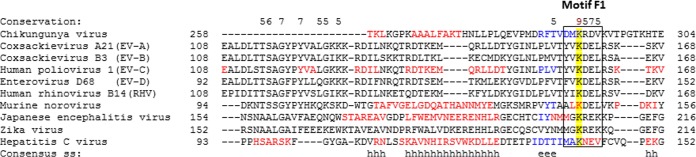
Multiple-sequence alignment of motif F1 of viral RdRp. Part of the multiple-sequence alignment of RdRp of chikungunya virus (ACY09947.1), enteroviruses (coxsackievirus A21 [ABM54541.1], coxsackievirus B3 [AAA74400.1], poliovirus type 1 [AAP37265.1], enterovirus D68 [AAR98503.1], and human rhinovirus B14 [NP_740525.1]), flaviviruses (Zika virus [AMO03410.1] and Japanese encephalitis virus [ABU94628.1]), murine norovirus (AEY83582.1), and hepatitis C virus (CAB46913.1) was generated using the PROMALS server (http://prodata.swmed.edu/promals/promals.php). Motif F1 of the RdRp is indicated by a black box, and the residues corresponding to K291 in CHIKV are highlighted in yellow.
FIG 2
FIG 2
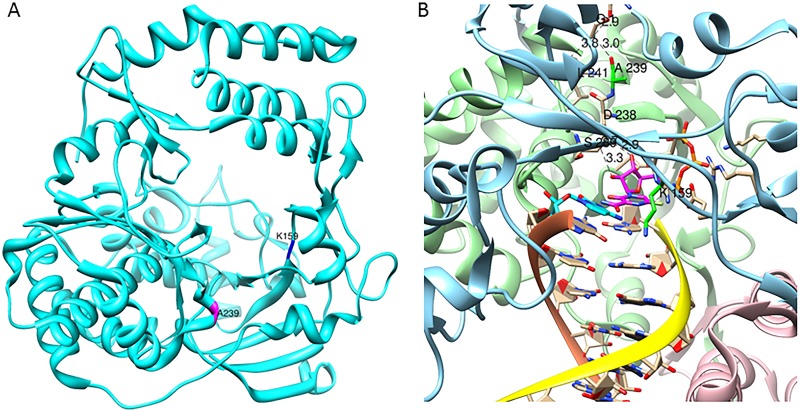
Coxsackievirus B3 polymerase structure. (A) Structure of CVB3 polymerase (PDB code 4K4Y) showing the locations of Lys159 (K159) and Ala239 (A239) highlighted in blue and magenta, respectively. (B) Model of CVB3 polymerase structure (fingers, blue; palm, green; thumb, red ribbons) with favipiravir triphosphate (T-705-RTP). The primer RNA strand has a yellow ribbon, the template has a brown ribbon. T-705-RTP has purple carbons. The complementary G is in cyan. The carbons of K159 and A239 residues are highlighted in green. CVB3 hydrogen bonds from the sugar part of T-705-RTP to the N terminus (in cyan) via A239 (green carbons) are shown as black dashed lines.
FIG 3
FIG 3
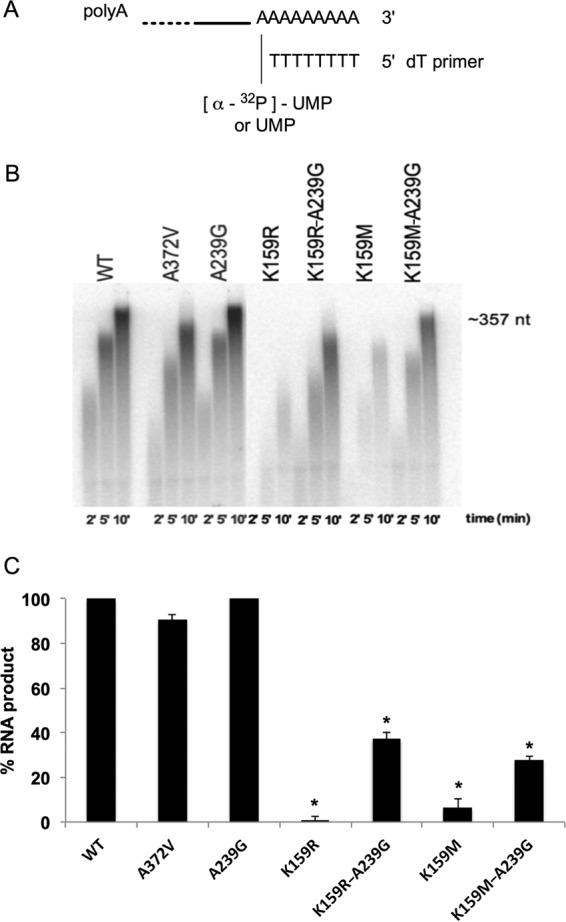
Coxsackievirus B3 RdRp variants exhibit distinct polymerase activities. RNA polymerase assays were performed as described in Materials and Methods. (A) dT15-poly(rA) is a homopolymeric primer-template allowing the incorporation of [α-32P]UMP or UMP at the dT primer 3′ end. (B) RNA products of a representative PAGE gel are shown after 2, 5, and 10 min of quenching. (C) The quantified percentages of RNA products shown are mean values ± SD of the results of two independent experiments. Statistical analysis was performed using two-way analysis of variance (ANOVA) in reference to the WT for the K159R or K159M variant (*, P < 0.05), to the K159R variant for the K159R A239G variant (*, P < 0.05), or to the K159M variant for the K159M A239G variant (*, P < 0.05).
FIG 4
FIG 4
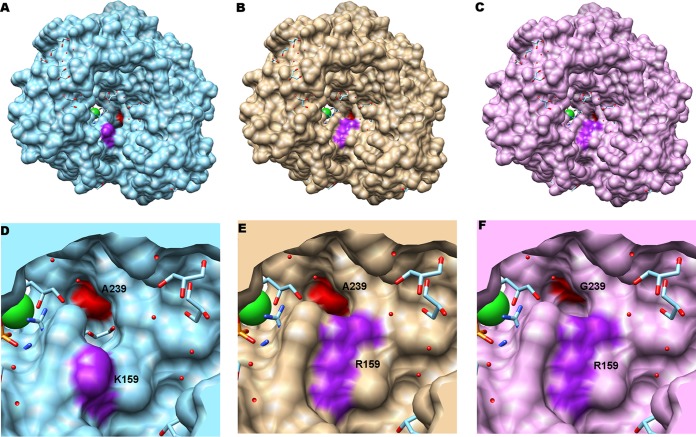
Top view of the RdRp from CVB3 (PDB code 3CDW). (A) The locations of the residues K159 and A239 are highlighted in purple and red, respectively. The channel from incoming ribonucleoside triphosphates (rNTPs) is shown between these residues. (B) The long chain of the arginine residue R159 mutant is highlighted in purple, narrowing the channel for incoming rNTPs. A239 is shown in red. (C) The G239 mutant, in red, is able to reestablish the access of rNTPs in the channel. The residue R159 is shown in purple. Panels D to F are representative zoom images of panels A to C, respectively.
FIG 5
FIG 5
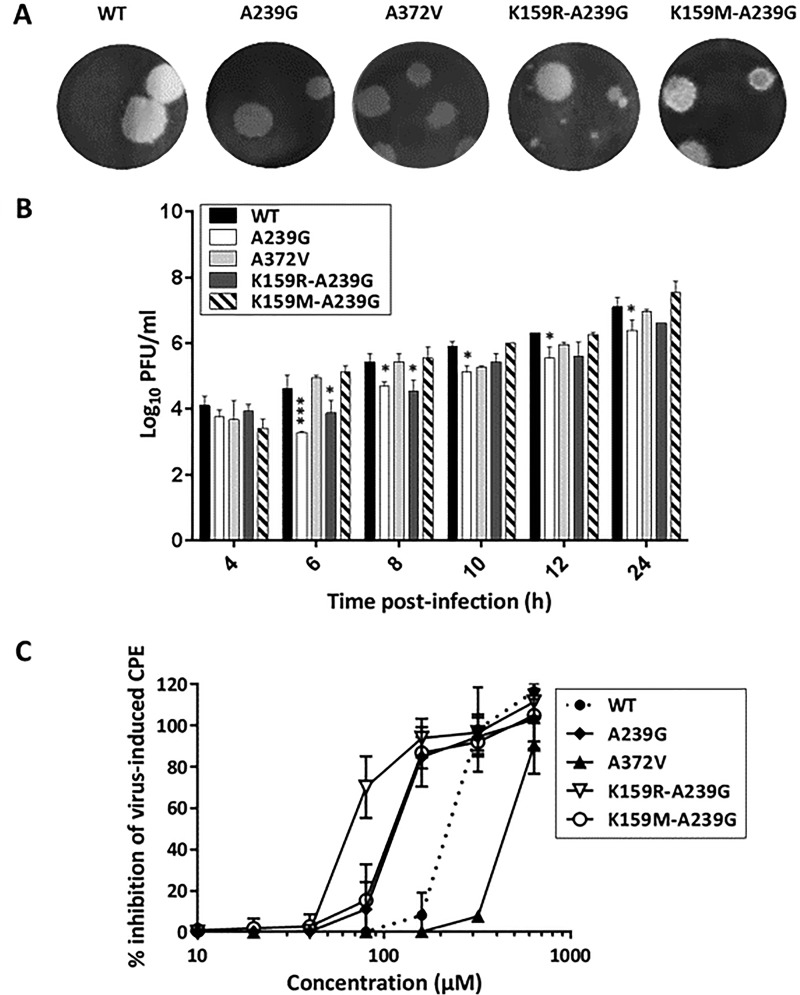
Phenotype of reverse-engineered CVB3 variants. (A) Plaque phenotypes of different CVB3 variants were determined by infecting Vero A cells with a 10-fold serial dilution of each variant, followed by the addition of an agarose overlay. After 3 days, viral plaques were visualized by Giemsa staining. A representative image with spread plaques is shown. (B) Growth curves were generated by infecting Vero A cells with the selected CVB3 variant at an MOI of 3, after which the infectious virus titer in the medium was determined at various time points after infection by plaque assay. Infectious virus titers are the means ± SD of the results of two independent experiments. Significant differences with respect to the WT (*, P < 0.05, or ***, P < 0.001) were analyzed by two-way ANOVA. (C) The sensitivity of the reverse-engineered CVB3 variants to the antiviral effect of T-705 was assessed in HeLa Rh cells by a CPE reduction assay. Cell viability was measured using the MTS/PMS method. Data are expressed as percentages of untreated controls and are mean values ± SD of the results of at least three independent experiments.
FIG 6
FIG 6
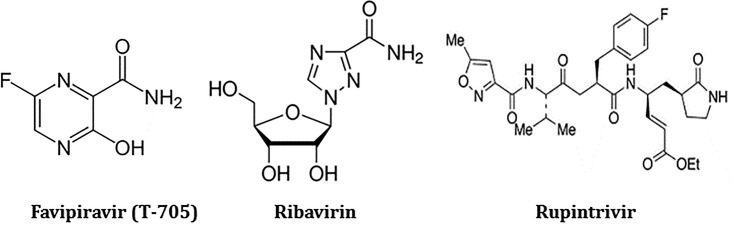
Chemical structures of favipiravir, ribavirin, and rupintrivir.
FIG 7
FIG 7
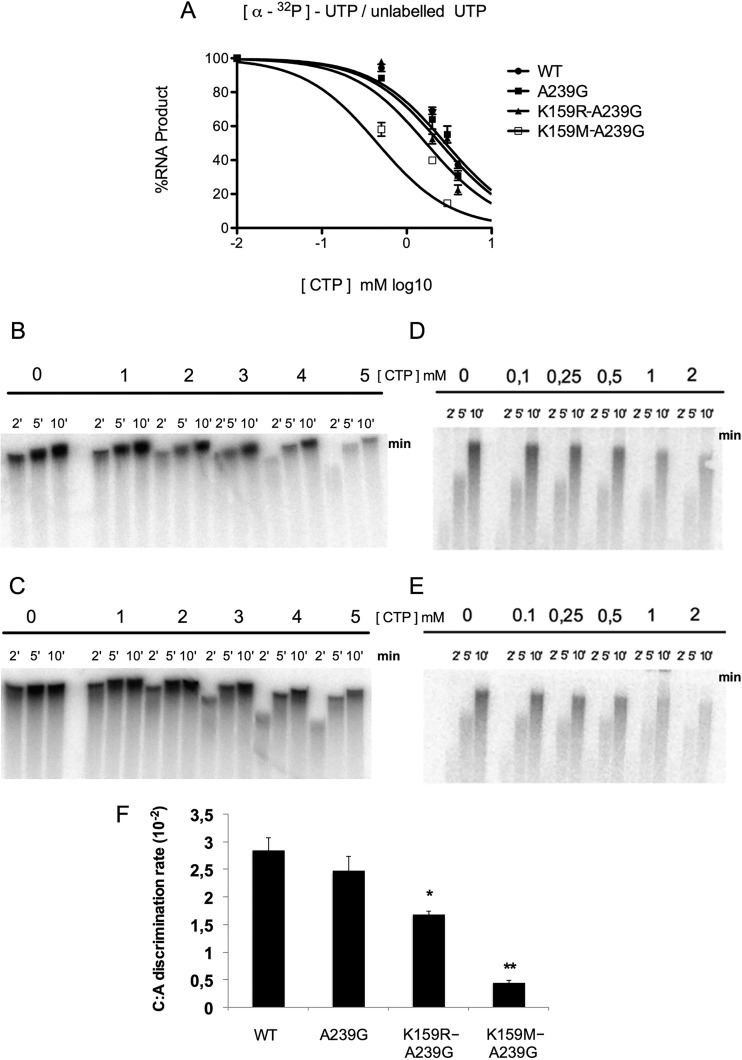
K159R A239G and K159M A239G mutants are low-fidelity RdRp variants. Competition assays were performed with 3 μCi [α-32P]UTP or cold 10 μM UTP challenged with CTP concentrations of 1, 2, 3, 4, and 5 mM for the WT (B) and the A239G variant (C) or 0.1, 0.25, 0.5, 1, 2 mM for K159R A239G (D) and K159M A239G (E) variants. The total percentage of RNA product formed represents a mean ± SD of the results of two independent experiments and was measured as a dose-response curve with at least one data point above and below 50% RNA product formed (A) to be able to calculate an interpolated apparent IC50. Data were fit (F) and statistical analyses were performed using two-way ANOVA in reference to the WT for the K159R A239G variant (*, P < 0.05) and for the K159M A239G variant (**, P < 0.01).
FIG 8
FIG 8
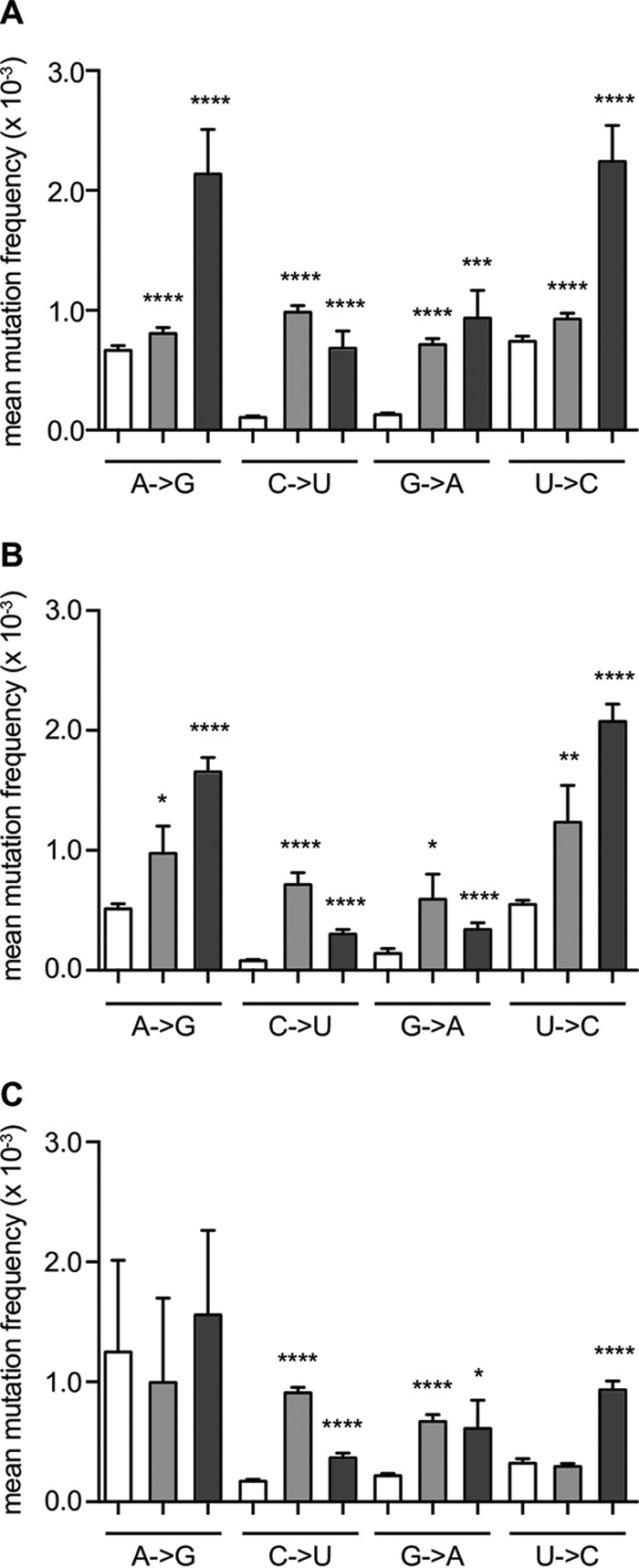
T-705 significantly increases the mutation frequency of CVB3. Wild-type (A), high-fidelity A372V (B), and low-fidelity A239G (C) viruses were either mock treated (open bars) or treated with T-705 (light gray bars) or ribavirin (dark gray bars) at concentrations equal to the corresponding EC50s and subjected to whole-genome deep sequencing. The frequency of transition mutations occurring at each A, C, G, and U was calculated and used to determine the mean frequency and SEM. *, P < 0.05; **, P < 0.01; ***, P = 0.0006; ****, P < 0.0001; two-tailed paired t test; n = 1,416 (A to G), n = 1,169 (C to U); n = 988 (G to A); n = 1,182 (U to C).
FIG 9
FIG 9
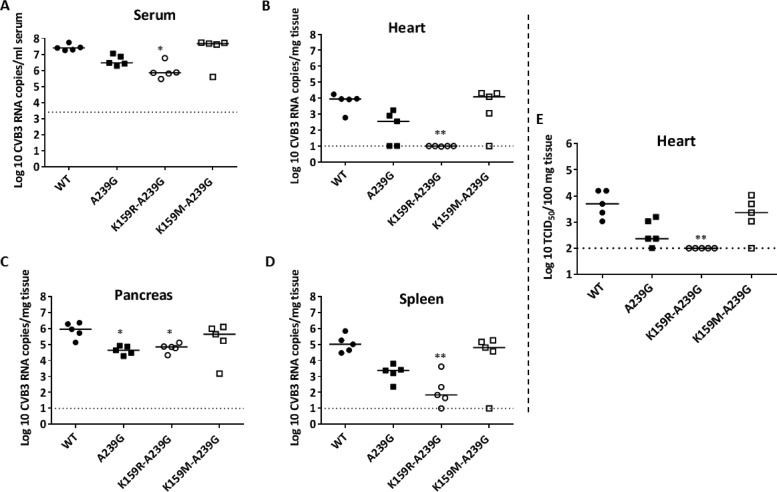
In vivo fitness of CVB3 K159 variants in SJL mice. SJL mice were infected with 105 PFU of CVB3 WT or A239G, K159R A239G, or K159R A239G variants (n = 5 per variant). On day 3 p.i., all mice were euthanized, after which serum samples and selected organs were collected for RNA extraction. The amount of viral RNA in serum (A), heart (B), pancreas (C), and spleen (D) was determined by qRT-PCR. The number of infectious virus particles in the heart (E) was determined by endpoint titration (*, P < 0.05, and **, P < 0.01, Kruskal-Wallis test).

References

    1. Furuta Y, Gowen BB, Takahashi K, Shiraki K, Smee DF, Barnard DL. 2013. Favipiravir (T-705), a novel viral RNA polymerase inhibitor. Antiviral Res 100:446–454. doi:10.1016/j.antiviral.2013.09.015. - DOI - PMC - PubMed
    1. Rocha-Pereira J, Jochmans D, Dallmeier K, Leyssen P, Nascimento MSJ, Neyts J. 2012. Favipiravir (T-705) inhibits in vitro norovirus replication. Biochem Biophys Res Commun 424:777–780. doi:10.1016/j.bbrc.2012.07.034. - DOI - PubMed
    1. Zmurko J, Marques RE, Schols D, Verbeken E, Kaptein SJF, Neyts J. 2016. The viral polymerase inhibitor 7-deaza-2′-C-methyladenosine is a potent inhibitor of in vitro zika virus replication and delays disease progression in a robust mouse infection model. PLoS Negl Trop Dis 10:e0004695. doi:10.1371/journal.pntd.0004695. - DOI - PMC - PubMed
    1. Safronetz D, Falzarano D, Scott DP, Furuta Y, Feldmann H, Gowen BB. 2013. Antiviral efficacy of favipiravir against two prominent etiological agents of hantavirus pulmonary syndrome. Antimicrob Agents Chemother 57:4673–4680. doi:10.1128/AAC.00886-13. - DOI - PMC - PubMed
    1. Mentré F, Taburet A-M, Guedj J, Anglaret X, Keïta S, de Lamballerie X, Malvy D. 2015. Dose regimen of favipiravir for Ebola virus disease. Lancet Infect Dis 15:150–151. doi:10.1016/S1473-3099(14)71047-3. - DOI - PubMed

MeSH terms

LinkOut - more resources