Review
. 2017 Apr 1;10(4):373-383.
doi: 10.1242/dmm.027789.

Identifying genes for neurobehavioural traits in rodents: progress and pitfalls

Affiliations
Review

Identifying genes for neurobehavioural traits in rodents: progress and pitfalls

Amelie Baud et al. Dis Model Mech. .

Abstract

Identifying genes and pathways that contribute to differences in neurobehavioural traits is a key goal in psychiatric research. Despite considerable success in identifying quantitative trait loci (QTLs) associated with behaviour in laboratory rodents, pinpointing the causal variants and genes is more challenging. For a long time, the main obstacle was the size of QTLs, which could encompass tens if not hundreds of genes. However, recent studies have exploited mouse and rat resources that allow mapping of phenotypes to narrow intervals, encompassing only a few genes. Here, we review these studies, showcase the rodent resources they have used and highlight the insights into neurobehavioural traits provided to date. We discuss what we see as the biggest challenge in the field - translating QTLs into biological knowledge by experimentally validating and functionally characterizing candidate genes - and propose that the CRISPR/Cas genome-editing system holds the key to overcoming this obstacle. Finally, we challenge traditional views on inbred versus outbred resources in the light of recent resource and technology developments.

Keywords: Genetics of behaviour; Quantitative trait loci; Rodent resources.


Conflict of interest statement

Competing interests

The authors declare no competing or financial interests.

Figures
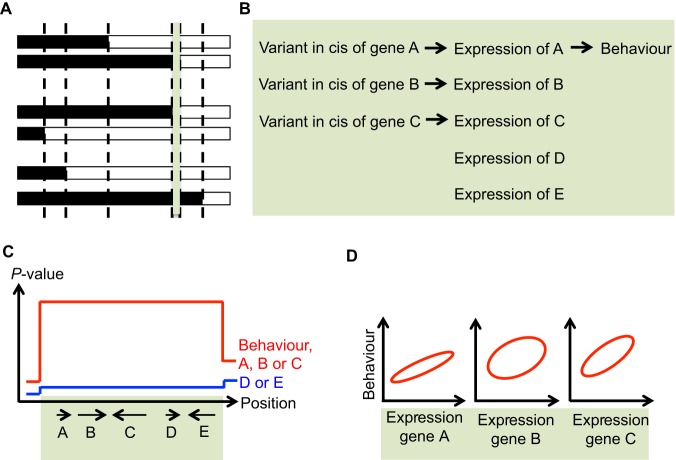
Fig. 1.
Fig. 1.
Low levels of recombination preclude identification of genes associated with behavioural phenotypes. (A) Large unrecombined genomic segments in F2 crosses. Three pairs of homologous chromosomes, from three individuals of an F2 cross, are represented. As each chromosome presents on average only one recombination event, large segments of DNA are unrecombined in F2 crosses (even with hundreds of individuals). One such segment is highlighted in green. (B) Example scenario for behavioural variation. Variation in behaviour arises from differences in expression of gene A driven by a variant in cis of the gene. Gene A lies in the unrecombined segment shown in green in panel A with many other genes, four of which (gene B to gene E) are presented in this scenario. Expression of genes B and C is controlled by variants in cis, while expression of genes D and E is not. In reality the proportion of genes with a cis-eQTL in any given tissue is about 10%. (C) Primary analysis: QTL mapping of the behaviour and of the genes encompassed by the behavioural QTL. The position along the chromosome is shown on the x-axis and spans the green unrecombined interval. Genes A to E are represented by arrows. The y-axis shows the significance of the association between genotype and trait (behaviour or gene expression level). The red curve shows the shape of the association curve for behaviour and genes A, B and C, the blue curve that for genes D and E. The shape of the red curve denotes a QTL for the behaviour and a cis-eQTL for each of genes A, B, C. As genes A, B and C have a cis-eQTL, they will be considered candidate causal genes for the behavioural QTL effect. (D) Gene-behaviour correlation analysis to further prioritise candidate genes. The ovals represent the spread of the data points (not shown); hence the tighter the oval, the stronger the correlation between the variables on the x- and y-axes. A correlation between expression of gene A and behaviour is likely to exist as a result of the causal path shown in panel B. As genes B and C also have cis-eQTLs and the underlying genotypes are perfectly correlated with the genotypes of the cis-eQTL for gene A (no recombination in the green interval), a correlation will likely exist between expression of genes B and behaviour and expression of gene C and behaviour. The strength of these correlations will depend on many parameters, including non-local genetic and non-genetic effects. Hence, prioritising genes A, B, C based on the strength (or significance) of the correlations is not straightforward, and is subject to caveats.
Fig. 2.
Fig. 2.
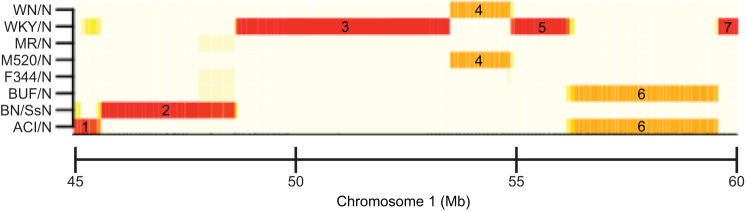
Reconstruction of the chromosomes of an HS rat as a probabilistic mosaic of the eight founder genomes. A 16 Mb region of chromosome 1 is represented (x-axis). The figure describes the probability that the pair of homologous chromosomes is descended from each of the eight founders (y-axis) using a colour code (white: 0; red: 2; yellow ∼1). Seven sub-segments (labelled 1-7) can be identified based on breaks in the colour pattern. The first sub-segment (45-45.5 Mb) has a probability of 2 (maximum probability) to be descended from the founder ACI/N; this means that we can be confident both homologous chromosomes are descended from that founder. Similarly, both chromosomes are descended from BN/SsN in the second segment and from WKY/N in the third segment. The fourth segment shows equal probability (probability of 1) to be descended from WN/N and M520/N; this can be interpreted either as one chromosome is descended from WN/N and the other from M520/N or those two founders are similar in that region and so we are unsure whether both chromosomes are descended from one or the other founder. Both chromosomes are descended from WKY/N in segments 5 and 7, and they are descended from BUF/N and/or ACI/N in segment 6. This fragmented pattern of genomic inheritance is referred to as ‘mosaic’. The probabilities can be used as input to the statistical models used to map QTLs.

References

    1. Allardyce J., Gaebel W., Zielasek J. and van Os J. (2007). Deconstructing Psychosis conference February 2006: the validity of schizophrenia and alternative approaches to the classification of psychosis. Schizophr. Bull. 33, 863-867. 10.1093/schbul/sbm051 - DOI - PMC - PubMed
    1. Allen H. L., Estrada K., Lettre G., Berndt S. I., Weedon M. N., Rivadeneira F., Willer C. J., Jackson A. U., Vedantam S., Raychaudhuri S. et al. (2010). Hundreds of variants clustered in genomic loci and biological pathways affect human height. Nature 467, 832-838. 10.1038/nature09410 - DOI - PMC - PubMed
    1. American Psychiatric Association (2000). Diagnostic and Statistical Manual of Mental Disorders, Fourth Edition: DSM-IV-TR®. Washington, DC: American Psychiatric Association.
    1. Andreux P. A., Williams E. G., Koutnikova H., Houtkooper R. H., Champy M.-F., Henry H., Schoonjans K., Williams R. W. and Auwerx J. (2012). Systems genetics of metabolism: the use of the BXD murine reference panel for multiscalar integration of traits. Cell 150, 1287-1299. 10.1016/j.cell.2012.08.012 - DOI - PMC - PubMed
    1. Atanur S. S., Diaz A. G., Maratou K., Sarkis A., Rotival M., Game L., Tschannen M. R., Kaisaki P. J., Otto G. W., Ma M. C. J. et al. (2013). Genome sequencing reveals loci under artificial selection that underlie disease phenotypes in the laboratory rat. Cell 154, 691-703. 10.1016/j.cell.2013.06.040 - DOI - PMC - PubMed

Publication types

LinkOut - more resources