Review
. 2017 Apr 6;7(2):20160100.
doi: 10.1098/rsfs.2016.0100.

Mitochondrial metabolites: undercover signalling molecules

Affiliations
Review

Mitochondrial metabolites: undercover signalling molecules

Christian Frezza. Interface Focus. .

Abstract

Mitochondria are one of most characterized metabolic hubs of the cell. Here, crucial biochemical reactions occur and most of the cellular adenosine triphosphate (ATP) is produced. In addition, mitochondria act as signalling platforms and communicate with the rest of the cell by modulating calcium fluxes, by producing free radicals, and by releasing bioactive proteins. It is emerging that mitochondrial metabolites can also act as second messengers and can elicit profound (epi)genetic changes. This review describes the many signalling functions of mitochondrial metabolites under normal and stress conditions, focusing on metabolites of the tricarboxylic acid cycle. We provide a new framework for understanding the role of mitochondrial metabolism in cellular pathophysiology.

Keywords: metabolism; mitochondria; signalling.


Figures
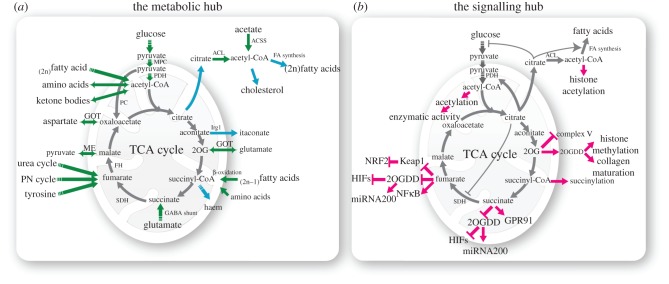
Figure 1.
Figure 1.
The metabolic and signalling roles of TCA cycle metabolites. (a) In this panel, the major sources (green arrows) and fates (blue arrows) of TCA cycle metabolites are indicated. Dotted arrows indicate multi-step reactions, whereas solid lines indicate a single-step reaction. (b) Mitochondrial metabolites are also key signalling molecules. Some of the most established signalling functions of TCA cycle metabolites are indicated (purple arrows). ACL, ATP-citrate lyase; ACSS, acetyl-CoA synthetase; FA, fatty acid; FH, fumarate hydratase; GABA, gamma amino butyric acid; GOT, glutamate oxaloacetate transaminase; GPR91, G-protein-coupled receptor 91, also known as succinate receptor; Irg1, immunoresponsive 1 homologue, also known as aconitate dehydrogenase; ME, malic enzyme; MPC, mitochondrial pyruvate carrier; 2OGDH, 2-oxoglutarate dehydrogenase; 2OGDD, 2-oxoglutarate-dependent dioxygenases; PC, pyruvate carboxylase; PDH, pyruvate dehydrogenase complex; PN, purine nucleotides; SDH, succinate dehydrogenase.

References

    1. Blackstone N. 2016. An evolutionary framework for understanding the origin of eukaryotes. Biology 5, 18 (10.3390/biology5020018) - DOI - PMC - PubMed
    1. Searcy DG. 2003. Metabolic integration during the evolutionary origin of mitochondria. Cell Res. 13, 229–238. (10.1038/sj.cr.7290168) - DOI - PubMed
    1. Martin WF, Neukirchen S, Zimorski V, Gould SB, Sousa FL. 2016. Energy for two: new archaeal lineages and the origin of mitochondria. Bioessays 38, 850–856. (10.1002/bies.201600089) - DOI - PubMed
    1. Rizzuto R, De Stefani D, Raffaello A, Mammucari C. 2012. Mitochondria as sensors and regulators of calcium signalling. Nat. Rev. Mol. Cell Biol. 13, 566–578. (10.1038/nrm3412) - DOI - PubMed
    1. Tait SWG, Green DR. 2010. Mitochondria and cell death: outer membrane permeabilization and beyond. Nat. Rev. Mol. Cell Biol. 11, 621–632. (10.1038/nrm2952) - DOI - PubMed

LinkOut - more resources