


Surfer's myelopathy without surfing: a report of two pediatric patients
- PMID: 28382219
- PMCID: PMC5352672
- DOI: 10.1038/scsandc.2017.8
Surfer's myelopathy without surfing: a report of two pediatric patients
Abstract
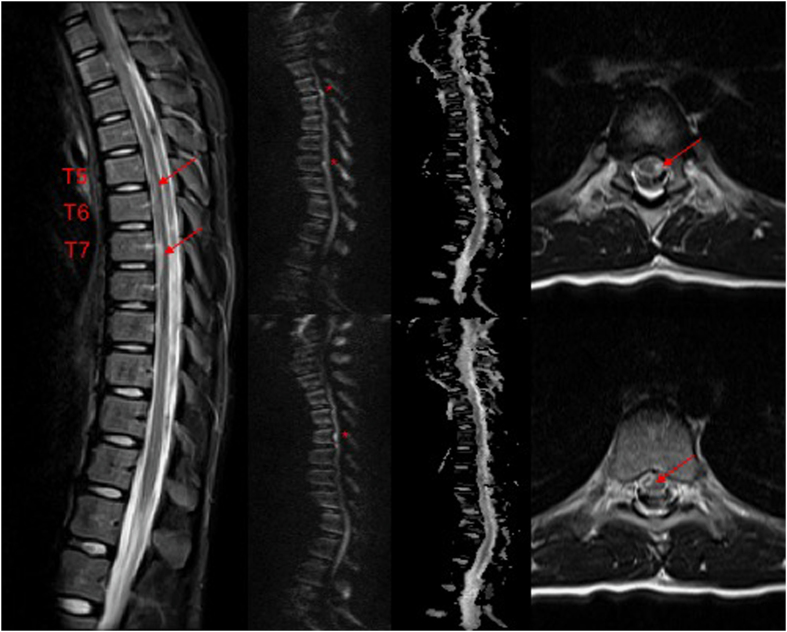
Introduction: Surfer's myelopathy (SM) is a rare disorder described in subjects presenting with acute paraparesis while learning how to surf. It is thought to be secondary to spinal ischemia triggered by hyperextension. Spinal magnetic resonance imaging (MRI) shows changes consistent with spinal cord ischemia on T2-weighted and diffusion-weighted imaging (DWI).
Case presentation: We report two patients who presented with acute onset paraplegia shortly after spinal hyperextension. They had no physical or radiological evidence of soft tissue injury. Their clinical and imaging findings closely resemble those described in SM.
Discussion: We propose the use of the term 'acute hyperextension myelopathy' to categorize patients with spinal cord infarction secondary to hyperextension. DWI sequencing on MRI should be considered to evaluate for early signs of spinal cord ischemia in these patients. Use of a broader term for diagnostic classification can help include patients with spinal cord infarction due to a common mechanism.
Keywords: Paediatric neurological disorders; Spinal cord diseases.
Conflict of interest statement
The authors declare no conflict of interest.
Figures

References
-
- Thompson TP, Pearce J, Chang G, Madamba J. Surfer's myelopathy. Spine (Phila PA 1976) 2004; 29: E353–E356. - PubMed
-
- Conidi F. Some unusual sports-related neurologic conditions. Continuum (Minneap Minn) 2014; 20(6 Sports Neurology): 1645–1656. - PubMed
-
- Freedman BA, Malone DG, Rasmussen PA, Cage JM, Benzel EC. Surfer's myelopathy: a rare form of spinal cord infarction in novice surfers: a systematic review. Neurosurgery 2016; 78: 602–611. - PubMed
-
- Wadia S, Padmanabhan P, Moeller K, Rominger A. Pediatric surfer's myelopathy. J Emerg Med 2015; 49: e143–e145. - PubMed
LinkOut - more resources
Full Text Sources
Other Literature Sources
