. 2017 Mar;22(1):22-32.
doi: 10.15430/JCP.2017.22.1.22. Epub 2017 Mar 30.

Protective Effect of White-fleshed Peach (Prunus persica (L.) Batsch) on Chronic Nicotine-induced Toxicity

Affiliations

Protective Effect of White-fleshed Peach (Prunus persica (L.) Batsch) on Chronic Nicotine-induced Toxicity

Hyun-Jeong Kim et al. J Cancer Prev. 2017 Mar.

Abstract

Background: Nicotine is a major toxic component of tobacco smoke and has been recognized as a risk factor to induce oxidative tissue damage, which is a precursor to cardiovascular diseases, lung-related diseases, and cancers. Peaches (Prunus persica) have been used for the treatment of degenerative disorders, such as hypermenorrhea, dysmenorrhea, and infertility in Asian countries. In this study, we investigated the effects of white-fleshed peach on the excretion of nicotine metabolites and 1-hydroxypyrene in smokers and chronic nicotine-induced tissue damages in mice.

Methods: The concentrations of cotinine and 1-hydroxypyrene were measured in urine of smokers before or after intake of white-fleshed peaches. In addition, ICR mice were injected with nicotine (5 mg/kg body weight) and then orally administered with white-fleshed peach extracts (WFPE) (250 or 500 mg/kg body weight) for 36 days. The oxidative stress parameters and the activities of antioxidant enzymes were measured in liver and kidney tissues. Also, histological changes and nitrotyrosine expression were assessed.

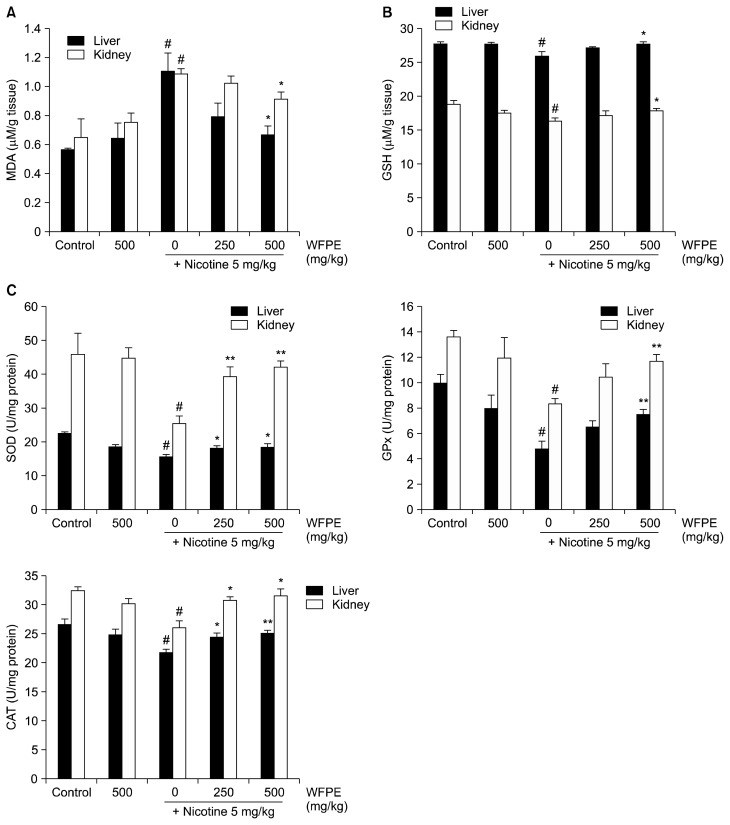
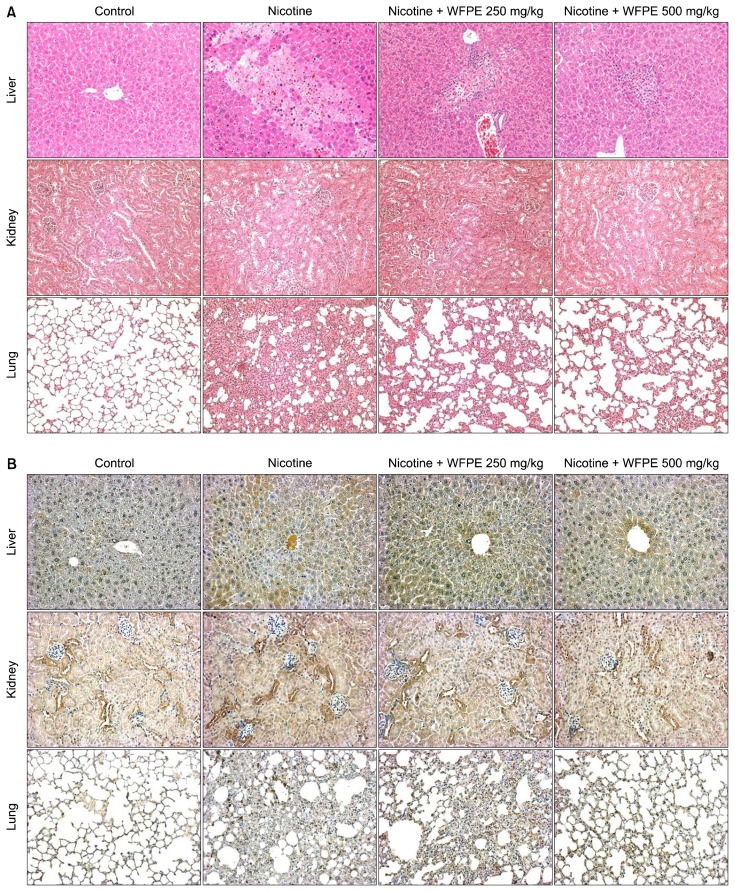
Results: Intake of white-fleshed peaches increased the urinary concentration of nicotine metabolites and 1-hydroxypyrene in 91.67% and 83.33% of smokers, respectively. WFPE decreased the malondialdehyde levels and recovered the activities of antioxidant enzymes in nicotine-injected mice. In addition, WFPE inhibited nitrotyrosine expression and inflammatory responses in the liver, kidney, and lung tissues of nicotine-treated mice.

Conclusions: White-fleshed peaches may increase the metabolism of toxic components in tobacco smoke in smokers and protect normal tissues against nicotine toxicity in mice. Therefore, supplementation of white-fleshed peaches might be beneficial to smokers.

Keywords: Nicotine; Oxidative stress; Prunus persica; Toxicity.


Figures
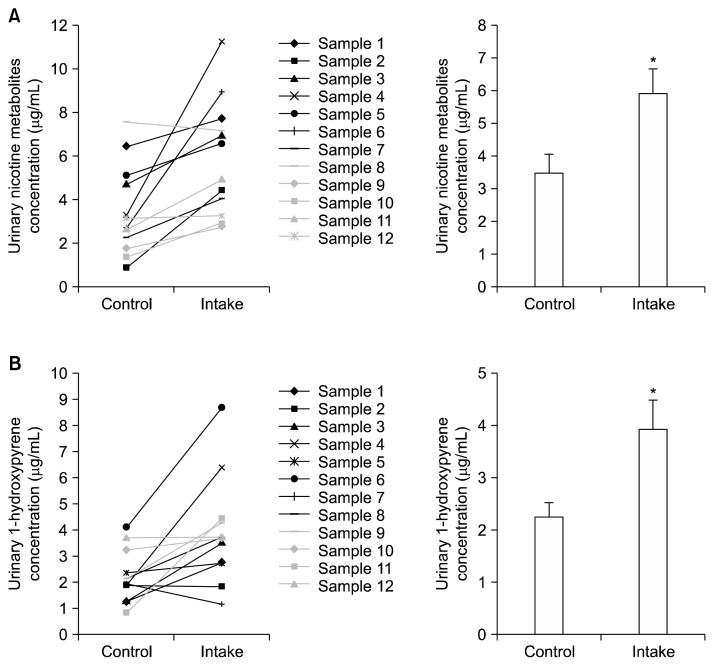
Figure 1
Figure 1
Effect of white-fleshed peach on the excretion of nicotine metabolites and 1-hydroxypyrene in urine of smokers. Urine and saliva of subjects were collected before intake of white-fleshed peach and 4 days after intake. (A) Nicotine metabolite concentration in urine and cotinine concentration in saliva were measured by the colorimetric method and the enzyme immunoassay, respectively. (B) The 1-hydroxypyrene and creatinine concentrations in urine were measured by high-performance liquid chromatography analysis and colorimetric method, respectively. Urinary nicotine metabolite concentration and 1-hydroxypyrene concentration were corrected by salivary cotinine concentration and urinary creatinine concentration, respectively. Data are expressed as mean ± SEM. *P < 0.05 versus control (before intake).
Figure 2
Figure 2
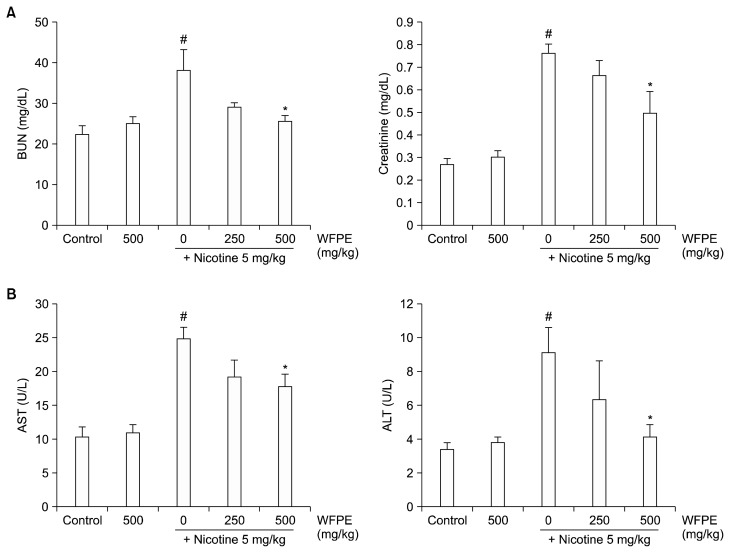
Effect of white-fleshed peach extracts (WFPE) on chronic nicotine-induced nephrotoxicity and hepatotoxicity in mice. Nicotine (5 mg/kg body weight [BW]) and/or WFPE (250 mg/kg BW or 500 mg/kg BW) were administered to mice (n = 6) once daily for 5 weeks. The control mice (n = 6) received saline alone. (A) The serum blood urea nitrogen (BUN) and creatinine levels were measured using commercially available kits for analysis of nephrotoxicity. (B) The serum levels of alanine aminotransferase (ALT) and aspartate aminotransferase (AST) were analyzed as evidence of hepatotoxicity. Data are expressed as mean ± SEM (n = 6 per group). #P < 0.05 versus control group; *P < 0.05 versus nicotine group.
Figure 3
Figure 3
Effect of white-fleshed peach extracts (WFPE) on chronic nicotine-induced oxidative stress in mouse tissues. After mice were administrated nicotine (5 mg/kg body weight [BW]) and/or WFPE (250 mg/kg BW or 500 mg/kg BW) for 5 weeks, liver and kidney tissues were collected and homogenized. (A) The level of malondialdehyde (MDA), as an indicator of lipid peroxidation, was measured in tissue homogenates. (B) Glutathione (GSH) content was evaluated by the reaction with Ellman’s reagent. (C) Among the enzymatic antioxidants, superoxide dismutase (SOD), glutathione peroxidase (GPx), and catalase (CAT) were analyzed by commercial available kits, respectively. Data are expressed as mean ± SEM (n = 6 per group). #P < 0.05 versus control group; *P < 0.05, **P < 0.01 versus nicotine group.
Figure 4
Figure 4
Effect of white-fleshed peach extracts (WFPE) on histological changes and nitrotyrosine expression in the liver, kidney, and lung tissues of chronic nicotine-injected mice. The liver, kidney, and lung tissues from mice, which were administrated nicotine (5 mg/kg body weight [BW]) and/or WFPE (250 mg/kg BW or 500 mg/kg BW) for 5 weeks, were fixed and stained. (A) The morphological features of tissue sections were evaluated by Hematoxylin and eosin staining (×200). (B) Nitrotyrosine expressions were evaluated by immunohistochemistry (×200).

References

    1. Hecht SS. Tobacco carcinogens, their biomarkers and tobacco-induced cancer. Nat Rev Cancer. 2003;3:733–44. doi: 10.1038/nrc1190. - DOI - PubMed
    1. Bringuier PP, McCredie M, Sauter G, Bilous M, Stewart J, Mihatsch MJ, et al. Carcinomas of the renal pelvis associated with smoking and phenacetin abuse: p53 mutations and polymorphism of carcinogen-metabolising enzymes. Int J Cancer. 1998;79:531–6. doi: 10.1002/(SICI)1097-0215(19981023)79:5<531::AID-IJC15>3.0.CO;2-4. - DOI - PubMed
    1. Joshi HN, Makaju R, Karmacharya A, Karmacharya RM, Shrestha B, Shrestha R, et al. Urinary bladder carcinoma: impact of smoking, age and its clinico-pathological spectrum. Kathmandu Univ Med J (KUMJ) 2013;11:292–5. doi: 10.3126/kumj.v11i4.12524. - DOI - PubMed
    1. Xu Y, Qi Y, Zhang J, Lu Y, Song J, Dong B, et al. The impact of smoking on survival in renal cell carcinoma: a systematic review and meta-analysis. Tumour Biol. 2014;35:6633–40. doi: 10.1007/s13277-014-1862-8. - DOI - PubMed
    1. Grando SA. Connections of nicotine to cancer. Nat Rev Cancer. 2014;14:419–29. doi: 10.1038/nrc3725. - DOI - PubMed

LinkOut - more resources