


Asymptomatic hyperuricemia is independently associated with coronary artery calcification in the absence of overt coronary artery disease: A single-center cross-sectional study
- PMID: 28383435
- PMCID: PMC5411219
- DOI: 10.1097/MD.0000000000006565
Asymptomatic hyperuricemia is independently associated with coronary artery calcification in the absence of overt coronary artery disease: A single-center cross-sectional study
Abstract
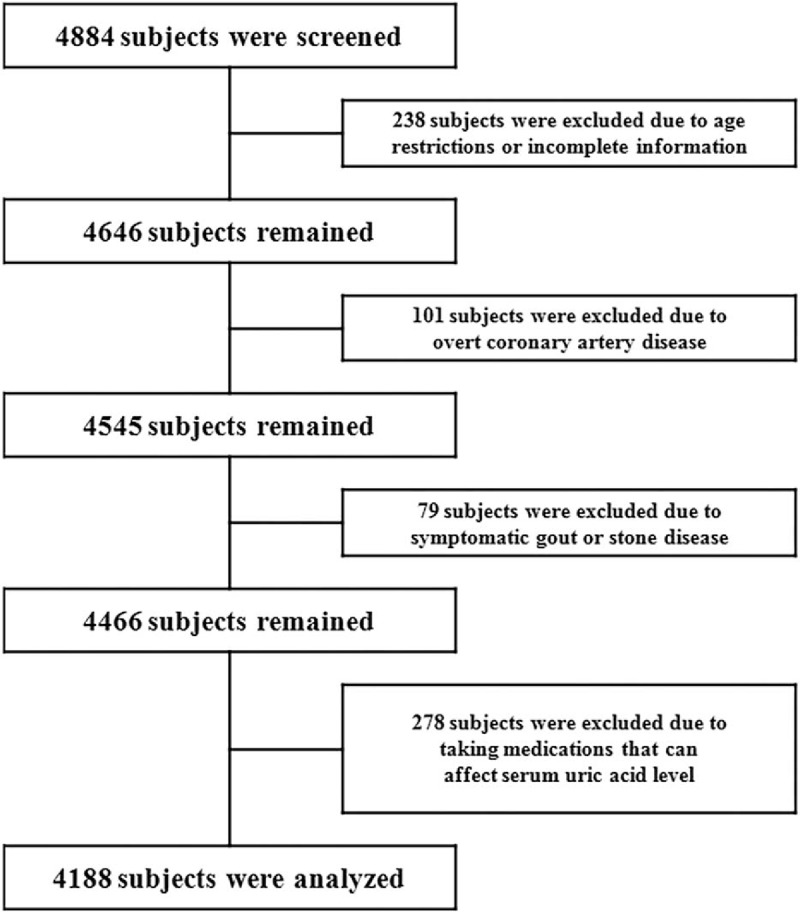
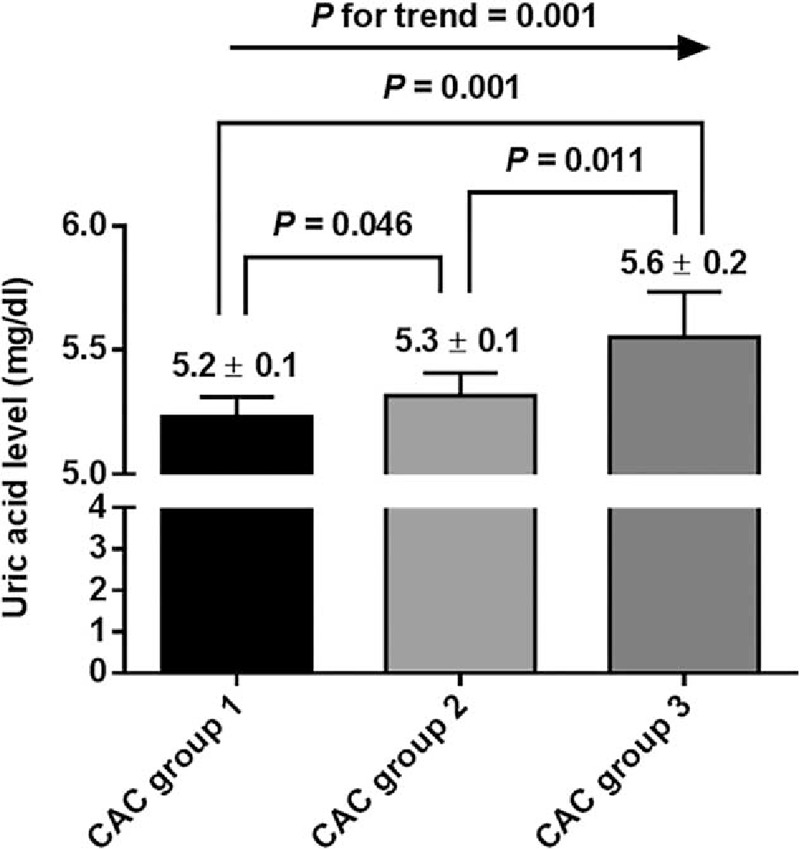
Recently, the pathogenic role of uric acid (UA) in both systemic metabolic and atherosclerotic diseases has been investigated. We sought to determine the independent correlation between serum UA levels and coronary artery calcification, as a marker of subclinical atherosclerosis. A total of 4188 individuals without prior coronary artery disease or urate-deposition disease were included. All of the participants underwent multidetector computed tomography (MDCT) for the evaluation of coronary artery calcification (CAC) during their health check-ups. The subjects were divided into thre groups according to CAC scores (group 1: 0; group 2: 1-299; group 3: ≥300). After controlling for other confounders, serum UA levels were found to be positively associated with increasing CAC scores (P = 0.001). Adjusted mean serum UA levels in each CAC group were estimated to be 5.2 ± 0.1 mg/dL, 5.3 ± 0.1 mg/dL, and 5.6 ± 0.2 mg/dL from groups 1, 2, and 3, respectively. Subsequent subgroup analyses revealed that this positive association was only significant in participants who were male, relatively older, less overweight, and did not have diabetes mellitus (DM), hypertension, smoking history, or renal dysfunction. In conclusion, serum uric acid levels were independently associated with CAC score severity and this finding is particularly relevant to the subjects who were male, relatively older, less overweight (body mass index < 25 kg/m), and without a history of DM, hypertension, smoking, or renal dysfunction.
Conflict of interest statement
The authors have no conflicts of interest to disclose.
Figures
References
-
- Bach MH, Simkin PA. Uricosuric drugs: the once and future therapy for hyperuricemia? Curr Opin Rheumatol 2014;26:169–75. - PubMed
-
- Phelps P, Steele AD, McCarty DJ., Jr Compensated polarized light microscopy. Identification of crystals in synovial fluids from gout and pseudogout. JAMA 1968;203:508–12. - PubMed
Publication types
MeSH terms
Substances
LinkOut - more resources
Full Text Sources
Other Literature Sources
Medical
