


Risk analysis of use of different classes of antidepressants on subsequent dementia: A nationwide cohort study in Taiwan
- PMID: 28384235
- PMCID: PMC5383251
- DOI: 10.1371/journal.pone.0175187
Risk analysis of use of different classes of antidepressants on subsequent dementia: A nationwide cohort study in Taiwan
Abstract
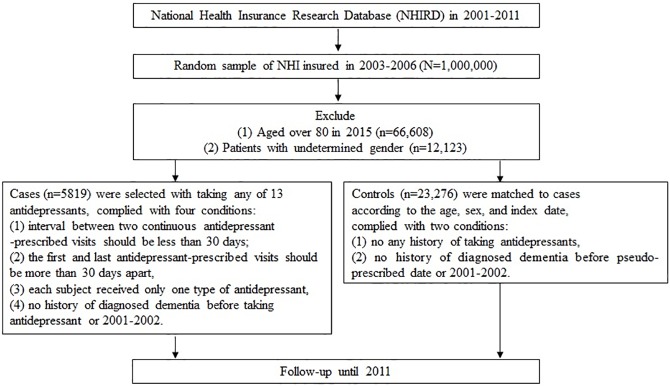
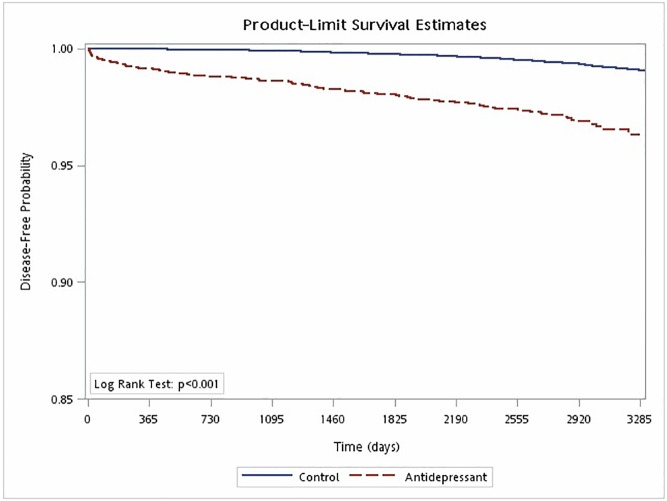
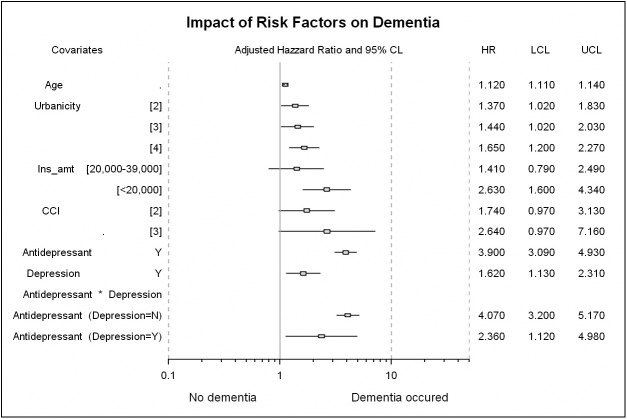
Depression and dementia are common mental health problems and are associated in several ways. Early-life depression is associated with increased risk of later life dementia, and depression can present as a preclinical symptom or consequence of dementia. Despite the plausible relationship between these two clinical entities, the potential association between antidepressant medication and dementia has rarely been investigated. We conducted a 9-year retrospective analysis of Taiwan's National Health Insurance Research Database (NHIRD), enrolling 5819 cases who had received prescriptions of antidepressants between 2003 and 2006, and 23,276 (with ratio of 1:4) age, sex, and index date-matched controls. The hazard ratio (HR) of dementia among antidepressant users with depression was 2.42 (95% confidence interval (CI): 1.15-5.10), for those without depression was 4.05 (95% CI: 3.19-5.15), compared to antidepressant non-users respectively. Among the 6 classes of common antidepressants used in Taiwan, the adjusted HRs were 3.66 (95% CI: 2.62-5.09) for SSRIs, 4.73 (95% CI: 2.54-8.80) for SNRI, 3.26 (95% CI: 2.30-4.63) for TCAs, 6.62 (95% CI: 3.34-13.13) for TeCA, 4.94 (95% CI: 2.17-11.24) for MAOI, and 4.48 (95% CI: 3.13-6.40) for SARI. Furthermore, the multivariate analysis result showed that the adjusted HRs of cumulative defined daily doses (cDDDs) were 3.74 (95% CI: 2.91-4.82), 3.73 (95% CI: 2.39-5.80) and 5.22 (95% CI: 3.35-8.14) for those who had cDDDs of <90, 90-180 and >180 compared to those who had taken no antidepressant medication. This is a retrospective study based on secondary data, hence, we could not claim causality between antidepressant medication and dementia. However, a potential association between antidepressant and occurrence of dementia after controlling for the status of depression was observed. Lack of patients' data about smoking status and body mass index in NHIRD, which are considered related to dementia, was also a limitation in this study. In this study, we concluded that antidepressant medication is a potential risk factor for dementia, independent from any effect of depression itself.
Conflict of interest statement
Figures
References
-
- MacQueen GM, Memedovich KA. Cognitive dysfunction in major depression and bipolar disorder: Assessment and treatment options. Psychiatry and clinical neurosciences. 2017;71(1):18–27. doi: 10.1111/pcn.12463 - DOI - PubMed
-
- Chen R, Wei L, Hu Z, Qin X, Copeland JR, Hemingway H. Depression in older people in rural China. Archives of internal medicine. 2005;165(17):2019–25. doi: 10.1001/archinte.165.17.2019 - DOI - PubMed
-
- Chong MY, Tsang HY, Chen CS, Tang TC, Chen CC, Yeh TL, et al. Community study of depression in old age in Taiwan: prevalence, life events and socio-demographic correlates. The British journal of psychiatry: the journal of mental science. 2001;178(1):29–35. - PubMed
-
- da Silva J, Goncalves-Pereira M, Xavier M, Mukaetova-Ladinska EB. Affective disorders and risk of developing dementia: systematic review. The British journal of psychiatry: the journal of mental science. 2013;202(3):177–86. - PubMed
MeSH terms
Substances
LinkOut - more resources
Full Text Sources
Other Literature Sources
Medical
