


Studies on sand fly fauna and ecological analysis of Phlebotomus orientalis in the highland and lowland foci of kala-azar in northwestern Ethiopia
- PMID: 28384307
- PMCID: PMC5383282
- DOI: 10.1371/journal.pone.0175308
Studies on sand fly fauna and ecological analysis of Phlebotomus orientalis in the highland and lowland foci of kala-azar in northwestern Ethiopia
Abstract
Background: Visceral leishmaniasis (VL) also known as kala-azar is a growing health problem in Ethiopia with an estimated annual VL incidence between 3700 and 7400. The disease is mainly endemic in northwestern parts of the country. The aim of the current study was to determine the sand fly fauna and ecology of Phlebotomus orientalis in two endemic and ecologically distinct areas of northwestern Ethiopia.
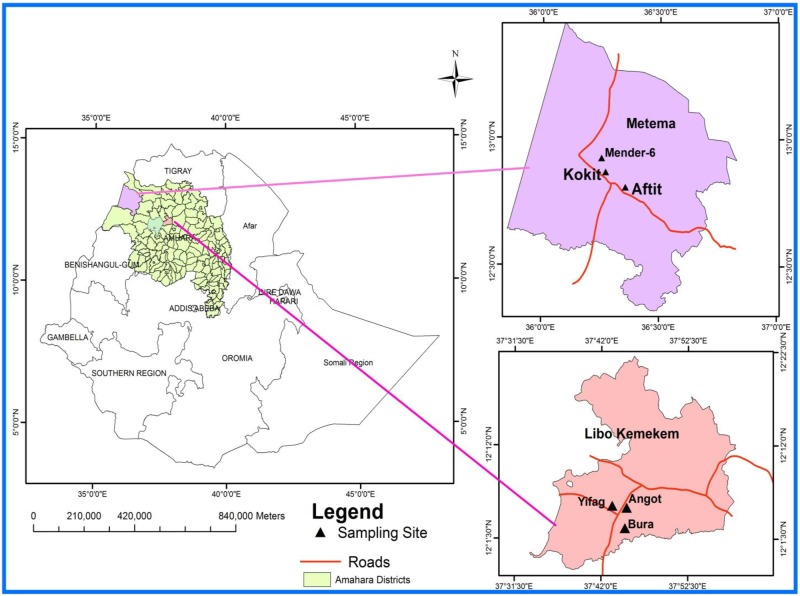
Methods: Sand flies were collected using CDC light traps, sticky traps and pyrethrum spray catches from peri-domestic, mixed forest, farm field and indoor habitats from both Libo-Kemkem (May 2011-April 2012) and Metema (October 2012-September 2013) districts.
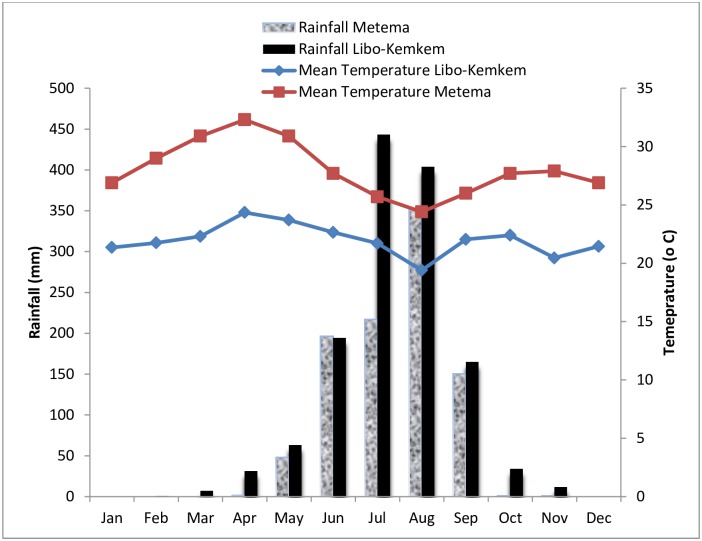
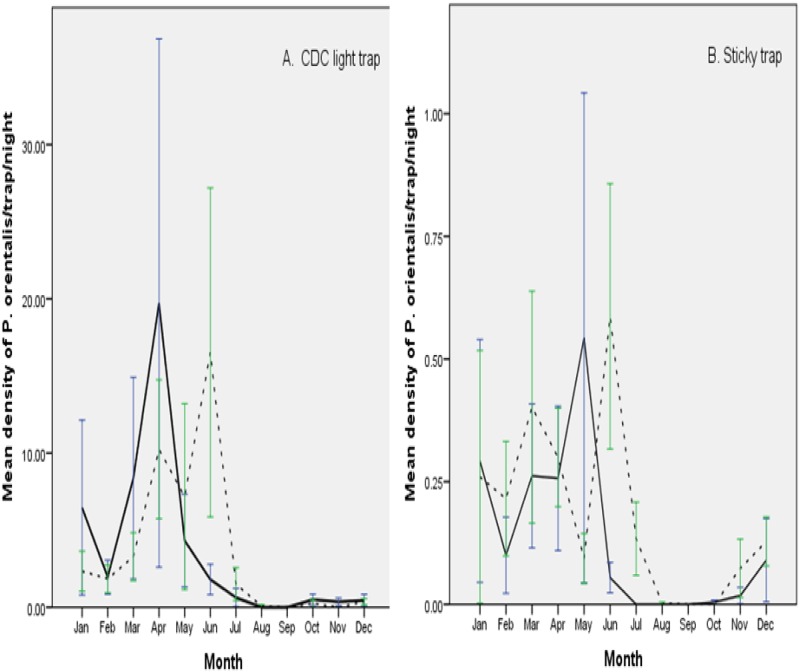
Results: A total of 51,411 sand fly specimens were collected and identified (10,776 from highland and 40, 635 from the lowland areas). Seven species were found in the highland area: two Phlebotomus spp. (P. orientalis and P. rodhaini) and five Sergentomyia species. Whereas 19 species were found in the lowland area: six Phlebotomus (P. orientalis, P. rodhaini, P. bergeroti, P. duboscqi, P. papatasi and P. martini) and 13 Sergentomyia species. Of the Phlebotomus spp., P. orientalis was the predominant species in both the highland (99.9%) and lowland (93.7%) areas. Indoor collections using pyrethrum spray catches and sticky traps indicated that P. orientalis has a strong exophilic and exophagic behaviors in both districts. In both areas, this species showed seasonal occurrence and showing abundance during the dry months (March-May/June) of the year and increasing in numbers till the rain season, when numbers dropped dramatically. Mean density of P. orientalis in the two areas had positive and significant correlation with mean temperature in light trap collections (P<0.05). However, mean density of P. orientalis in the two areas in sticky trap collections had positive and insignificant association with the temperature (P>0.05). Regarding the rainfall pattern, density of P. orientalis had negative and statistically insignificant correlation (for light trap collections for both areas) and significant correlation (for sticky trap collections for lowland area).
Conclusions: The current study indicated the variation in sand fly fauna between the highland and lowland districts, wherein, P. orientalis was found to be the most abundant Phlebotomus species. The study also determined that P. orientalis exhibits distinct seasonality, where its abundance increases during the dry season and disappears when the rainy period starts in both study areas. This entomological observation on the bionomics of P. orientalis provides significant evidence for considering vector control or preventive measures in the areas studied.
Conflict of interest statement
Figures
References
-
- Hailu A, Gebre-Michael T, Berhe N, Balkew M. Leishmaniasis in Ethiopia In: Berhane Y, Haile-Mariam D, Kloos H, editors. The Ecology and Epidemiology of Health and Disease in Ethiopia. 1st ed Addis Ababa: Sharma Books; 2006. pp. 615–34.
-
- Alvar J, Bashaye S, Argaw D, Cruz I, Aparicio P, Kassa A, et al. Kala-azar outbreak in Libo-Kemkem: Epidemiologic and parasitologic assessment. Am J Trop Med Hyg. 2007; 77: 275–282. - PubMed
-
- Bashaye S, Nombela N, Argaw D, Mulugeta A, Herrero M, Nieto J, et al. Risk factors for visceral leishmaniasis in a new epidemic site in Amhara Region, Ethiopia. Am J Trop Med Hyg. 2009; 81:34–39. - PubMed
MeSH terms
LinkOut - more resources
Full Text Sources
Other Literature Sources
Miscellaneous
