


Effect of serial pig passages on the adaptation of an avian H9N2 influenza virus to swine
- PMID: 28384328
- PMCID: PMC5383288
- DOI: 10.1371/journal.pone.0175267
Effect of serial pig passages on the adaptation of an avian H9N2 influenza virus to swine
Abstract
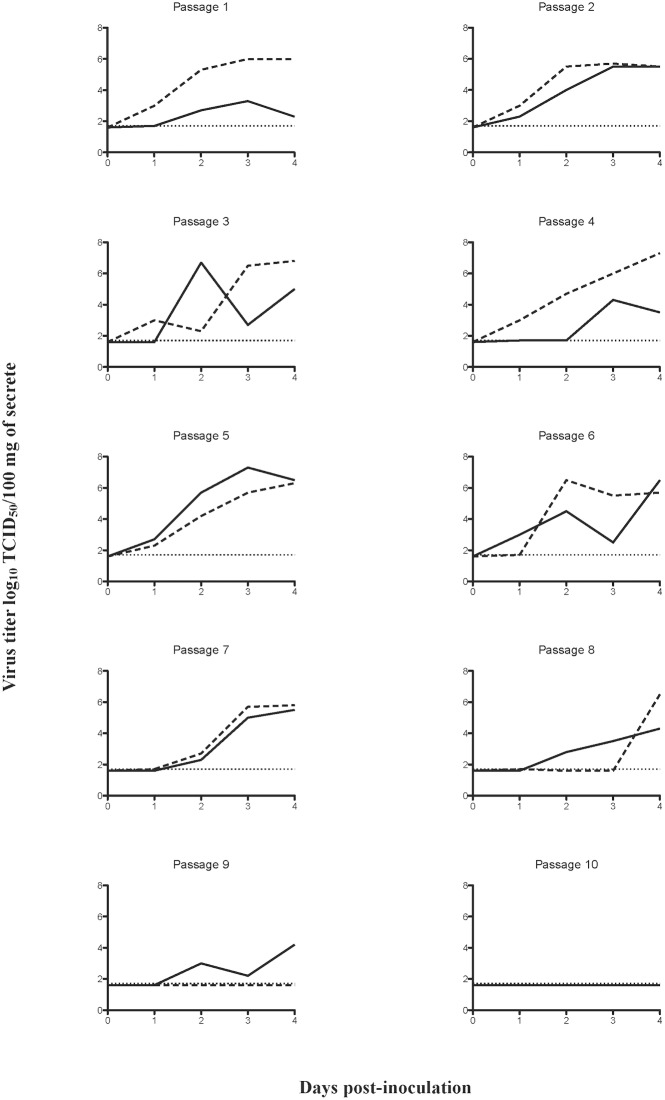
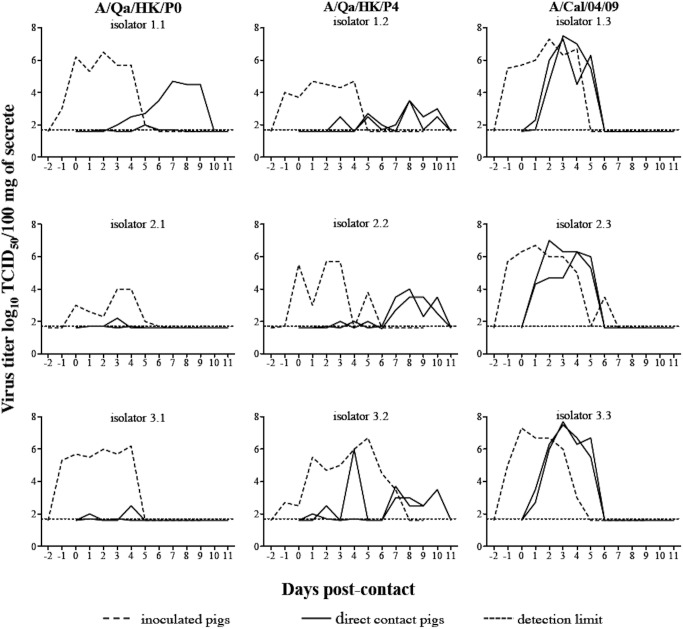
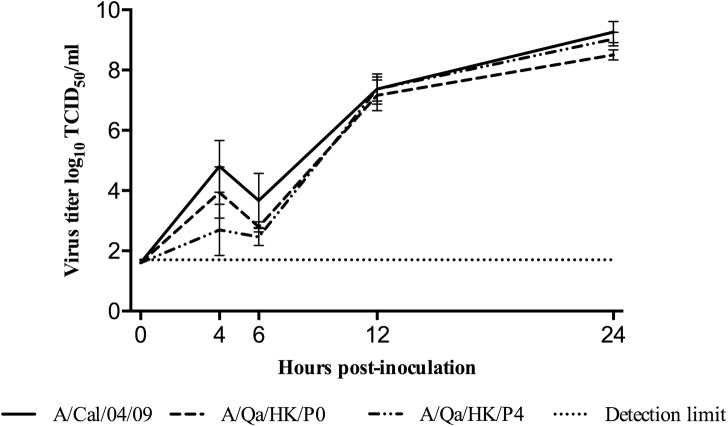
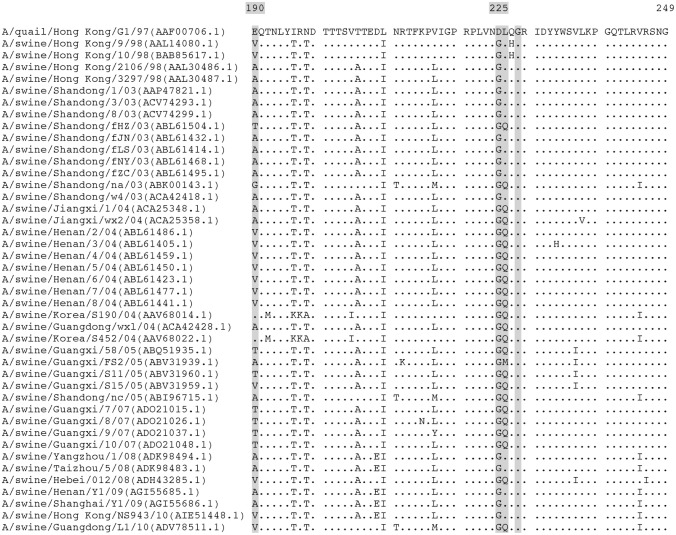
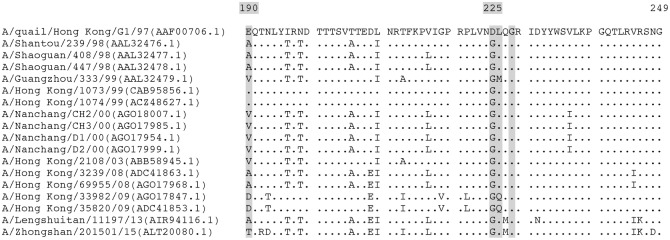
H9N2 avian influenza viruses are endemic in poultry in Asia and the Middle East. These viruses sporadically cause dead-end infections in pigs and humans raising concerns about their potential to adapt to mammals or reassort with human or swine influenza viruses. We performed ten serial passages with an avian H9N2 virus (A/quail/Hong Kong/G1/1997) in influenza naïve pigs to assess the potential of this virus to adapt to swine. Virus replication in the entire respiratory tract and nasal virus excretion were examined after each passage and we deep sequenced viral genomic RNA of the parental and passage four H9N2 virus isolated from the nasal mucosa and lung. The parental H9N2 virus caused a productive infection in pigs with a predominant tropism for the nasal mucosa, whereas only 50% lung samples were virus-positive. In contrast, inoculation of pigs with passage four virus resulted in viral replication in the entire respiratory tract. Subsequent passages were associated with reduced virus replication in the lungs and infectious virus was no longer detectable in the upper and lower respiratory tract of inoculated pigs at passage ten. The broader tissue tropism after four passages was associated with an amino acid residue substitution at position 225, within the receptor-binding site of the hemagglutinin. We also compared the parental H9N2, passage four H9N2 and the 2009 pandemic H1N1 (pH1N1) virus in a direct contact transmission experiment. Whereas only one out of six contact pigs showed nasal virus excretion of the wild-type H9N2 for more than four days, all six contact animals shed the passage four H9N2 virus. Nevertheless, the amount of excreted virus was significantly lower when compared to that of the pH1N1, which readily transmitted and replicated in all six contact animals. Our data demonstrate that serial passaging of H9N2 virus in pigs enhances its replication and transmissibility. However, full adaptation of an avian H9N2 virus to pigs likely requires an extensive set of mutations.
Conflict of interest statement
Figures
References
-
- Sun Y, Pu J, Jiang Z, Guan T, Xia Y, Xu Q, et al. Genotypic evolution and antigenic drift of H9N2 influenza viruses in China from 1994 to 2008. Vet Microbiol. 2010;146(3–4):215–25. doi: 10.1016/j.vetmic.2010.05.010 - DOI - PubMed
-
- Guo YJ, Krauss S, Senne DA, Mo IP, Lo KS, Xiong XP, et al. Characterization of the pathogenicity of members of the newly established H9N2 influenza virus lineages in Asia. Virology. 2000;267(2):279–88. doi: 10.1006/viro.1999.0115 - DOI - PubMed
-
- Slomka MJ, Hanna A, Mahmood S, Govil J, Krill D, Manvell RJ, et al. Phylogenetic and molecular characteristics of Eurasian H9 avian influenza viruses and their detection by two different H9-specific RealTime reverse transcriptase polymerase chain reaction tests. Vet Microbiol. 2013;162(2–4):530–42. doi: 10.1016/j.vetmic.2012.11.013 - DOI - PubMed
-
- Peiris M, Yuen KY, Leung CW, Chan KH, Ip PL, Lai RW, et al. Human infection with influenza H9N2. Lancet. 1999;354(9182):916–7. - PubMed
-
- Lin YP, Shaw M, Gregory V, Cameron K, Lim W, Klimov A, et al. Avian-to-human transmission of H9N2 subtype influenza A viruses: relationship between H9N2 and H5N1 human isolates. Proc Natl Acad Sci U S A. 2000;97(17):9654–8. doi: 10.1073/pnas.160270697 - DOI - PMC - PubMed
MeSH terms
LinkOut - more resources
Full Text Sources
Other Literature Sources
