Vocalization Rate and Consonant Production in Toddlers at High and Low Risk for Autism
- PMID: 28384664
- PMCID: PMC5548082
- DOI: 10.1044/2016_JSLHR-S-15-0400
Vocalization Rate and Consonant Production in Toddlers at High and Low Risk for Autism
Abstract
Background: Previous work has documented lower vocalization rate and consonant acquisition delays in toddlers with autism spectrum disorder (ASD). We investigated differences in these variables at 12, 18, and 24 months in toddlers at high and low risk for ASD.
Method: Vocalization rate and number of different consonants were obtained from speech samples from a prospective study of infant siblings of children with ASD. Three groups were compared: 18 toddlers at low risk for ASD (low-risk control), 18 high-risk siblings without ASD (HRA-), and 10 high-risk siblings with ASD (HRA+).
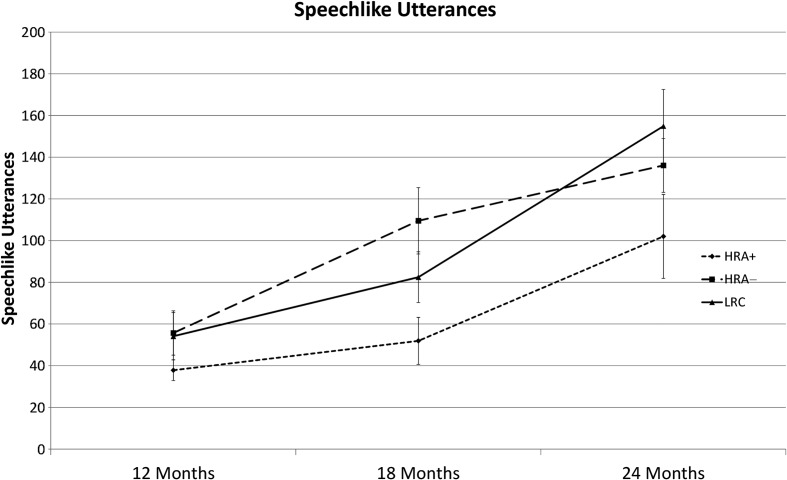
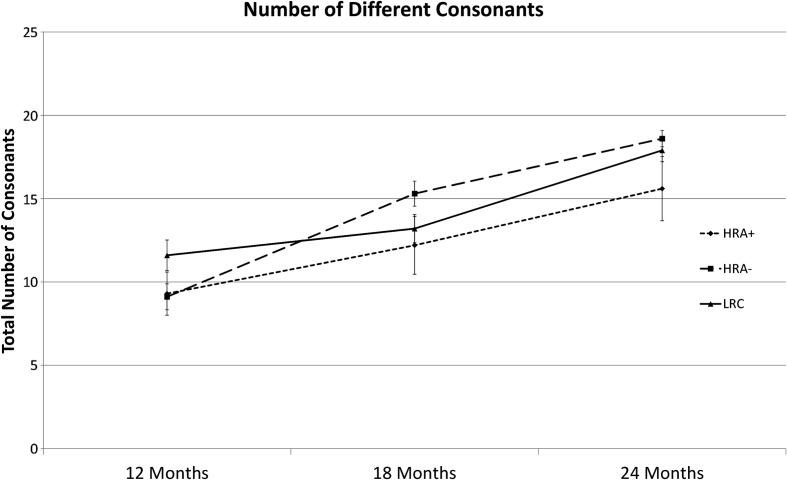
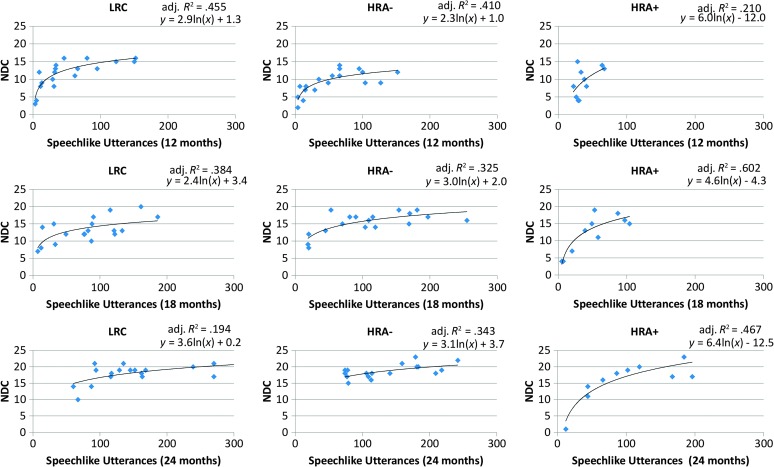
Results: All groups' mean language scores were within the normal range. HRA+ toddlers showed consistently lower vocalization rate; vocalization rate did not predict number of different consonants at 12 months for HRA+. HRA-, not HRA+, toddlers had the smallest number of different consonants and produced significantly fewer different consonants than predicted by their vocalization rate at 12 months. Consonant-acquisition trajectories differed between groups, with HRA- showing the greatest increase from 12 to 18 months.
Conclusion: Lower vocalization rate was not associated with reduced number of different consonants in these toddlers. Between-groups differences in developmental trajectories are discussed in the context of the social feedback loop and differential ability to benefit from adult feedback between groups.
Figures
References
-
- American Psychiatric Association. (2013). Diagnostic and Statistical Manual of Mental Disorders (5th ed.). Washington, DC: Author.
-
- Bleile K. (2003). Manual of articulation and phonological disorders: Infancy through adulthood (2nd ed.). Clifton Park, NY: Delmar Learning.
-
- Bleile K., Stark R., & Silverman McGowan J. (1993). Speech development in a child after decannulation: Further evidence that babbling facilitates later speech development. Clinical Linguistics & Phonetics, 7, 319–337.
-
- Boucher J. (2012). Research review: Structural language in autistic spectrum disorder – characteristics and causes. Journal of Child Psychology and Psychiatry, 53, 219–233. - PubMed
-
- Bryson S., Zwaigenbaum L., McDermott C., Rombough C., & Brian J. (2007). The autism observation scale for infants: Scale development and reliability data. Journal of Autism and Developmental Disorders, 38, 731–738. - PubMed
Publication types
MeSH terms
Grants and funding
LinkOut - more resources
Full Text Sources
Other Literature Sources
Medical