


Association of Household Income Level and In-Hospital Mortality in Patients With Sepsis: A Nationwide Retrospective Cohort Analysis
- PMID: 28385107
- PMCID: PMC5680141
- DOI: 10.1177/0885066617703338
Association of Household Income Level and In-Hospital Mortality in Patients With Sepsis: A Nationwide Retrospective Cohort Analysis
Abstract
Objective: Associations between low socioeconomic status (SES) and poor health outcomes have been demonstrated in a variety of conditions. However, the relationship in patients with sepsis is not well described. We investigated the association of lower household income with in-hospital mortality in patients with sepsis across the United States.
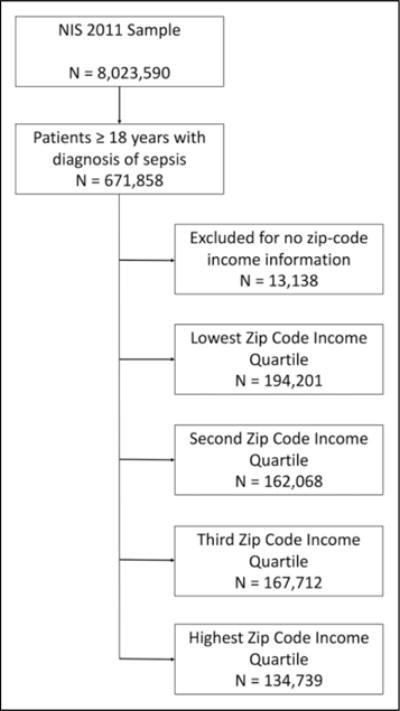
Methods: Retrospective nationwide cohort analysis utilizing the Nationwide Inpatient Sample (NIS) from 2011. Patients aged 18 years or older with sepsis were included. Socioeconomic status was approximated by the median household income of the zip code in which the patient resided. Multivariate logistic modeling incorporating a validated illness severity score for sepsis in administrative data was performed.
Results: A total of 8 023 590 admissions from the 2011 NIS were examined. A total of 671 858 patients with sepsis were included in the analysis. The lowest income residents compared to the highest were younger (66.9 years, standard deviation [SD] = 16.5 vs 71.4 years, SD = 16.1, P < .01), more likely to be female (53.5% vs 51.9%, P < .01), less likely to be white (54.6% vs 76.6%, P < .01), as well as less likely to have health insurance coverage (92.8% vs 95.9%, P < .01). After controlling for severity of sepsis, residing in the lowest income quartile compared to the highest quartile was associated with a higher risk of mortality (odds ratio [OR]: 1.06, 95% confidence interval [CI]: 1.03-1.08, P < .01). There was no association seen between the second (OR: 1.02, 95% CI: 0.99-1.05, P = .14) and third (OR: 0.99, 95% CI: 0.97-1.01, P = .40) quartiles compared to the highest.
Conclusion: After adjustment for severity of illness, patients with sepsis who live in the lowest median income quartile had a higher risk of mortality compared to residents of the highest income quartile. The association between SES and mortality in sepsis warrants further investigation with more comprehensive measures of SES.
Keywords: epidemiology; hospital mortality; outcomes; sepsis.
Conflict of interest statement
The author(s) declared the following potential conflicts of interest with respect to the research, authorship, and/or publication of this article. Dr Russell reports patents owned by the University of British Columbia (UBC) that are related to PCSK9 inhibitor(s) and sepsis and related to the use of vasopressin in septic shock. Dr Russell is an inventor on these patents. Dr Russell is a founder, Director and shareholder in Cyon Therapeutics Inc (developing a sepsis therapy). Dr Russell has share options in Leading Biosciences Inc. Dr Russell is a shareholder in Molecular You Corp. Dr Walley reports patents owned by the University of British Columbia (UBC) that are related to PCSK9 inhibitor(s) and sepsis and related to the use of vasopressin in septic shock. Dr Walley is an inventor on these patents. Dr Walley is a founder, Director and shareholder in Cyon Therapeutics Inc (developing a sepsis therapy). Dr Boyd reports patents owned by the University of British Columbia (UBC) that are related to PCSK9 inhibitor(s) and sepsis and related to the use of vasopressin in septic shock. Dr Boyd is an inventor on these patents. Dr Boyd is a founder, Director and shareholder in Cyon Therapeutics Inc (developing a sepsis therapy).
References
-
- Alter DA, Naylor CD, Austin P, Tu JV. Effects of socioeconomic status on access to invasive cardiac procedures and on mortality after acute myocardial infarction. N Engl J Med. 1999;341(18):1359–1367. - PubMed
-
- Kapral MK, Wang H, Mamdani M, Tu JV. Mortality after stroke. Stroke. 2002;33(1):268–275. - PubMed
-
- Anderson GM, Grumbach K, Luft HS, Roos LL, Mustard C, Brook R. Use of coronary artery bypass surgery in the United States and Canada. Influence of age and income. JAMA. 1993;269(13):1661–1666. - PubMed
-
- Katz S. Hospital utilization in Ontario and the United States: the impact of socioeconomic status and health status. Can J Public Heal. 1996;87(4):253–256. - PubMed
MeSH terms
Grants and funding
LinkOut - more resources
Full Text Sources
Other Literature Sources
Medical
