Review
. 2017 Apr;92(4):642-662.
doi: 10.1016/j.mayocp.2017.01.015.

Precision Cardiovascular Medicine: State of Genetic Testing

Affiliations
Review

Precision Cardiovascular Medicine: State of Genetic Testing

John R Giudicessi et al. Mayo Clin Proc. 2017 Apr.

Abstract

In the 15 years following the release of the first complete human genome sequences, our understanding of rare and common genetic variation as determinants of cardiovascular disease susceptibility, prognosis, and therapeutic response has grown exponentially. As such, the use of genomics to enhance the care of patients with cardiovascular diseases has garnered increased attention from clinicians, researchers, and regulatory agencies eager to realize the promise of precision genomic medicine. However, owing to a large burden of "complex" common diseases, emphasis on evidence-based practice, and a degree of unfamiliarity/discomfort with the language of genomic medicine, the development and implementation of genomics-guided approaches designed to further individualize the clinical management of a variety of cardiovascular disorders remains a challenge. In this review, we detail a practical approach to genetic testing initiation and interpretation as well as review the current state of cardiovascular genetic and pharmacogenomic testing in the context of relevant society and regulatory agency recommendations/guidelines.


Figures

Figure 1 |
Figure 1 |
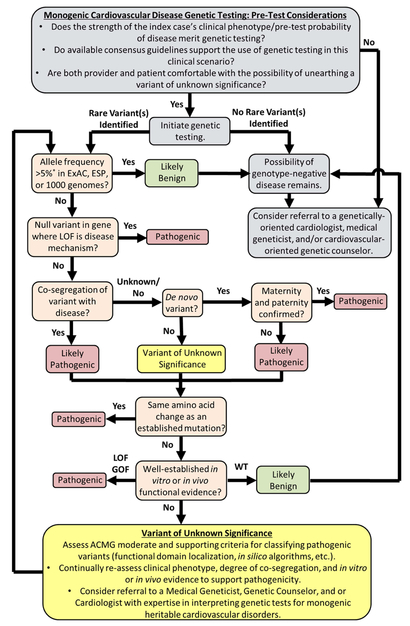
A rational approach to genetic test initiation, rare variant interpretation, and the fluid re-assessment of variants of unknown/uncertain significance. Gray boxes denote basic considerations pertaining to the initiation of genetic testing. Beige boxes denote key steps in the classification of rare genetic variation based on widely acceptable American College of Medical Genetics criteria. Yellow boxes denote basic considerations pertaining to the identification of a rare variant of unknown/uncertain significance that currently lacks sufficient evidence to either up or down grade its probability of pathogenicity. *Allele frequency > 5% or greater than widely accepted estimates of disease prevalence in the Exome Aggregation Consortium, Exome Sequencing Project, or 1000 genomes serve as stand-alone or strong evidence of pathogenicity, respectively. ACMG = American College of Medical Genetics; ESP = Exome Sequencing Project; ExAC = Exome Aggregation Consortium; GOF = gain-of-function; LOF = loss-of-function; VUS = variant of unknown/uncertain significance; WT = wild-type.
Figure 2 |
Figure 2 |
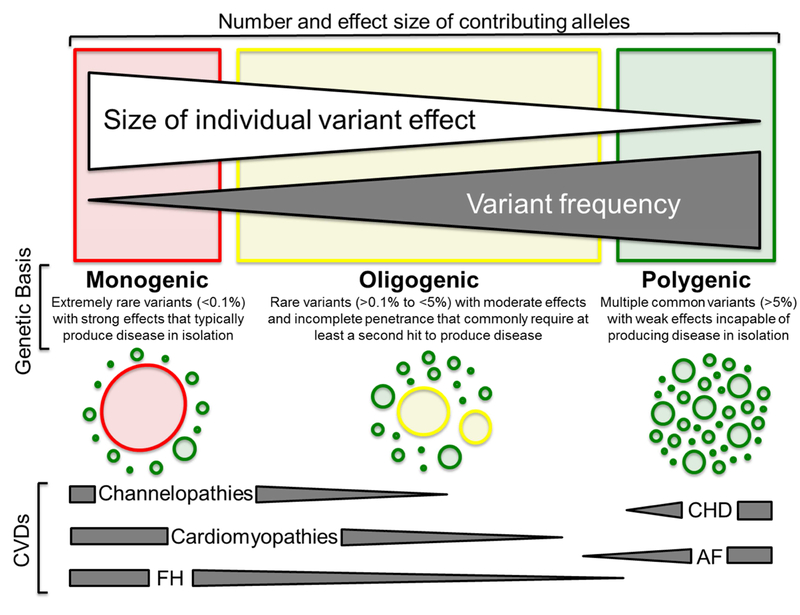
The spectrum of genetic variation underlying the heritable component of commonly encountered cardiovascular disorders (CVDs). At the severe (red) end of the spectrum are extremely rare disease-causative mutations with strong effects on gene function that typically result in monogenic disorders such as long QT syndrome, hypertrophic cardiomyopathy, and familial hypercholesterolemia. In the middle of the spectrum (yellow) are rare variants with moderate effects on gene function that rarely produce disease in isolation, but in the presence of one or more second hits result in disease as seen in some instances of arrhythmogenic cardiomyopathy. Lastly, at the benign (green) end of the spectrum are common variants with weak effects on gene function that are incapable of producing disease in isolation, but may confer disease risk when multiple risk-associated common variants are present within the genome of an individual with environmental risk factors for disorders such as coronary heart disease and atrial fibrillation. In recognition that the genetic basis of most heritable CVDs is variable, dark gray triangles denote the spectrum of genetic variation underlying each CVD or class of CVDs. ACM = arrhythmogenic cardiomyopathy; AF = atrial fibrillation; CHD = coronary heart disease; CVD = cardiovascular disease; FH = familial hypercholesterolemia; HCM = hypertrophic cardiomyopathy; LQTS = long QT syndrome. Adapted from Giudicessi, J.R., and Ackerman, M.J. Determinants of incomplete penetrance and variable expressivity in heritable cardiac arrhythmia syndromes. Translational Research 161(1), 1–14 (2013) with permission from Elsevier.
Figure 3 |
Figure 3 |
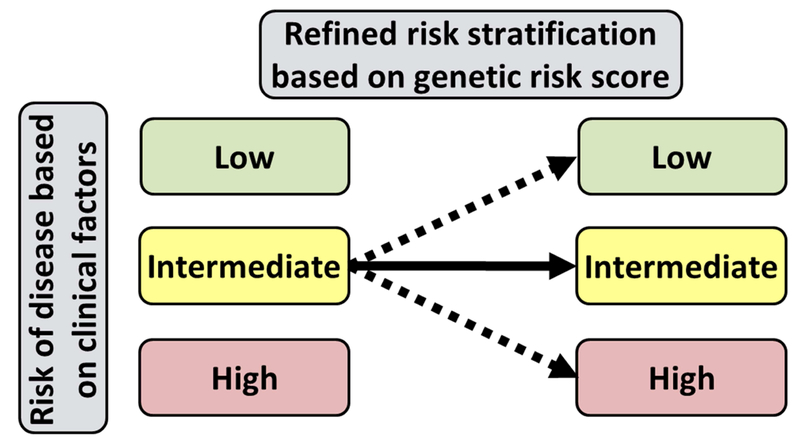
Refinement of clinical disease risk estimates with the use of genetic risk scores (GRS). Generalized schematic displaying how the use of an aggregate GRS can be used to refine the risk assessment in individuals at intermediate risk for disease based on clinical risk factors leading to earlier identification of individuals at increased risk of developing disease. GRS = genetic risk score.

References

    1. Loeys BL, Schwarze U, Holm T, et al. Aneurysm Syndromes Caused By Mutations In The Tgf-Beta Receptor. NEngl JMed 2006;355(8):788–798. - PubMed
    1. Paterick TE, Humphries JA, Ammar KA, et al. Aortopathies: Etiologies, Genetics, Differential Diagnosis, Prognosis And Management. Am J Med 2013;126(8):670–678. - PubMed
    1. Watkins H, Ashrafian H, Redwood C. Inherited Cardiomyopathies. The New England journal of medicine. 2011;364(17):1643–1656. - PubMed
    1. Gersh BJ, Maron BJ, Bonow RO, et al. 2011 Accf/Aha Guideline For The Diagnosis And Treatment Of Hypertrophic Cardiomyopathy: Executive Summary: A Report Of The American College Of Cardiology Foundation/American Heart Association Task Force On Practice Guidelines. J Am Coll Cardiol 2011;58(25):2703–2738. - PubMed
    1. Giudicessi JR, Ackerman MJ. Genetic Testing In Heritable Cardiac Arrhythmia Syndromes: Differentiating Pathogenic Mutations From Background Genetic Noise. Curr Opin Cardiol 2013;28(1):63–71. - PMC - PubMed

Publication types

MeSH terms

Substances