Review
doi: 10.1503/cmaj.160771.
Principles of diagnosis and management of neuroendocrine tumours
Affiliations
- PMID: 28385820
- PMCID: PMC5359105
- DOI: 10.1503/cmaj.160771
Item in Clipboard
Review
Principles of diagnosis and management of neuroendocrine tumours
CMAJ.
.
No abstract available
Figures
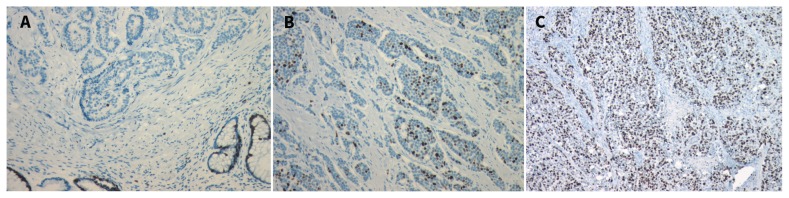
Pathology specimens of tissue from a neuroendicrine tumour with staining for Ki67 (a nuclear protein involved with cell proliferation). MIB-1 is an immunoglobulin G (IgG) antibody directed against Ki67 that can be used to identify the percentage of cells undergoing active cell proliferation. (A) Ki67 index < 3%. (B) Ki67 index 3%–20%. (C) Ki67 index > 20%. Images provided by Dr. Corwyn Rowsell (St. Michael’s Hospital, Department of Laboratory Medicine and Pathobiology, University of Toronto, Toronto, Ont.).
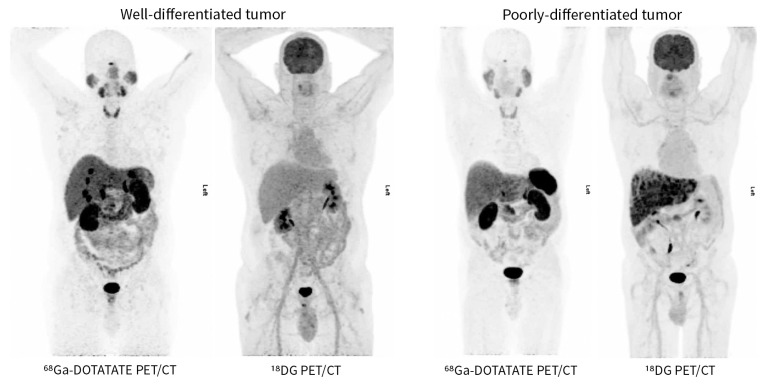
Comparison of 68Ga-DOTATATE PET/CT and 18FDG PET/CT for detection of poorly and well-differentiated neuroendocrine tumours. 68Gallium radiolabelled somatostatin analogue PET/CT is more sensitive for identifying well-differentiated tumours in which the somatostatin receptor expression is preserved on neuroendocrine cells. 18FDG PET/CT is more sensitive for identifying poorly differentiated tumours in which the somatostatin receptor expression has been lost. Please note that the comparison images are from from different patients to illustrate differences in detail by modality based on the differentiation of the tumour. Images provided by Dr. David Chan (Department of Medicine, Sunnybrook Health Sciences Centre, University of Toronto, Toronto, Ont.). FDG = fluorodeoxyglucose, PET/CT = positron emission tomography–computed tomography.
References
-
- Hallet J, Law CHL, Cukier M, et al. Exploring the rising incidence of neuroendocrine tumors: a population-based analysis of epidemiology, metastatic presentation, and outcomes. Cancer 2015;121:589–97. - PubMed
-
- Canadian Cancer Society’s Advisory Committee on Cancer Statistics. Canadian Cancer Statistics 2015. Toronto: Canadian Cancer Society; 2015.
-
- Yao JC, Hassan M, Phan A, et al. One hundred years after “carcinoid”: epidemiology of and prognostic factors for neuroendocrine tumors in 35,825 cases in the United States. J Clin Oncol 2008;26:3063–72. - PubMed
-
- Pape UF, Berndt U, Muller-Nordhorn J. Prognostic factors of long-term outcome in gastroenteropancreatic neuroendocrine tumors. Endocr Relat Cancer 2008;15: 1083–97. - PubMed
Publication types
MeSH terms
LinkOut - more resources
Full Text Sources
Other Literature Sources
Medical