. 2017 Apr 6;7(1):686.
doi: 10.1038/s41598-017-00790-9.

Salvia fruticosa Induces Vasorelaxation In Rat Isolated Thoracic Aorta: Role of the PI3K/Akt/eNOS/NO/cGMP Signaling Pathway

Affiliations

Salvia fruticosa Induces Vasorelaxation In Rat Isolated Thoracic Aorta: Role of the PI3K/Akt/eNOS/NO/cGMP Signaling Pathway

M Akhtar Anwar et al. Sci Rep. .

Abstract

Salvia fruticosa (SF) Mill. is traditionally used for its antihypertensive actions. However, little is known about its pharmacologic and molecular mechanisms of action. Here we determined the effects of an ethanolic extract of SF leaves on rings of isolated thoracic aorta from Sprague-Dawley rats. Our results show that SF extract increased nitric oxide production and relaxed endothelium-intact rings in a dose-dependent (0.3 µg/ml-1 mg/ml) manner, and the maximum arterial relaxation (Rmax) was significantly reduced with endothelium denudation. Pretreatment of endothelium-intact rings with L-NAME (a non-selective inhibitor of nitric oxide synthase, 100 µM), or ODQ (an inhibitor of soluble guanylyl cyclase, 10 µM) significantly diminished SF-mediated vasorelaxation. Furthermore, SF induced Akt phosphorylation as well as increased cGMP levels in rings treated with increasing doses of SF. Prior exposure to PI3K inhibitors, wortmannin (0.1 µM) or LY294002 (10 µM), decreased cGMP accumulation and attenuated the SF-induced vasorelaxation by approximately 50% (Rmax). SF-evoked relaxation was not affected by indomethacin, verapamil, glibenclamide, tetraethylammonium, pyrilamine or atropine. Taken together, our results indicate that SF induces endothelium-dependent vasorelaxation through the PI3K/Akt/eNOS/NO/sGC/cGMP signaling pathway. Our data illustrate the health-orientated benefits of consuming SF which may act as an antihypertensive agent to reduce the burden of cardiovascular complications.


Conflict of interest statement

The authors declare that they have no competing interests.

Figures
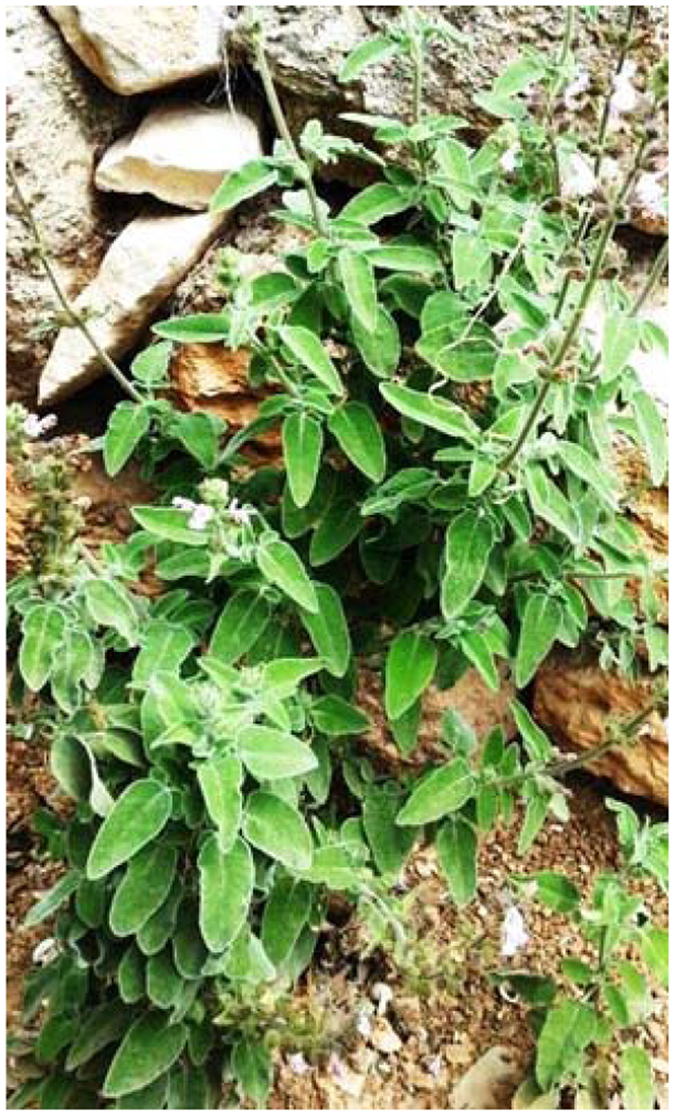
Figure 1
Figure 1
Salvia fruticosa Mill. (Sage). A photograph showing the aerial parts of SF. For medicinal uses, leaves are the most commonly consumed part of this plant.
Figure 2
Figure 2
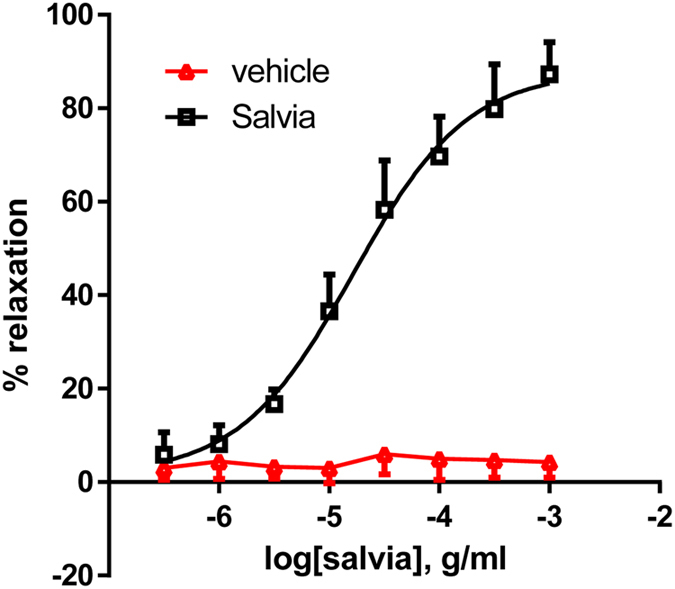
Effect of SF extract on vasorelaxation of aortic rings. Cumulative dose-dependent curves for SF-induced relaxation and of the vehicle (ethanol) in rat aortic rings. n = 7.
Figure 3
Figure 3
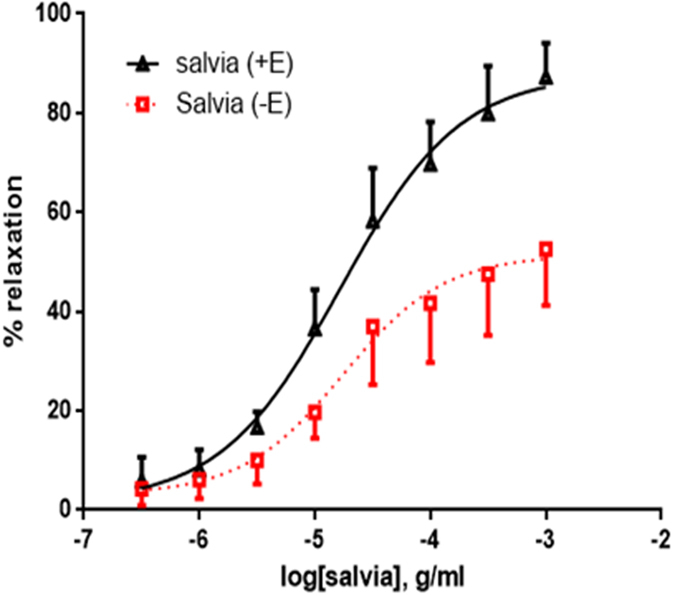
Role of endothelium in SF-induced relaxation. Cumulative dose-response curves for SF in isolated norepinephrine-precontracted rat aortic rings either with intact (+E; triangles) or denuded endothelium (−E; squares). n = 7; p < 0.01 for +E versus −E.
Figure 4
Figure 4
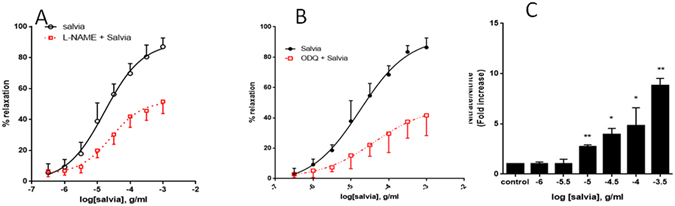
Effect of L-NAME or ODQ on SF-induced relaxation. (A) Endothelium-intact rings were incubated with cumulative doses of SF in the absence (circles) or presence of L-NAME (100 µM; squares. Data represent mean ± SEM (n = 7; p < 0.01 for Salvia versus L-Name plus Salvia). (B) Endothelium-intact rings were incubated with cumulative doses of SF in the absence (circles) or presence of ODQ (1 µM; squares). n = 7; p < 0.01 for Salvia versus ODQ plus Salvia. (C) Endothelium-intact rings were incubated with increasing doses of SF and levels of NO determined. n = 3; *denotes a p < 0.05 and **a p < 0.01 (compared to control).
Figure 5
Figure 5
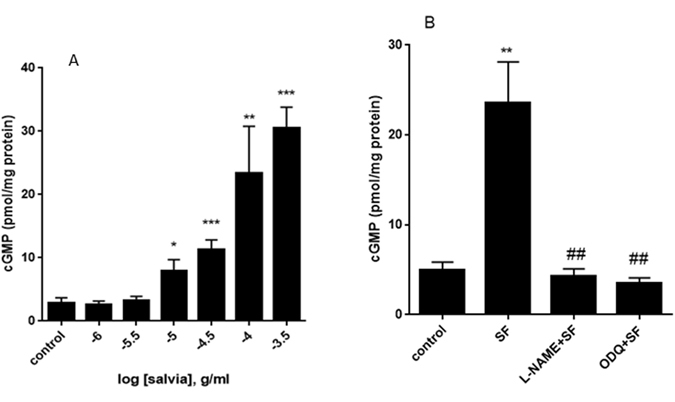
Modulation of cGMP levels by SF, L-NAME and ODQ. (A) Rings were incubated in the absence (control) or presence of increasing concentrations of SF. cGMP immunoassay followed and levels of cGMP were determined. n = 6; *denotes a p < 0.05, **a p < 0.01 and ***a p < 0.001 compared to control. (B) Rings were pretreated for 30 minutes with L-NAME (100 µM) or ODQ (1 µM) followed by SF (0.67 mg/ml) and cGMP levels determined. n = 5; **denotes a p < 0.01 compared to control; ##denotes a p < 0.01 compared to SF).
Figure 6
Figure 6
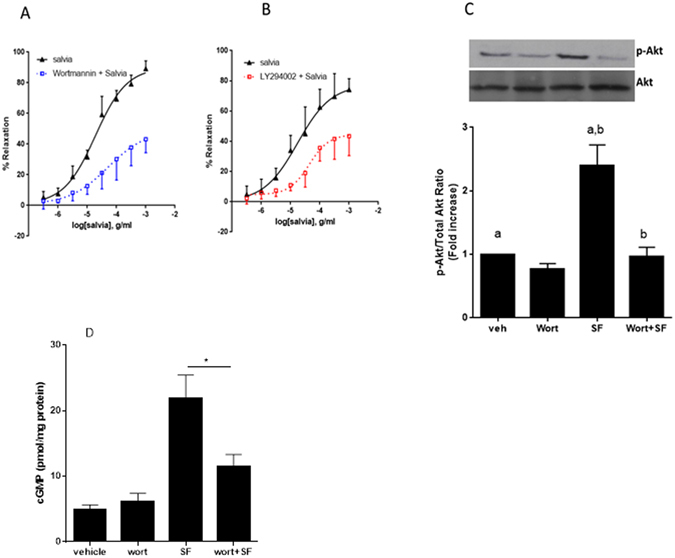
Interplay between SF and PI3K pathway. Endothelium-intact rings were incubated with cumulative doses of SF in the absence (triangles) or presence of PI3K inhibitors: (A) Wortmannin (0.1 µM; squares) or (B) LY29400 (10 µM; squares). Data represent mean ± SEM (n = 5; p < 0.01 for Salvia versus Wortmannin + Salvia or LY29400 + Salvia). (C) Modulation of Akt phosphorylation by SF. Aortic rings were incubated in either the absence (veh) or presence of wortmannin (wort) for 30 minutes. Rings were then pre-contracted with NE (3 µM) followed by treatment with SF (0.67 mg/ml) for 15 minutes. Proteins were extracted and subjected to SDS-PAGE against phosphorylated and total Akt levels. Bar graph represents normalization of the phosphorylated Akt levels to total ones. Bars with similar letters are significantly different; p < 0.05); n = 4 rings. (D) Rings were incubated with or without SF (0.67 mg/ml) after having been pre-treated without (vehicle) or with wortmannin (wort; 0.1 µM) for 30 minutes. Then, cGMP levels were determined. n = 5; *denotes a p < 0.05.
Figure 7
Figure 7
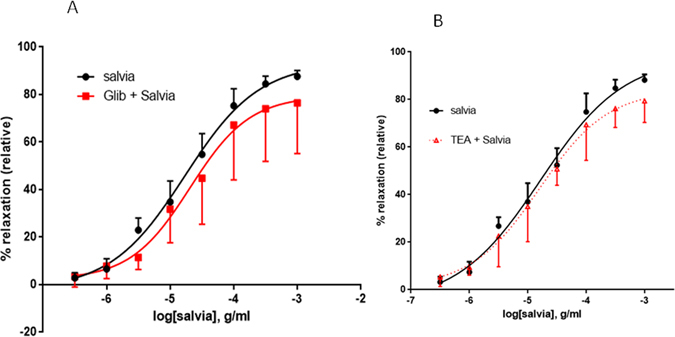
Role of potassium channels in SF-induced relaxation of aortic rings. Endothelium-intact rings were incubated with cumulative doses of SF in the absence (Salvia plus vehicle; filled circles) or presence of (A) 10 µM of Glibenclamide (Glib + Salvia; squares), or (B) Tetraethylammonium (100 µM) (TEA + Salvia; triangles). n = 6 or 5 for glibenclamide or TEA experiments, respectively. In both cases, no difference was noted between inhibitor treated and vehicle administered curves; p > 0.05 for Salvia alone versus either Glib + Salvia or Salvia + TEA.
Figure 8
Figure 8
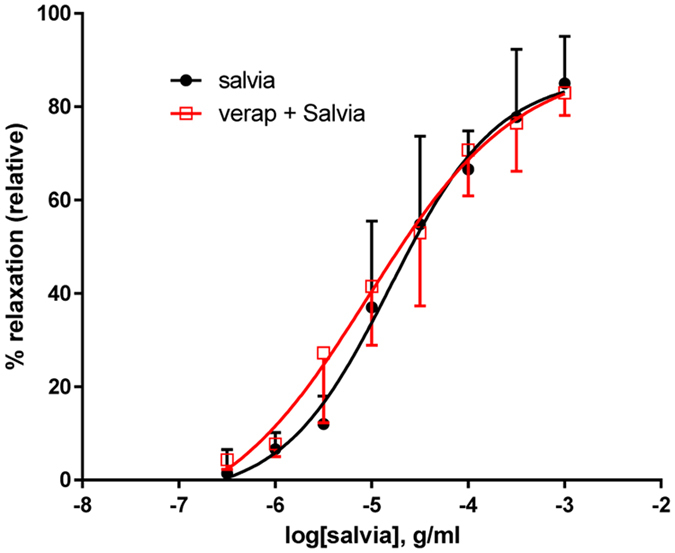
Role of Calcium Channels in SF-induced relaxation of aortic rings. Endothelium-intact rings were incubated with cumulative doses of SF in the absence (Salvia; circles) or presence of verapamil (1 µM; verap + Salvia; squares). n = 5; p > 0.05.
Figure 9
Figure 9
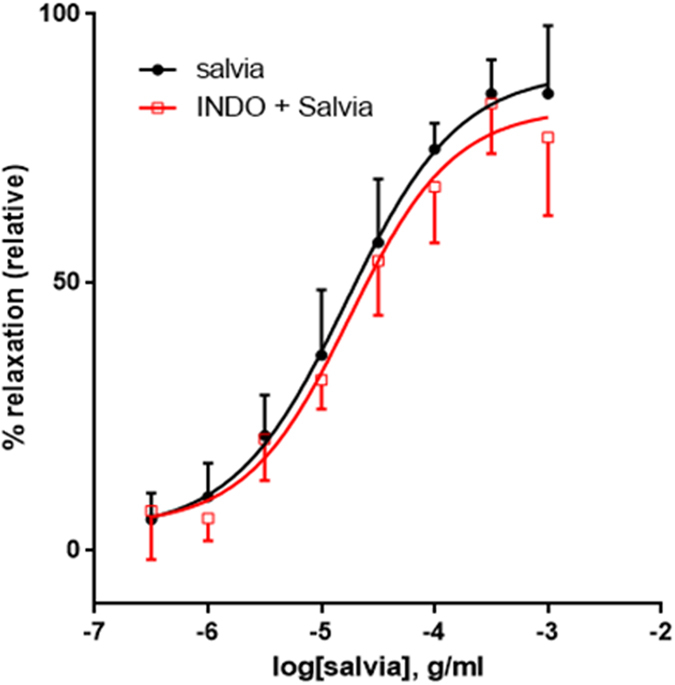
Role of cyclooxygenases in SF-induced relaxation of aortic rings. Endothelium-intact rings were incubated with cumulative doses of SF in the absence (Salvia; circles) or presence of indomethacin (10 µM; Indo + Salvia; squares). Data represent mean ± SEM (n = 5; p > 0.05).
Figure 10
Figure 10
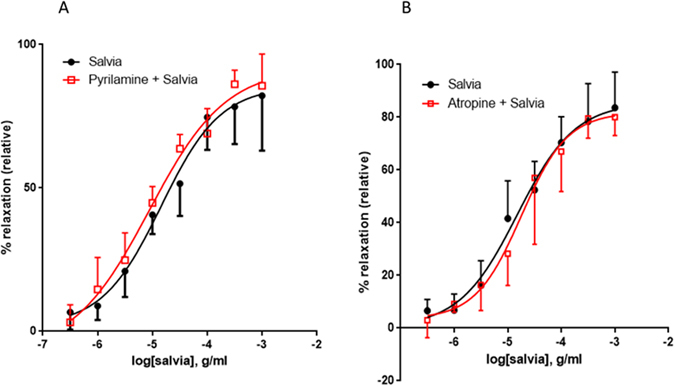
Involvement of histaminergic or muscarinic receptors in SF-induced vasorelaxation. Endothelium-intact rings were exposed to cumulative doses of SF in the absence (Salvia; circles) or presence of (A) 10 µM of pyrilamine (pyrilamine + Salvia; squares), or (B) 10 µM of atropine (atropine + Salvia; squares). Data represent mean ± SEM (n = 6 or 5 for pyrilamine or atropine experiments, respectively). p > 0.05 for Salvia alone versus either pyrilamine + Salvia or Salvia + atropine.
Figure 11
Figure 11
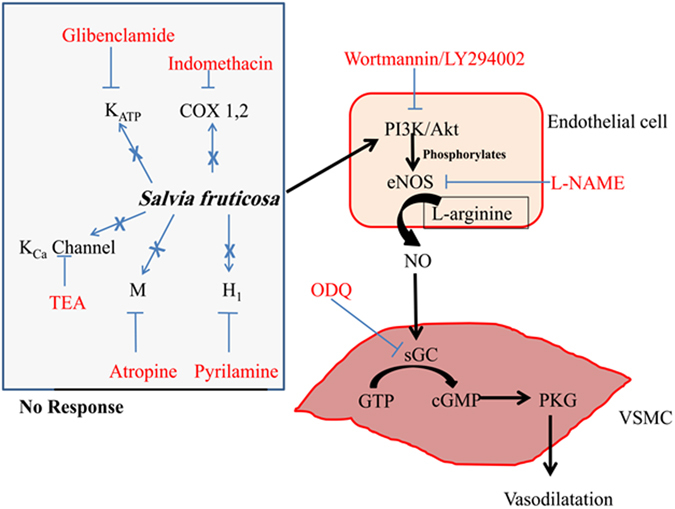
Schematic representation of the mechanism of Salvia fruticosa-induced relaxation of rat isolated aorta. The diagram displays the central role of nitric oxide, and its upstream activators and downstream effectors. Pharmacologic inhibitors are shown in red font color. Blue crosses reveal no involvement in the mechanism of SF-induced relaxation. The pathways for SF mechanism of action are drawn in black arrows.

References

    1. Laslett LJ, et al. The worldwide environment of cardiovascular disease: prevalence, diagnosis, therapy, and policy issues: a report from the American College of Cardiology. J Am Coll Cardiol. 2012;60:S1–49. doi: 10.1016/j.jacc.2012.11.002. - DOI - PubMed
    1. World Health Organization. Global status report on noncommunicable diseases 2010. http://apps.who.int/iris/handle/10665/44579 (2011).
    1. August P. Overview: mechanisms of hypertension: cells, hormones, and the kidney. J Am Soc Nephrol. 2004;15:1971–1973. doi: 10.1097/01.ASN.0000133197.23478.76. - DOI - PubMed
    1. Frishman WH, Beravol P, Carosella C. Alternative and complementary medicine for preventing and treating cardiovascular disease. Dis Mon. 2009;55:121–192. doi: 10.1016/j.disamonth.2008.12.002. - DOI - PubMed
    1. Anwar MA, Al Disi SS, Eid AH. Anti-Hypertensive Herbs and Their Mechanisms of Action: Part II. Front Pharmacol. 2016;7:50. doi: 10.3389/fphar.2016.00050. - DOI - PMC - PubMed

MeSH terms

LinkOut - more resources