. 2017 Feb 28;50(1):11-19.
doi: 10.1267/ahc.16025. Epub 2017 Feb 22.

Histological and Immunohistochemical Basis of the Effect of Aminoguanidine on Renal Changes Associated with Hemorrhagic Shock in a Rat Model

Affiliations

Histological and Immunohistochemical Basis of the Effect of Aminoguanidine on Renal Changes Associated with Hemorrhagic Shock in a Rat Model

Abdulmajeed Al Drees et al. Acta Histochem Cytochem. .

Abstract

Acute kidney failure is the main cause of death among patients with severe trauma due to massive blood loss and hemorrhagic shock (HS). Renal cell injury is caused by tissue ischemia. Renal ischemia initiates a complex and interconnected chain of events resulting in cell injury and renal cell necrosis. Nitric oxide plays a crucial role in renal function and can be inhibited by aminoguanidine (AG). We studied whether AG can ameliorate pathological renal changes associated with HS syndrome in a rat model and explored the AG protection mechanism. Rats were intraperitoneally injected with heparin sodium and mean arterial blood pressure was monitored. Animals were divided into three groups: control (without hemorrhage), with or without intra-arterially injected AG; HS (blood continuously withdrawn or reinfused to maintain an MABP of 35-40 mmHg); and HS with AG. We found that AG decreased plasma concentrations of urea, creatinine, and nitrates; ameliorated histological changes of HS-induced rats; and decreased the expressions of inducible nitrogen oxide synthase (iNOS), proapoptotic protein (BAX), and vitamin D receptors (VDR). AG ameliorated kidney injury by inhibiting iNOS resulting in decreased BAX and VDR expressions. Therefore, a therapeutic strategy targeting AG may provide new insights into kidney injury during severe shock.

Keywords: aminoguanidine; hemorrhagic shock; histology; immunohistochemistry; kidney.


Figures
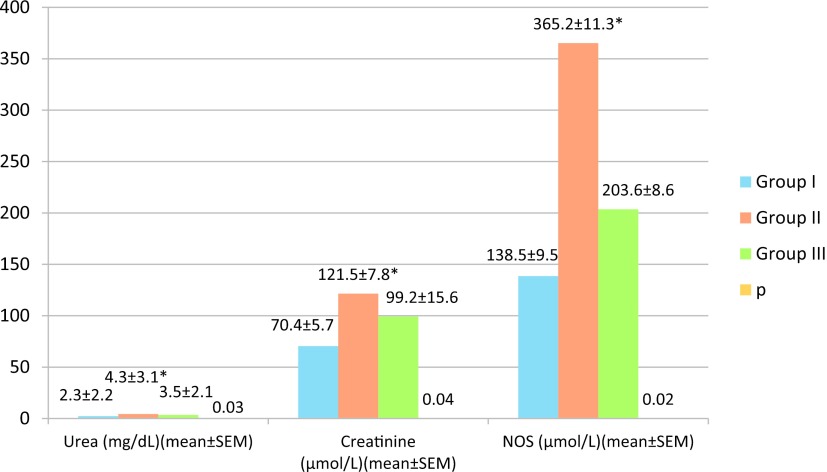
Fig. 1.
Fig. 1.
Plasma concentrations of creatinine, urea, and nitric oxide synthase (NOS) in rats under different hemorrhage shock treatments. * = p ≤ 0.05 as determined from an ANOVA; Group I consisted of control rats that had been cannulated but not hemorrhaged. Half of these rats also received aminoguanidine (AG). Group II consisted of rats that had been hemorrhaged. Group III consisted of rats that had been hemorrhaged and then administered AG.
Fig. 2.
Fig. 2.
Results of hematoxylin and eosin (H&E), periodic acid-Schiff (PAS), and immunohistochemical staining (3,3'-diaminobenzidine and hematoxylin, DAB&H) of renal tissue from control rats. A. H&E staining. D, distal tubules; G, glomerulus; P, proximal tubules. B. PAS staining. Arrows, brush borders; BM, tubular basement membranes; D, distal tubules; P, proximal tubules. C. iNOS immunostaining (DAB&H). D. BAX immunostaining (DAB&H). E. VDR immunostaining (DAB&H).
Fig. 3.
Fig. 3.
Results of hematoxylin and eosin (H&E), periodic acid-Schiff (PAS), and immunohistochemical staining (3,3'-diaminobenzidine and hematoxylin, DAB&H) of renal tissue from rats in which HS was induced. A. H&E staining. Arrowheads, pyknotic nuclei; Arrows, detached tubular cells; Di, dilated renal tubules; N, tubular necrosis; S, swollen tubular cells; Star, blood containing renal tubules. B. PAS staining. BM, tubular basement membranes. C. iNOS immunostaining (DAB&H). D. BAX immunostaining (DAB&H). E. VDR immunostaining (DAB&H).
Fig. 4.
Fig. 4.
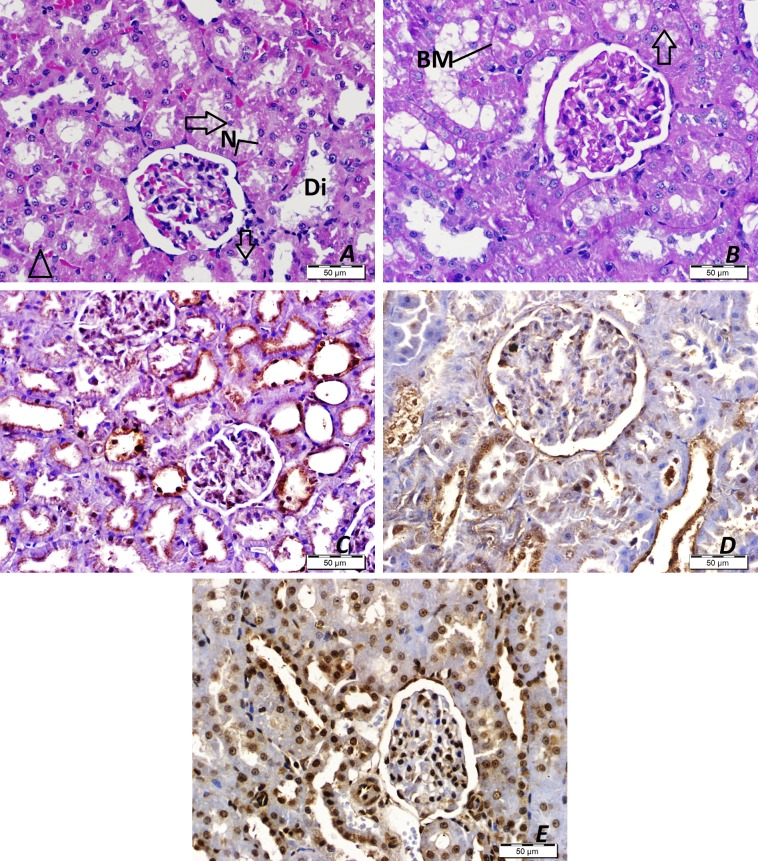
Results of hematoxylin and eosin (H&E), periodic acid-Schiff (PAS), and immunohistochemical staining (3,3'-diaminobenzidine and hematoxylin, DAB&H) of renal tissue from rats in which HS was induced and then aminoguanidine (AG) was administered. A. H&E staining. Arrowheads, pyknotic nuclei; Arrows, detached tubular cells; Di, dilated renal tubules; N, tubular necrosis. B. PAS staining. Arrows, brush borders; BM, tubular basement membranes. C. iNOS immunostaining (DAB&H). D. BAX immunostaining (DAB&H). E. VDR immunostaining (DAB&H).
Fig. 5.
Fig. 5.
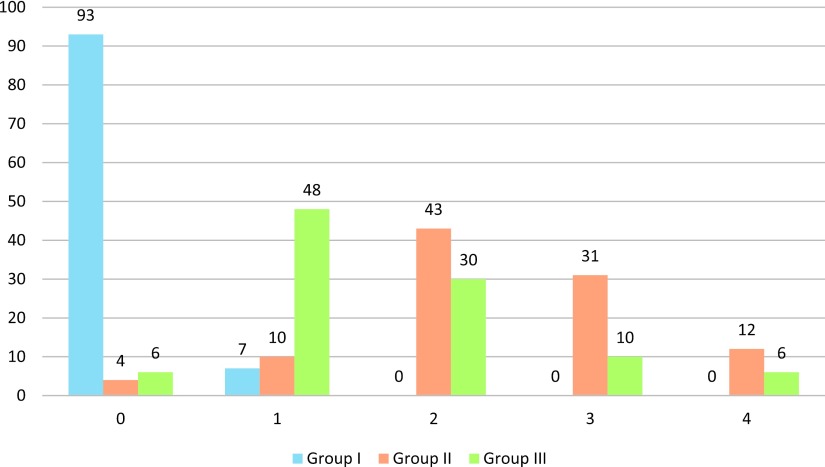
Semi-quantitative analysis of renal histological changes in groups of rats under different hemorrhage shock treatments. Results expressed in number of the studied fields in each group (100 fields/each). Group I consisted of control rats that had been cannulated but not hemorrhaged. Half of these rats also received aminoguanidine (AG). Group II consisted of rats that had been hemorrhaged. Group III consisted of rats that had been hemorrhaged and then administered AG.
Fig. 6.
Fig. 6.
Quantitative comparison of optical density (OD) scores of rats under different HS treatments. * = p ≤ 0.05 as determined from an ANOVA; Group I consisted of control rats that had been cannulated but not hemorrhaged. Half of these rats also received aminoguanidine (AG). Group II consisted of rats that had been hemorrhaged. Group III consisted of rats that had been hemorrhaged and then administered AG.

References

    1. Amir M., Liu K., Zhao E. and Czaja M. J. (2012) Distinct functions of JNK and c-Jun in oxidant induced hepatocyte death. J. Cell Biochem. 113; 3254–3265. - PMC - PubMed
    1. Ates E., Yalcin A. U., Yilmaz S., Koken T. and Tokyol C. (2005) Protective effect of erythropoietin on renal ischemia and reperfusion injury. ANZ J. Surg. 75; 1100–1105. - PubMed
    1. Barmaki B. and Khazaei M. (2015) Effect of aminoguanidine on cardiovascular responses and survival time during blood loss: A study in normotensive and deoxycorticosterone acetate-salt hypertensive rats. Int. J. Appl. Basic Med. Res. 5; 12–17. - PMC - PubMed
    1. Bond R. F. and Johnson G. (1985) Vascular adrenergic interactions during hemorrhagic shock. Fed. Proc. 44; 281–289. - PubMed
    1. Chatterjee P. K., Hawksworth G. M. and McLay J. S. (1999) Cytokine-stimulated nitric oxide production in human renal proximal tubule and its modulation by natriuretic peptides: a novel immunomodulatory mechanism? Exp. Nephrol. 7; 438–448. - PubMed