. 2017 Mar 15;9(3):1088-1100.
eCollection 2017.

Celecoxib enhances the radiosensitivity of HCT116 cells in a COX-2 independent manner by up-regulating BCCIP

Affiliations

Celecoxib enhances the radiosensitivity of HCT116 cells in a COX-2 independent manner by up-regulating BCCIP

Xiao-Ting Xu et al. Am J Transl Res. .

Abstract

It has been reported that celecoxib, a cyclooxygenase-2 (COX-2)-selective nonsteroidal anti-inflammatory drug (NSAID), regulates the radiosensitivity of several cancer cells. BCCIP (BRCA2 and CDKN1A interacting protein) plays a critical role in maintaining the critical functions of p53 in tumor suppression and response to therapy. However, whether the effect of celecoxib on the radiosensitivity of colorectal cancer (CRC) cells is dependent on BCCIP is largely unclear. In this study, we found that celecoxib enhanced the radiosensitivity of HeLa (a human cervical carcinoma cell line), A549 (a human lung carcinoma cell line), and HCT116 cells (a human CRC cells line). Among these cells, COX-2 expression was undetected in HCT116 cells. Treatment with celecoxib significantly increased BCCIP expression in COX-2 negative HCT116 cells. Knockdown of BCCIP obviously abrogated the enhanced radiosensitivity of HCT116 cells induced by celecoxib. A combination of celecoxib and irradiation treatment induced much more γ-H2AX foci formation, higher levels of radiation injury-related proteins phosphorylation, G2/M arrest, apoptosis, and p53 and p21 expression, and lower levels of Cyclin B1 in HCT116 cells than those in cells treated with irradiation alone. However, these changes were undetected in BCCIP-silenced HCT116 cells. Therefore, these data suggest that BCCIP gene may be a radiosensitivity-related gene in CRC. Celecoxib affects the functions of p53 and inhibits the recovery from the irradiation-induced injury by up-regulating the expression of BCCIP, and subsequently regulates the expressions of genes such as p21 and Cyclin B1 to enhance the radiosensitivity of HCT116 cells in a COX-2 independent manner.

Keywords: BCCIP; COX-2; Celecoxib; colorectal cancer cells; radiosensitivity.


Figures
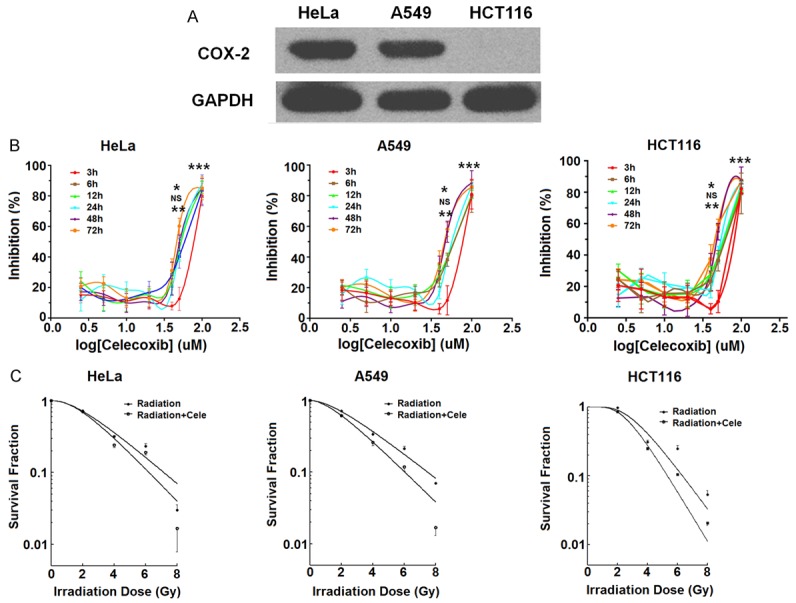
Figure 1
Figure 1
Celecoxib enhances the radiosensitivity of HCT116 cells in a COX-2 independent manner. A. Western blotting analysis for COX-2 expression in HeLa, A549, and HCT116 cells. B. After stimulation with different concentrations of celecoxib (2.5, 5, 10, 20, 40, 50 or 100 μM) for 3, 6, 12, 24, 48, or 72 h, respectively, the viability of HeLa, A549 and HCT116 cells was analyzed by the CCK-8 assay. C. Clonogenic survival assay was performed to evaluate the radiosensitivity of HeLa, A549 and HCT116 cells after pre-treatment with celecoxib (30 μM) and/or irradiation (0, 1, 2, 4, 6, or 8 Gy). Irradiation+cele: combination of irradiation and celecoxib treatment. The data are presented as mean ± SD. *P<0.05, **P<0.01 and ***P<0.001 (one-way ANOVA). NS: no statistically significant difference.
Figure 2
Figure 2
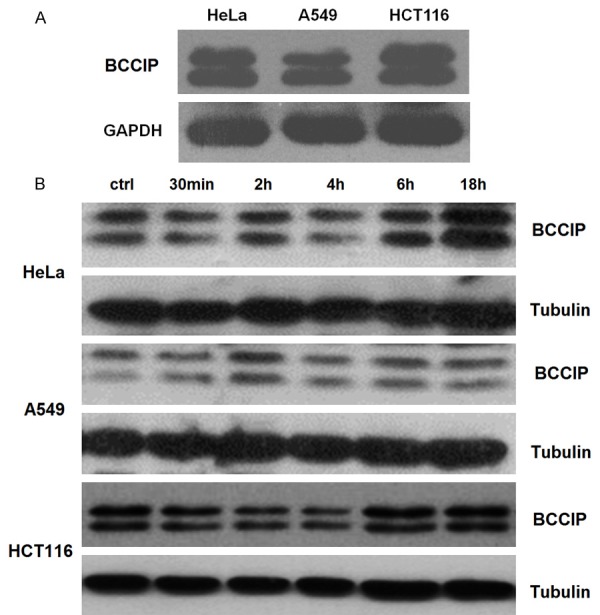
Celecoxib up-regulated the expression of BCCIP in HCT116 cells. A. Western blotting analysis for BCCIP expression in HeLa, A549, and HCT116 cells. B. After stimulation with celecoxib (30 μM) for 30 min, 2, 4, 6, or 18 h, respectively. Then, the expression of BCCIP in HeLa, A549, and HCT116 cells was analyzed by western blotting.
Figure 3
Figure 3
The enhanced radiosensitivity of HCT116 cells induced by celecoxib is dependent on BCCIP. A, B. After transfection with the plasmids (pPUR/U6-NC, pSilencer2.1Hyg-NC, pPUR/U6-sh1, pSilencer2.1Hyg-sh2, pSilencer2.1Hyg-sh3, pPUR/U6-sh1+pSilencer2.1Hyg-sh2 or pPUR/U6-sh1+pSilencer2.1Hyg-sh3), qRT-PCR was used to evaluate the transcriptional level of BCCIP in HCT116 cells. Blank: no plasmid transfection; NC: transfection with pPUR/U6-NC; RNAi1: transfection with pPUR/U6-sh1; RNAi2: transfection with pSilencer2.1Hyg-sh2; RNAi3: transfection with pSilencer2.1Hyg-sh3; RNAi1+2: transfection with pPUR/U6-sh1 and pSilencer2.1Hyg-sh2; RNAi1+3: transfection with pPUR/U6-sh1 and pSilencer2.1Hyg-sh3. C. BCCIP stably silenced HCT116 cell line (S-BCCIP) was established by transfection with the plasmid combination (pPUR/U6-sh1+pSilencer2.1Hyg-sh3) and the subsequent antibiotic screening. Meanwhile the corresponding NC cell line was established. The efficiency of BCCIP silencing was verified by western blotting. D. Clonogenic survival assay was performed to evaluate the radiosensitivity of NC and S-BCCIP cells after pre-treatment with celecoxib (30 μM) and/or irradiation (0, 1, 2, 4, 6, or 8 Gy). The data are presented as mean ± SD. **P<0.01 and ***P<0.001 (one-way ANOVA).
Figure 4
Figure 4
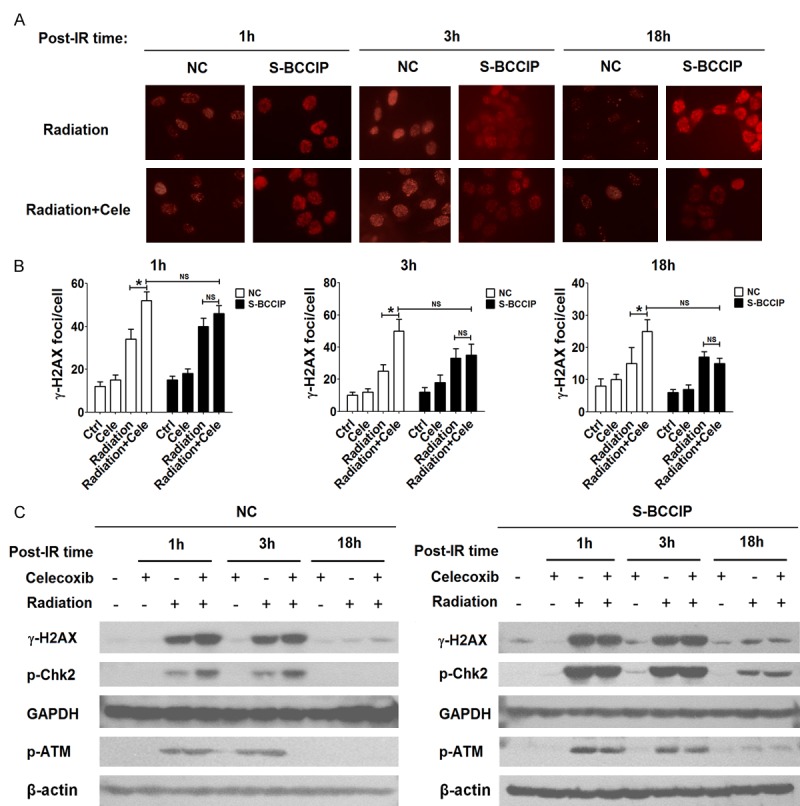
Celecoxib/BCCIP signaling amplifies irradiated-induced injury. A, B. Immunofluorescence staining was performed to analyze the γ-H2AX foci formation in NC and S-BCCIP cells at different time points of after irradiation (6 Gy) and/or pre-treatment with celecoxib (30 μM). C. NC and S-BCCIP cells were pre-treated with celecoxib (30 μM) and/or irradiation (6 Gy) for 1, 3, or 18 h, and then the protein levels of γ-H2AX, p-ATM and p-Chk2 in NC and S-BCCIP cells were detected by western blotting.
Figure 5
Figure 5
Celecoxib promotes irradiation-induced G2/M arrest in HCT116 cells by BCCIP. (A-C) After pre-treatment with celecoxib (30 μM) and/or irradiation (0, 1, 2, 4, 6, 8 or 10 Gy), the cell cycle distributions (A, B) and percentage of cells arrested in the G2/M phase (C) of both NC and S-BCCIP cells were analyzed by flow cytometry analysis. The data are presented as the mean ± SD. **P<0.01 (t-test).
Figure 6
Figure 6
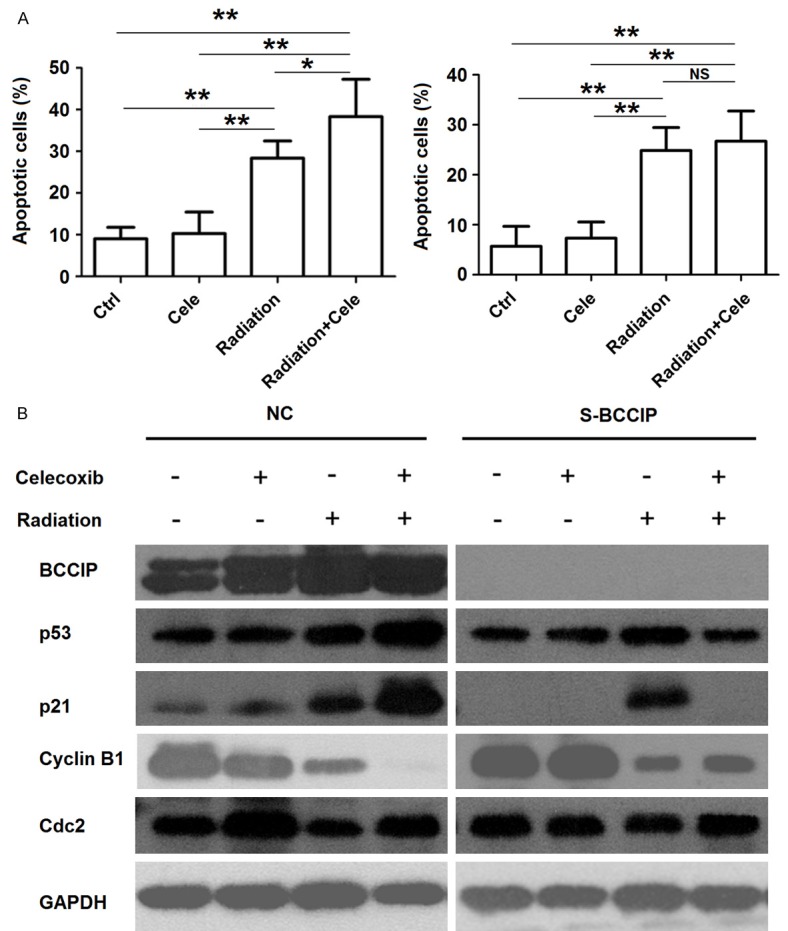
Celecoxib promotes irradiation-induced apoptosis in HCT116 cells by BCCIP. (A, B) After pre-treatment with celecoxib (30 μM) and/or irradiation (6 Gy), the apoptosis (A) and the protein levels of BCCIP, p53, p21, and Cyclin B1 (B) in both NC and S-BCCIP cells were analyzed by apoptosis assay and western blotting, respectively. The data are presented as mean ± SD. *P<0.05 and **P<0.01 (one-way ANOVA).

References

    1. Jemal A, Bray F, Center MM, Ferlay J, Ward E, Forman D. Global cancer statistics. CA Cancer J Clin. 2011;61:69–90. - PubMed
    1. Siegel R, Ma J, Zou Z, Jemal A. Cancer statistics, 2014. CA Cancer J Clin. 2014;64:9–29. - PubMed
    1. Improved survival with preoperative radiotherapy in respectable rectal cancer. Swedish rectal cancer trial. N Engl J Med. 1997;336:980–987. - PubMed
    1. Bosset JF, Collette L, Calais G, Mineur L, Maingon P, Radosevic-Jelic L, Daban A, Bardet E, Beny A, Ollier JC EORTC Radiotherapy Group Trial 22921. Chemotherapy with preoperative radiotherapy in rectal cancer. N Engl J Med. 2006;355:1114–1123. - PubMed
    1. Gerard JP, Conroy T, Bonnetain F, Bouché O, Chapet O, Closon-Dejardin MT, Untereiner M, Leduc B, Francois E, Maurel J, Seitz JF, Buecher B, Mackiewicz R, Ducreux M, Bedenne L. Preoperativeradiotherapy with or without concurrent fluorouracil and leucovorin in T3-4 rectal cancers: results of FFCD 9203. J. Clin. Oncol. 2006;24:4620–4625. - PubMed

LinkOut - more resources