. 2017 Feb 27;7(1):55-64.
doi: 10.1556/1886.2016.00039. eCollection 2017 Mar.

Characterization of Virulence Potential of Pseudomonas Aeruginosa Isolated from Bovine Meat, Fresh Fish, and Smoked Fish

Affiliations

Characterization of Virulence Potential of Pseudomonas Aeruginosa Isolated from Bovine Meat, Fresh Fish, and Smoked Fish

Comoé Koffi Donatien Benie et al. Eur J Microbiol Immunol (Bp). .

Abstract

Pseudomonas aeruginosa owns a variability of virulence factors. These factors can increase bacterial pathogenicity and infection severity. Despite the importance of knowledge about them, these factors are not more characterized at level of strains derived from local food products. This study aimed to characterize the virulence potential of P. aeruginosa isolated from various animal products. Several structural and virulence genes of P. aeruginosa including lasB, exoS, algD, plcH, pilB, exoU, and nan1 were detected by polymerase chain reaction (PCR) on 204 strains of P. aeruginosa. They were isolated from bovine meat (122), fresh fish (49), and smoked fish (33). The 16S rRNA gene was detected on 91.1% of the presumptive strains as Pseudomonas. The rpoB gene showed that 99.5% of the strains were P. aeruginosa. The lasB gene (89.2%) was the most frequently detected (p < 0.05). In decreasing importance order, exoS (86.8%), algD (72.1%), plcH (72.1%), pilB (40.2%), and exoU (2.5%) were detected. The lasB gene was detected in all strains of P. aeruginosa serogroups O11 and O16. The prevalence of algD, exoS, and exoU genes in these strains varied from 51.2% to 87.4%. The simultaneous determination of serogroups and virulence factors is of interest for the efficacy of surveillance of infections associated with P. aeruginosa.

Keywords: PCR; Pseudomonas aeruginosa; bovine meat; fresh fish; serogroups; smoked fish; virulence.


Conflict of interest statement

Conflict of interest The authors declare that there is no conflict of interest.

Figures
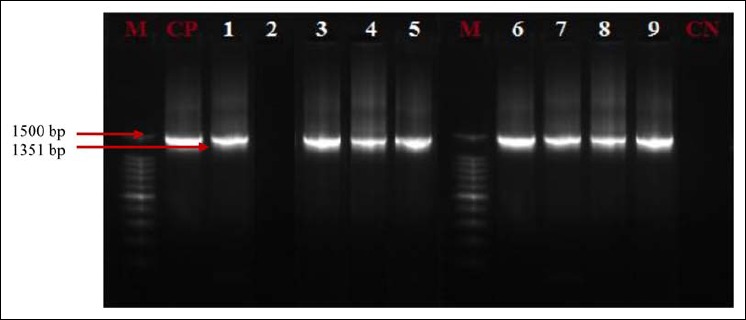
Fig. 1.
Fig. 1.
16S rRNA profiles of Pseudomonas isolates. Lanes 1, 3–9: Presence of Pseudomonas in analyzed products; lane 2: absence of Pseudomonas in analyzed products; CP: positive control (Pseudomonas aeruginosa ATCC 27853); CN: negative control; M: marker gene ruler, 100 bp (Bench Top, 100-bp DNA Ladder, Promega Corporation, USA)
Fig. 2.
Fig. 2.
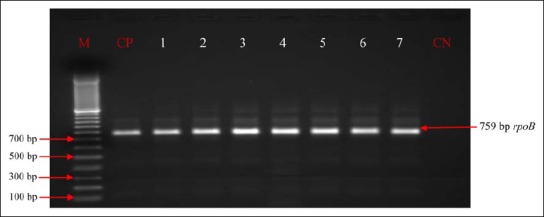
RpoB profiles of Pseudomonas aeruginosa isolates. Lanes 1–7: Presence of Pseudomonas aeruginosa in analyzed products; CP: positive control (Pseudomonas aeruginosa ATCC 27853); CN: negative control; M: marker gene ruler, 100 bp (Bench Top, 100-bp DNA Ladder, Promega Corporation, USA)
Fig. 3.
Fig. 3.
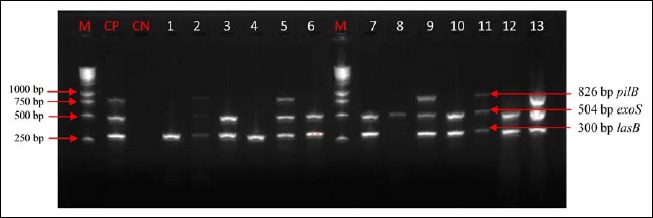
Electrophoretic profile of amplification products of the virulence genes pilB, exoS, and lasB in analyzed products. Virulence genes were present in analyzed products. Lane 1: lasB; lane 2: pilB, exoS, and lasB; lane 3: exoS and lasB; lane 4: lasB; lane 5: pilB, exoS, and lasB; lane 6: exoS and lasB; lane 7: exoS and lasB; lane 8: exoS and lasB; lane 9: pilB, exoS, and lasB; lane 10: exoS and lasB; lane 11: pilB, exoS, and lasB; lane 12: exoS and lasB; lane 13: pilB, exoS, and lasB; M: marker gene ruler, 250 bp (Bench Top, 1-kb DNA Ladder, Promega Corporation, USA); pilB, type IV fimbrial biogenesis protein PilB-encoding gene; lasB, elastase LasB-encoding gene; exoS, exoenzyme S-encoding gene
Fig. 4.
Fig. 4.
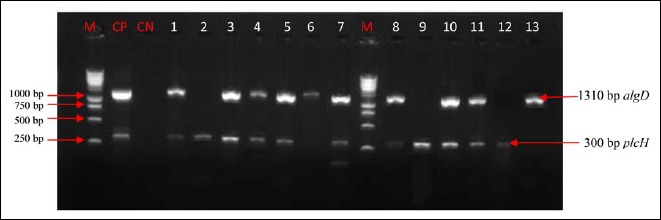
Electrophoretic profile of amplification products of the virulence genes algD and plcH in analyzed products. Virulence genes were present in analyzed products. Lane 1: algD and plcH; lane 2: plcH; lane 3: algD and plcH; lane 4: algD and plcH; lane 5: algD and plcH; lane 6: algD; lane 7: algD and plcH; lane 8: algD and plcH; lane 9: plcH; lane 10: algD and plcH; lane 11: algD and plcH; lane 12: plcH; lane 13: algD; M: marker gene ruler, 250 bp (Bench Top, 1-kb DNA Ladder, Promega Corporation, USA); algD, GDP-mannose 6-dehydrogenase AlgD (alginate)-encoding gene; plcH, hemolytic phospholipase C precursor-encoding gene
Fig. 5.
Fig. 5.
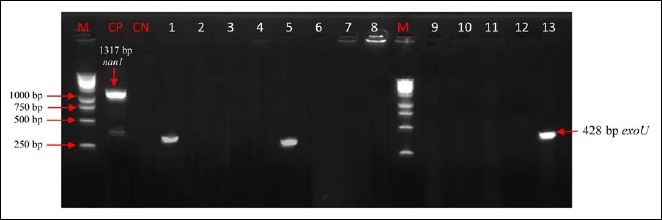
Electrophoretic profile of amplification products of the virulence gene exoU and nan1 in analyzed products. Virulence genes were present in analyzed products. Lanes 1, 5, 13: exoU; Virulence genes were absent in analyzed products; lanes 2–4, 6–12; M: marker gene ruler, 250 bp (Bench Top, 1-kb DNA Ladder, Promega Corporation, USA); algD, GDP-mannose 6-dehydrogenase AlgD (alginate)-encoding gene; plcH, hemolytic phospholipase C precursor-encoding gene. M: marker gene ruler, 250 bp (Bench Top, 1-kb DNA Ladder, Promega Corporation, USA); exoU, exoenzyme U-encoding gene
Fig. 6.
Fig. 6.
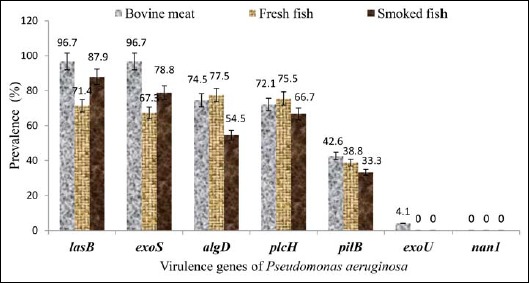
Virulence genes according to the origin of the strain. AlgD, GDP-mannose 6-dehydrogenase AlgD (alginate)-encoding gene; pilB, type IV fimbrial biogenesis protein PilB-encoding gene; nan1, neuraminidase-encoding gene; plcH, hemolytic phospholipase C precursor-encoding gene; lasB, elastase LasB-encoding gene; exoS, exoenzyme S-encoding gene; exoU, exoenzyme U-encoding gene
Fig. 7.
Fig. 7.
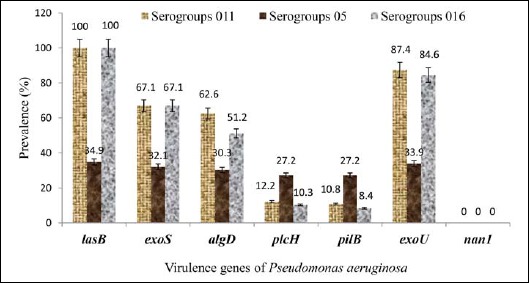
Virulence genes and serogroups of Pseudomonas aeruginosa. AlgD, GDP-mannose 6-dehydrogenase AlgD (alginate)-encoding gene; pilB, type IV fimbrial biogenesis protein PilB-encoding gene; nan1, neuraminidase-encoding gene; plcH, hemolytic phospholipase C precursor-encoding gene; lasB, elastase LasB-encoding gene; exoS, exoenzyme S-encoding gene; exoU, exoenzyme U-encoding gene
Fig. 8.
Fig. 8.
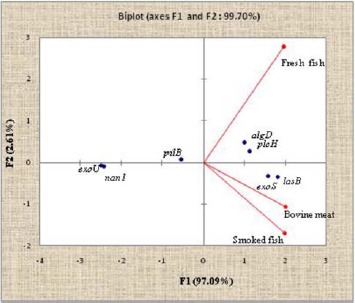
Distribution of Pseudomonas aeruginosa virulence genes isolated from animal products. The axes F1 and F2 of the ACP account for 99.7% of the inertia. The F1 axis represents 97.09% and the F2 axis 2.61%. AlgD, GDP-mannose 6-dehydrogenase AlgD (alginate)-encoding gene; pilB, type IV fimbrial biogenesis protein PilB-encoding gene; nan1, neuraminidase-encoding gene; plcH, hemolytic phospholipase C precursor-encoding gene; lasB, elastase LasB-encoding gene; exoS, exoenzyme S-encoding gene; exoU, exoenzyme U-encoding gene

References

    1. Edit K, Sándor S, Gyula D, Júlia R, Balázs K, Balázs K: Pathogenic and phylogenetic features of 2 multiresistant Pseudomonas aeruginosa strains originated from remediated sites. Int J Occup Med Environ Health 29, 503–516 (2016) - PubMed
    1. Fadhil L, Al-Marzoqi AH, Zahraa MA, Shalan AA: Molecular and phenotypic study of virulence genes in a pathogenic strain of Pseudomonas aeruginosa isolated from various clinical origins by PCR: profiles of genes and toxins. Res J Pharm, Biol Chem Sci 7, 590–598 (2016)
    1. Streeter K, Katouli M: Pseudomonas aeruginosa: a review of their pathogenesis and prevalence in clinical settings and the environment. Infect Epidemiol Med 2, 25–32 (2016)
    1. Mitov I, Tanya S, Boyka M: Prevalence of virulence genes among bulgarian nosocomial and cystic fibrosis isolates of Pseudomonas aeruginosa. Braz J Microbiol 41, 588–595 (2010) - PMC - PubMed
    1. Khattab MA, Nour MS, ElSheshtawy NM: Genetic identification of Pseudomonas aeruginosa virulence genes among different isolates. J Microb Biochem Technol 7, 274–277 (2015)

LinkOut - more resources