


Outcomes Following Carpal Tunnel Release in Patients Receiving Workers' Compensation: A Systematic Review
- PMID: 28387162
- PMCID: PMC5950969
- DOI: 10.1177/1558944717701240
Outcomes Following Carpal Tunnel Release in Patients Receiving Workers' Compensation: A Systematic Review
Abstract
Background: Carpal tunnel syndrome (CTS) is a common occupational pathology, representing a high percentage of workers' compensation (WC) claims.
Methods: The literature was reviewed for all studies evaluating CTS outcomes including WC patients between 1993 and 2016. A total of 348 articles were identified; 25 of which met inclusion and exclusion criteria. A systematic review was generated; patient demographics, outcomes, and complications were recorded. Weighted averages were calculated for the demographic and outcome data. Categorical data such as complications were pooled from the studies and used to determine the overall complication rate. Statistical significance was determined between WC and non-WC cohorts when applicable with the chi-square statistic.
Results: The WC cohort included 1586 wrists, and the non-WC cohort included 2781 wrists. The WC cohort was younger and more often involved the dominant extremity. The WC cohort was less likely to have appropriate physical exam findings confirming diagnosis and electrodiagnostic studies. WC patients took almost 5 weeks longer to return to work, were 16% less likely to return to preinjury vocation, and had lower Standard Form (SF)-36 scores. Finally, WC patients had nearly 3 times the number of complications and nearly twice the rate of persistent pain.
Conclusions: WC patients undergoing carpal tunnel release (CTR) fare poorly as compared with non-WC patients in nearly every metric. Higher rates of postoperative pain with delayed return to work can be anticipated in a WC cohort. In addition, WC patients receive suboptimal preoperative workup, and it is possible that unnecessary surgery is being completed in these cases. These findings are important to consider when treating the WC patient with CTS.
Keywords: carpal tunnel release; carpal tunnel syndrome; disability; workers’ compensation.
Conflict of interest statement
Figures
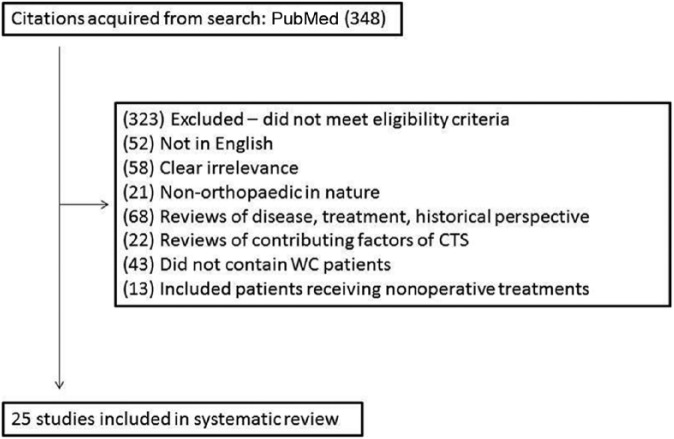
References
-
- Al-Qattan M, Bowen V, Manktelow RT. Factors associated with poor outcome following primary carpal tunnel release in non-diabetic patients. J Hand Surg Br. 1994;19:622-625. - PubMed
-
- American Academy of Orthopaedic Surgeons Work Group Panel. Clinical guidelines on diagnosis of carpal tunnel syndrome. http://www.aaos.org/Research/guidelines/CTS_guideline.pdf. Accessed April 16, 2016.
-
- Amick B, Habeck R, Ossmann J, et al. Predictors of successful work role functioning after carpal tunnel release surgery. J Occup Environ Med. 2004;46:490-500. - PubMed
-
- Atroshi I, Johnsson R, Nouhan R, et al. Use of outcome instruments to compare workers’ compensation and non-workers’ compensation carpal tunnel syndrome. J Hand Surg Am. 1997;22:882-888. - PubMed
-
- Bessette L, Keller R, Lew R, et al. Prognostic value of a hand symptom diagram in surgery for carpal tunnel syndrome. J Rheumatol. 1997;24:726-734. - PubMed
Publication types
MeSH terms
LinkOut - more resources
Full Text Sources
Other Literature Sources
Medical
Research Materials
Miscellaneous
