


Evolution of the hypoxia-sensitive cells involved in amniote respiratory reflexes
- PMID: 28387645
- PMCID: PMC5438250
- DOI: 10.7554/eLife.21231
Evolution of the hypoxia-sensitive cells involved in amniote respiratory reflexes
Abstract
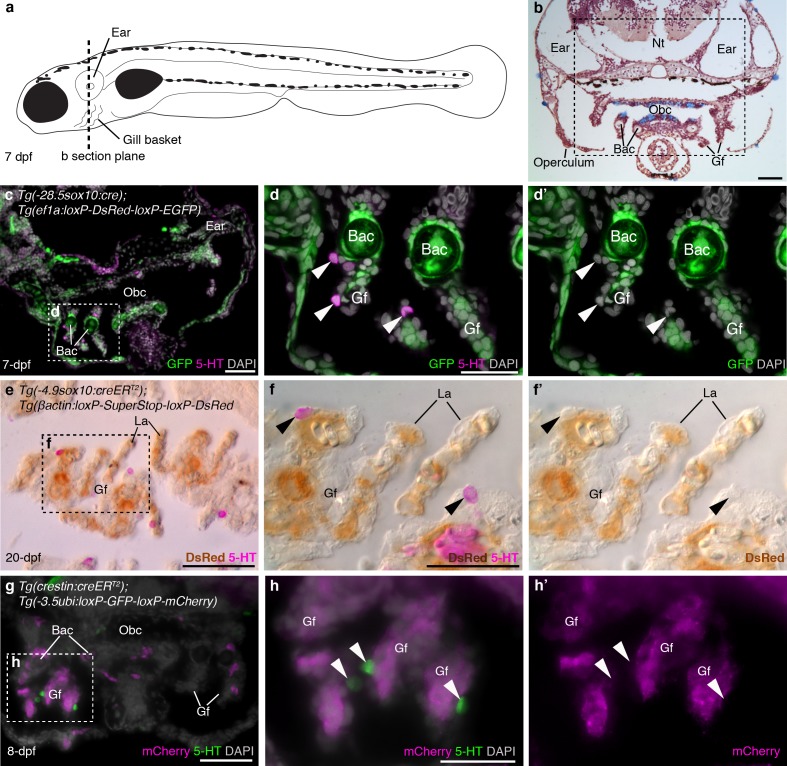
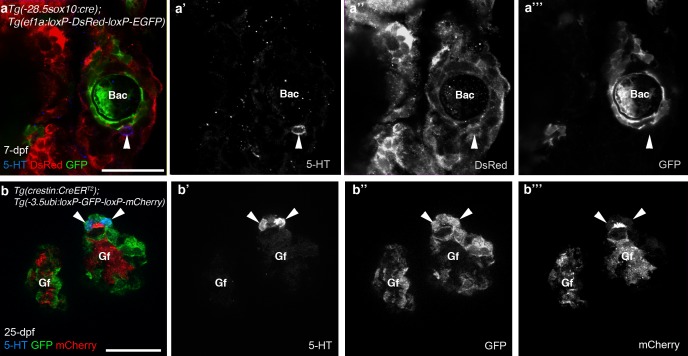
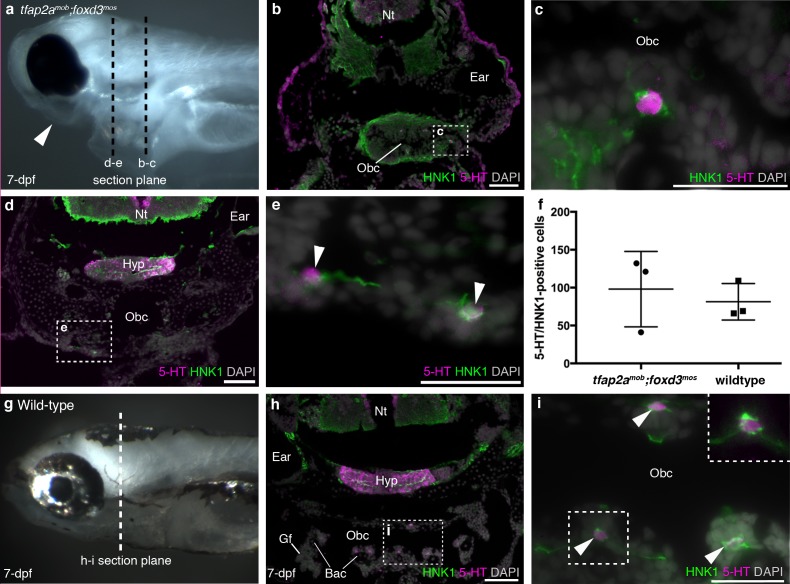
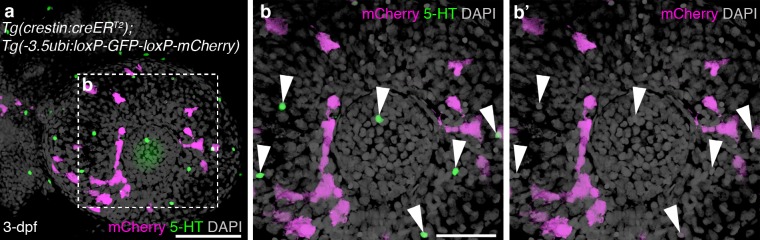
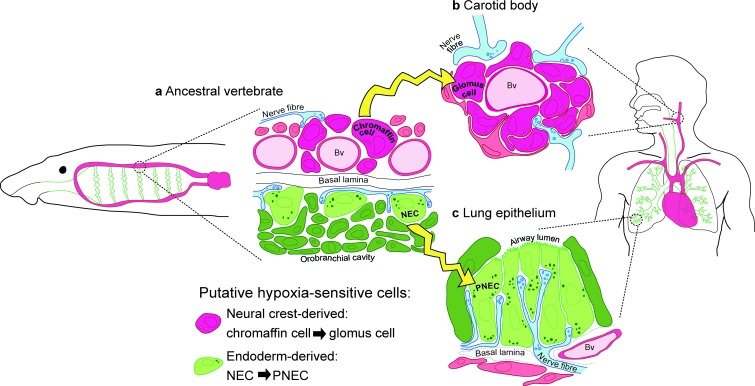
The evolutionary origins of the hypoxia-sensitive cells that trigger amniote respiratory reflexes - carotid body glomus cells, and 'pulmonary neuroendocrine cells' (PNECs) - are obscure. Homology has been proposed between glomus cells, which are neural crest-derived, and the hypoxia-sensitive 'neuroepithelial cells' (NECs) of fish gills, whose embryonic origin is unknown. NECs have also been likened to PNECs, which differentiate in situ within lung airway epithelia. Using genetic lineage-tracing and neural crest-deficient mutants in zebrafish, and physical fate-mapping in frog and lamprey, we find that NECs are not neural crest-derived, but endoderm-derived, like PNECs, whose endodermal origin we confirm. We discover neural crest-derived catecholaminergic cells associated with zebrafish pharyngeal arch blood vessels, and propose a new model for amniote hypoxia-sensitive cell evolution: endoderm-derived NECs were retained as PNECs, while the carotid body evolved via the aggregation of neural crest-derived catecholaminergic (chromaffin) cells already associated with blood vessels in anamniote pharyngeal arches.
Keywords: carotid body; chicken; developmental biology; endoderm; fate-mapping; mouse; neural crest; neuroepithelial cells; sea lamprey (Petromyzon marinus); stem cells; xenopus; zebrafish.
Conflict of interest statement
The authors declare that no competing interests exist.
Figures
Comment in
-
Sensing oxygen inside and out.Elife. 2017 May 19;6:e27467. doi: 10.7554/eLife.27467. Elife. 2017. PMID: 28525315 Free PMC article.
References
-
- Abo T, Balch CM. A differentiation antigen of human NK and K cells identified by a monoclonal antibody (HNK-1) Journal of Immunology. 1981;127:1024–1029. - PubMed
Publication types
MeSH terms
Grants and funding
LinkOut - more resources
Full Text Sources
Other Literature Sources
Molecular Biology Databases
