. 2017 Aug;11(8):1727-1735.
doi: 10.1038/ismej.2017.21. Epub 2017 Apr 7.

Who lives in a fungus? The diversity, origins and functions of fungal endobacteria living in Mucoromycota

Affiliations

Who lives in a fungus? The diversity, origins and functions of fungal endobacteria living in Mucoromycota

Paola Bonfante et al. ISME J. 2017 Aug.

Abstract

Bacterial interactions with plants and animals have been examined for many years; differently, only with the new millennium the study of bacterial-fungal interactions blossomed, becoming a new field of microbiology with relevance to microbial ecology, human health and biotechnology. Bacteria and fungi interact at different levels and bacterial endosymbionts, which dwell inside fungal cells, provide the most intimate example. Bacterial endosymbionts mostly occur in fungi of the phylum Mucoromycota and include Betaproteobacteria (Burkhoderia-related) and Mollicutes (Mycoplasma-related). Based on phylogenomics and estimations of divergence time, we hypothesized two different scenarios for the origin of these interactions (early vs late bacterial invasion). Sequencing of the genomes of fungal endobacteria revealed a significant reduction in genome size, particularly in endosymbionts of Glomeromycotina, as expected by their uncultivability and host dependency. Similar to endobacteria of insects, the endobacteria of fungi show a range of behaviours from mutualism to antagonism. Emerging results suggest that some benefits given by the endobacteria to their plant-associated fungal host may propagate to the interacting plant, giving rise to a three-level inter-domain interaction.


Conflict of interest statement

The authors declare no conflict of interest.

Figures
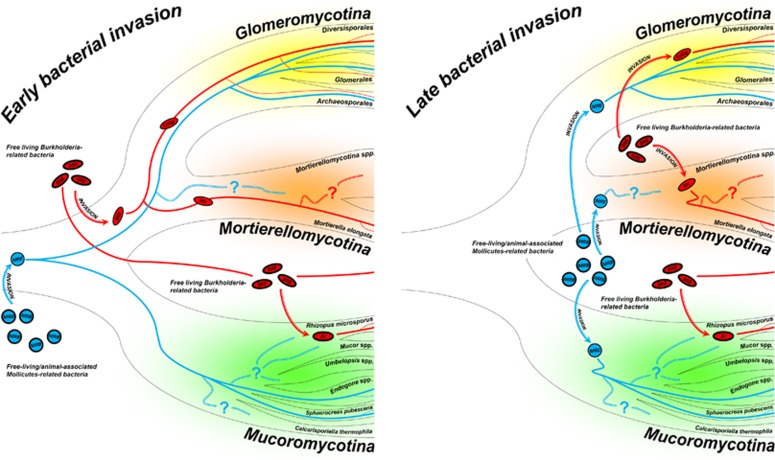
Figure 1
Figure 1
Schematic representation of the two hypothetical scenarios of bacterial invasion (early vs late) at the basis of the origin of the association between BRE (in red) and MRE (in blue) and members of Mucoromycota. BRE: The early bacterial invasion (left side) assumes the existence of an ancestral free-living BRB that invaded the common ancestor of Glomeromycotina and Mortierellomycotina. During the separation of fungal hosts, BRE have been diversified into Candidatus Glomeribacter gigasporarum and Mycoavidus cysteinexigens and maintained only in Gigasporaceae (a family of Diversisporales) and Mortierella elongata, respectively. On the contrary, the late bacterial invasion (right side) entails a subsequent invasion by an ancestral free-living BRB, which may have occurred when the evolutionary lines leading to Glomeromycotina and Mortierellomycotina had already separated but before the diversification of Gigasporaceae. Differently, Burkholderia rhizoxinica has had an independent origin, sharing with the free-living Burkholderia its most recent common ancestor. Irrespective of the bacterial invasion scenario, CaGg is absent in some Gigasporaceae strains and most of Glomeromycotina lineages, and that might be the result of secondary losses of the endobacterial partner. MRE: The early bacterial invasion (left side) assumes the existence of an ancestral free-living/animal-associated MRB that invaded the ancestor of Mucoromycota and began its evolutionary path toward obligate mutualism. During the diversification of Mucoromycota, MRE have been maintained in Glomeromycotina and Mucoromycotina, whereas it is still unknown whether Mortierellomycotina maintained these coccoid endosymbionts. By contrast, the late bacterial invasion (right side) entails a subsequent invasion by an ancestral free-living/animal-associated MRB, which may have occurred when the evolutionary lines leading to the three Mucoromycota subphyla had already separated. However, regardless of the bacterial invasion scenario, MRE are absent in several fungal lineages or strains and that might be the result of secondary losses of the endobacterial partner. Legend: Burkholderia rhizoxinica (Br); Candidatus Glomeribacter gigasporarum (CaGg); Mycoavidus cysteinexigens (Mc); bacterial invasion event (arrow); presence of bacteria/endobacteria (thick line); absence of endobacteria in at least one fungal strain or lineage (species, genus, family or order) (thin line); unknown/there are no data available about the presence/absence of endobacteria (double thin line with a question mark).
Figure 2
Figure 2
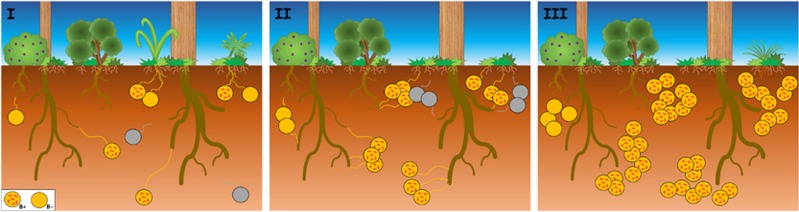
Schematic comparison of the colonization success of Gigaspora margarita with (B+) and without (B−) its endosymbiont (CaGg). When compared with the B+ strain, the growth of the germinating mycelium from a B− spore is slower and, when the host plant root is relatively distant (~10 cm from the spore), it stops after reaching a few centimetres (5 cm) (Lumini et al., 2007). Further, the B− strain often produces a lower number of spores than the B+ strain (Salvioli et al., 2016). Thus, in the words of Charles Darwin ‘survival of the fittest’, these differences make the B+ strain the fittest one. AMF are obligate biotrophs, that is, they need a plant host to complete their life cycle. In natural conditions, the capacity to grow faster and for a longer distance/time may provide the B+ strain a greater chance of success in finding and reaching a host plant root and then reproducing. On the contrary, the B− strain may have more difficulties in contacting plant host roots and, accordingly, completing its life cycle (grey spores). As a consequence, over the generations (from left to right), a decrease of the B− lines and a predominance of B+ lines in the soil might occur.

References

    1. Arendt KR, Hockett KL, Araldi-Brondolo SJ, Baltrus DA, Arnold AE. (2016). Isolation of endohyphal bacteria from foliar Ascomycota and in vitro establishment of their symbiotic associations. Appl Environmental Microbiol 10: 2943–2949. - PMC - PubMed
    1. Ash C, Mueller K. (2016). Manipulating the microbiota. Science 352: 530–531. - PubMed
    1. Bianciotto V, Lumini E, Bonfante P, Vandamme P. (2003). 'Candidatus Glomeribacter gigasporarum' gen. nov., sp. nov., an endosymbiont of arbuscular mycorrhizal fungi. Int Syst Evol Microbiol 53: 121–124. - PubMed
    1. Bonfante P, Scannerini S. (1977). Cytological observations on the mycorrhiza Endogone flammicorona-Pinus strobus. Allionia 22: 23–34.
    1. Bonfante P, Scannerini S. (1976). The ultrastructure of the zygospore in Endogone flammicorona Trappe and Gerdemann. Mycopathologia 59: 117–123.