


SNPPhenA: a corpus for extracting ranked associations of single-nucleotide polymorphisms and phenotypes from literature
- PMID: 28388928
- PMCID: PMC5383945
- DOI: 10.1186/s13326-017-0116-2
SNPPhenA: a corpus for extracting ranked associations of single-nucleotide polymorphisms and phenotypes from literature
Abstract
Background: Single Nucleotide Polymorphisms (SNPs) are among the most important types of genetic variations influencing common diseases and phenotypes. Recently, some corpora and methods have been developed with the purpose of extracting mutations and diseases from texts. However, there is no available corpus, for extracting associations from texts, that is annotated with linguistic-based negation, modality markers, neutral candidates, and confidence level of associations.
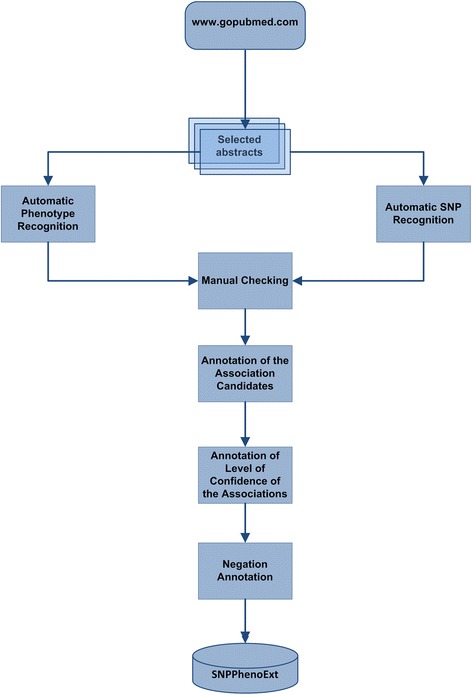
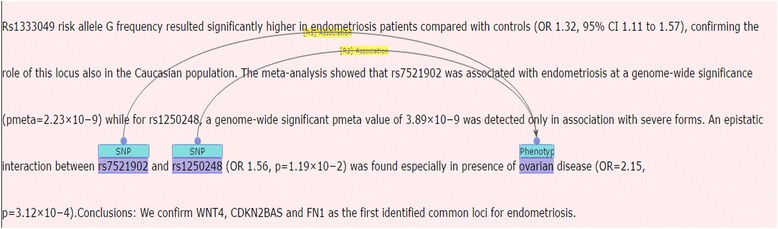
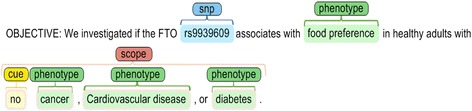
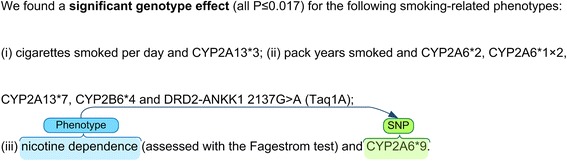
Method: In this research, different steps were presented so as to produce the SNPPhenA corpus. They include automatic Named Entity Recognition (NER) followed by the manual annotation of SNP and phenotype names, annotation of the SNP-phenotype associations and their level of confidence, as well as modality markers. Moreover, the produced corpus was annotated with negation scopes and cues as well as neutral candidates that play crucial role as far as negation and the modality phenomenon in relation to extraction tasks.
Result: The agreement between annotators was measured by Cohen's Kappa coefficient where the resulting scores indicated the reliability of the corpus. The Kappa score was 0.79 for annotating the associations and 0.80 for the confidence degree of associations. Further presented were the basic statistics of the annotated features of the corpus in addition to the results of our first experiments related to the extraction of ranked SNP-Phenotype associations. The prepared guideline documents render the corpus more convenient and facile to use. The corpus, guidelines and inter-annotator agreement analysis are available on the website of the corpus: http://nil.fdi.ucm.es/?q=node/639 .
Conclusion: Specifying the confidence degree of SNP-phenotype associations from articles helps identify the strength of associations that could in turn assist genomics scientists in determining phenotypic plasticity and the importance of environmental factors. What is more, our first experiments with the corpus show that linguistic-based confidence alongside other non-linguistic features can be utilized in order to estimate the strength of the observed SNP-phenotype associations.
Trial registration: Not Applicable.
Keywords: Degree of confidence; Modality; Negation; Phenotype; Relation extraction; SNP.
Figures









References
-
- Martin E, and Hine R. A Dictionary of Biology, 6 ed. Oxford University Press; 2014.
-
- Leslie R, O. C. Retrieved May 2016, from GRASP: 2016. http://grasp.nhlbi.nih.gov/Updates.aspx. Accessed May 2016.
MeSH terms
LinkOut - more resources
Full Text Sources
Other Literature Sources
