


Isolation and identification of a new strain of hirame rhabdovirus (HIRRV) from Japanese flounder Paralichthys olivaceus in China
- PMID: 28388934
- PMCID: PMC5384145
- DOI: 10.1186/s12985-017-0742-4
Isolation and identification of a new strain of hirame rhabdovirus (HIRRV) from Japanese flounder Paralichthys olivaceus in China
Abstract
Background: Hirame rhabdovirus virus (HIRRV) is a rhabdovirus that causes acute hemorrhage disease in fish culture, resulting in a great economic loss in parts of Asia and Europe.
Methods: In this study, we isolated a virus strain named as CNPo2015 from cultured Japanese flounder in Shandong province, China. Cell isolation, electron microscopic observation, RT-PCR detection and phylogenetic analysis were used for virus identification. Further, artificial infection experiment was conducted for virulence testing.
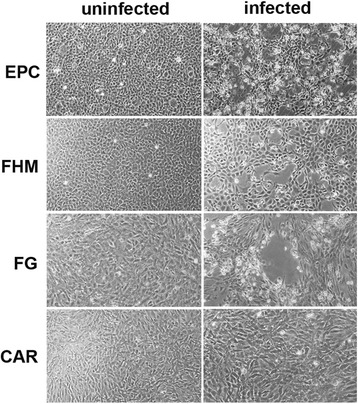
Results: The gross signs included abdominal distension, fin reddening and yellow ascitic fluid in the abdominal cavity. Histopathological examination revealed marked cell degeneration and necrosis in the kidney. The tissue homogenates induced obvious cytopathic effects in EPC, FHM and FG cell lines. Electron microscopic observation showed the virus had a bullet-like shape with a capsule membrane. RT-PCR and sequencing analysis revealed that CNPo2015 belonged to the HIRRV with high sequence identity to HIRRV isolates. Infection experiment confirmed that the HIRRV CNPo2015 strain was virulent to flounder juveniles with a LD50 value of 1.0 × 105.9 TCID50/fish.
Conclusion: In conclusion, we described the first isolation and characterization of a HIRRV from Japanese flounder in China. This will provide a candidate material for further research on the infection mechanism and preventive strategies of HIRRV.
Keywords: Hirame rhabdovirus; Identification; Paralichthys olivaceus; Pathogenicity.
Figures



References
-
- Kimura T, Yoshimizu M, Gorie S. A new rhabdovirus isolated in Japan from cultured hirame (Japanese flounder) Paralichthys olivaceus and ayu Plecoglossus altivelis. Dis Aquat Organ. 1986;1:209–17. doi: 10.3354/dao001209. - DOI
-
- Oh MJ, Choi TJ. A new rhabdovirus (HRV-like) isolated in Korea from cultured Japanese flounder Paralichthys olivaceus. J Fish Pathol. 1998;11:129–36.
Publication types
MeSH terms
Substances
LinkOut - more resources
Full Text Sources
Other Literature Sources
Research Materials
