Review
. 2017 Apr 7;10(1):81.
doi: 10.1186/s13045-017-0455-6.

Blocking the PD-1/PD-L1 pathway in glioma: a potential new treatment strategy

Affiliations
Review

Blocking the PD-1/PD-L1 pathway in glioma: a potential new treatment strategy

Song Xue et al. J Hematol Oncol. .

Abstract

Gliomas are the most common type of primary brain tumor in adults. High-grade neoplasms are associated with poor prognoses, whereas low-grade neoplasms are associated with 5-year overall survival rates of approximately 85%. Despite considerable progress in treatment modalities, the outcomes remain dismal. As is the case with many other tumors, gliomas express or secrete several immunosuppressive molecules that regulate immune cell function. Programmed death-ligand 1 (PD-L1) is a coinhibitory ligand that is predominantly expressed by tumor cells. The binding of PD-L1 to its receptor PD-1 has been demonstrated to induce an immune escape mechanism and to play a critical role in tumor initiation and development. Encouraging results following the blockade of the PD-1/PD-L1 pathway have validated PD-L1 or PD-1 as a target for cancer immunotherapy. Studies have reported that the PD-1/PD-L1 pathway plays a key role in glioma progression and in the efficacy of immunotherapies. Thus, progress in research into PD-L1 will enable us to develop a more effective and individualized immunotherapeutic strategy for gliomas. In this paper, we review PD-L1 expression, PD-L1-mediated immunosuppressive mechanisms, and the clinical applications of PD-1/PD-L1 inhibitors in gliomas. Potential treatment strategies and the challenges that may occur during the clinical development of these agents for gliomas are also reviewed.

Keywords: Expression; Glioma; Immunosuppressive; PD-1; PD-L1; Treatment.


Figures
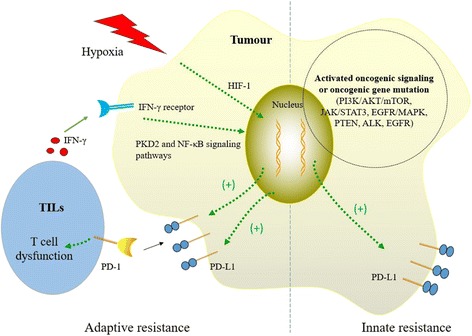
Fig. 1
Fig. 1
Adaptive resistance and innate resistance. (Left, adaptive resistance) Upon recognition of tumor antigens, TILs produce IFN-γ, which induces PD-L1 expression via nuclear NF-κB activation and the PKD2 signal pathway. In tumor hypoxia microenvironmental condition, HIF-1 regulates the expression of PD-L1 by binding directly to the hypoxia response element-4 in the PD-L1 proximal promoter. Upon binding to PD-1, PD-L1 delivers a suppressive signal to T cells, leading to T cell dysfunction. (Right, innate resistance) Tumor cell PD-L1 expression that might be related to oncogenic signaling pathways or oncogenic gene mutation as inherent in the tumor cell. Oncogenic signals (such as PI3K/Akt/mTOR, JAK/STAT 3, and EGFR/MAPK pathway) or oncogenic gene mutation (such as PTEN, ALK, and EGFR) upregulate PD-L1 expression on tumors as innate resistance. Abbreviations: IFN-γ interferon-γ, TILs tumor-infiltrating lymphocytes, NF-κB nuclear factor-kappaB, PI3K phosphatidylinositol 3-kinase, HIF-1 hypoxia inducible factor-1, JAK/STAT3 Janus kinase/signal transducer and activator of transcription 3, EGFR/MAPK epidermal growth factor receptor/mitogen-activated protein kinase, ALK anaplastic lymphoma kinase, PKD2 polycystin 2, PD-1 programmed death 1, PD-L1 programmed cell death-ligand 1, AKT protein kinase B, mTOR mammalian target of rapamycin, PTEN phosphatase and tensin homolog

References

    1. Goodenberger ML, Jenkins RB. Genetics of adult glioma. Cancer Genet. 2012;205(12):613–21. doi: 10.1016/j.cancergen.2012.10.009. - DOI - PubMed
    1. Han F, Hu R, Yang H, Liu J, Sui J, Xiang X, Wang F, Chu L, Song S. PTEN gene mutations correlate to poor prognosis in glioma patients: a meta-analysis. Onco Targets Ther. 2016;9:3485–92. - PMC - PubMed
    1. Gousias K, Markou M, Arzoglou V, Voulgaris S, Vartholomatos G, Kostoula A, Voulgari P, Polyzoidis K, Kyritsis AP. Frequent abnormalities of the immune system in gliomas and correlation with the WHO grading system of malignancy. J Neuroimmunol. 2010;226(1–2):136–42. doi: 10.1016/j.jneuroim.2010.05.027. - DOI - PubMed
    1. Sanmamed MF, Chen L. Inducible expression of B7-H1 (PD-L1) and its selective role in tumor site immune modulation. Cancer J. 2014;20(4):256–61. doi: 10.1097/PPO.0000000000000061. - DOI - PMC - PubMed
    1. Köhnke T, Krupka C, Tischer J, Knösel T, Subklewe M. Increase of PD-L1 expressing B-precursor ALL cells in a patient resistant to the CD19/CD3-bispecific T cell engager antibody blinatumomab. J Hematol Oncol. 2015;8(1):111. doi: 10.1186/s13045-015-0213-6. - DOI - PMC - PubMed

Publication types

MeSH terms
