


Emerging molecular therapeutic targets for cholangiocarcinoma
- PMID: 28389139
- PMCID: PMC5563275
- DOI: 10.1016/j.jhep.2017.03.026
Emerging molecular therapeutic targets for cholangiocarcinoma
Abstract
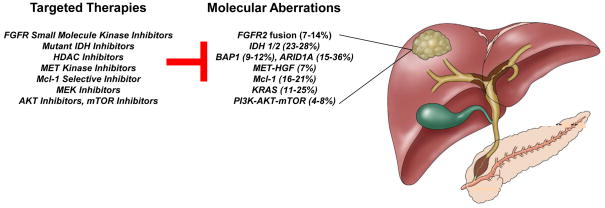
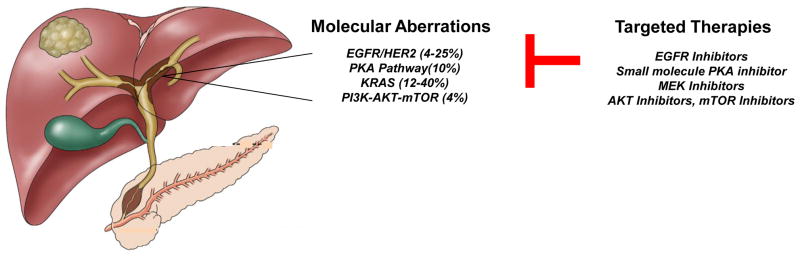
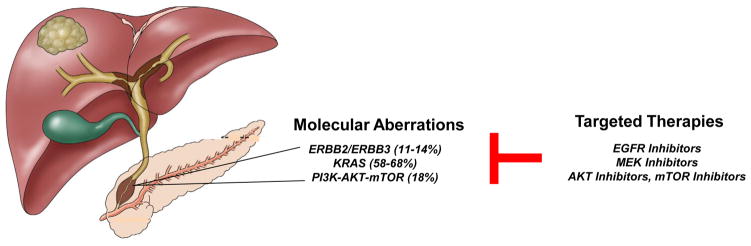
Cholangiocarcinomas (CCAs) are diverse epithelial tumors arising from the liver or large bile ducts with features of cholangiocyte differentiation. CCAs are classified anatomically into intrahepatic (iCCA), perihilar (pCCA), and distal CCA (dCCA). Each subtype has distinct risk factors, molecular pathogenesis, therapeutic options, and prognosis. CCA is an aggressive malignancy with a poor overall prognosis and median survival of less than 2years in patients with advanced disease. Potentially curative surgical treatment options are limited to the subset of patients with early-stage disease. Presently, the available systemic medical therapies for advanced or metastatic CCA have limited therapeutic efficacy. Molecular alterations define the differences in biological behavior of each CCA subtype. Recent comprehensive genetic analysis has better characterized the genomic and transcriptomic landscape of each CCA subtype. Promising candidates for targeted, personalized therapy have emerged, including potential driver fibroblast growth factor receptor (FGFR) gene fusions and somatic mutations in isocitrate dehydrogenase (IDH)1/2 in iCCA, protein kinase cAMP-activated catalytic subunit alpha (PRKACA) or beta (PRKACB) gene fusions in pCCA, and ELF3 mutations in dCCA/ampullary carcinoma. A precision genomic medicine approach is dependent on an enhanced understanding of driver mutations in each subtype and stratification of patients according to their genetic drivers. We review the current genomic landscape of CCA, the potentially actionable molecular aberrations in each CCA subtype, and the role of immunotherapy in CCA.
Keywords: Distal cholangiocarcinoma; Immunotherapy; Intrahepatic cholangiocarcinoma; Perihilar cholangiocarcinoma; Targeted therapy.
Copyright © 2017 European Association for the Study of the Liver. Published by Elsevier B.V. All rights reserved.
Conflict of interest statement
Figures
References
-
- Banales JM, Cardinale V, Carpino G, Marzioni M, Andersen JB, Invernizzi P, Lind GE, et al. Expert consensus document: Cholangiocarcinoma: current knowledge and future perspectives consensus statement from the European Network for the Study of Cholangiocarcinoma (ENS-CCA) Nat Rev Gastroenterol Hepatol. 2016;13:261–280. - PubMed
-
- Komuta M, Govaere O, Vandecaveye V, Akiba J, Van Steenbergen W, Verslype C, Laleman W, et al. Histological diversity in cholangiocellular carcinoma reflects the different cholangiocyte phenotypes. Hepatology. 2012;55:1876–1888. - PubMed
Publication types
MeSH terms
Substances
Grants and funding
LinkOut - more resources
Full Text Sources
Other Literature Sources
Medical
Miscellaneous
