. 2017 Jun 2;292(22):9252-9261.
doi: 10.1074/jbc.M117.783639. Epub 2017 Apr 7.

Large-scale analysis of variation in the insulin-like growth factor family in humans reveals rare disease links and common polymorphisms

Affiliations

Large-scale analysis of variation in the insulin-like growth factor family in humans reveals rare disease links and common polymorphisms

Peter Rotwein. J Biol Chem. .

Erratum in

Abstract

The insulin-like growth factors IGF1 and IGF2 are closely related proteins that are essential for normal growth and development in humans and other species and play critical roles in many physiological and pathophysiological processes. IGF actions are mediated by transmembrane receptors and modulated by IGF-binding proteins. The importance of IGF actions in human physiology is strengthened by the rarity of inactivating mutations in their genes and by the devastating impact caused by such mutations on normal development and somatic growth. Large-scale genome sequencing has the potential to provide new insights into human variation and disease susceptibility. Toward this end, the availability of DNA sequence data from 60,706 people through the Exome Aggregation Consortium has prompted the analyses presented here. Results reveal a broad range of potential missense and other alterations in the coding regions of every IGF family gene, but the vast majority of predicted changes were uncommon. The total number of different alleles detected per gene in the population varied over an ∼15-fold range, from 57 for IGF1 to 872 for IGF2R, although when corrected for protein length the rate ranged from 0.22 to 0.59 changes/codon among the 11 genes evaluated. Previously characterized disease-causing mutations in IGF2, IGF1R, IGF2R, or IGFALS all were found in the general population but with allele frequencies of <1:30,000. A few new highly prevalent amino acid polymorphisms were also identified. Collectively, these data provide a wealth of opportunities to understand the intricacies of IGF signaling and action in both physiological and pathological contexts.

Keywords: IGF binding proteins; IGF receptor; functional genomics; genomics; growth factor; human evolution; human variation; insulin; insulin-like growth factor (IGF); population genetics.


Conflict of interest statement

The author declares that he has no conflicts of interest with the contents of this article

Figures
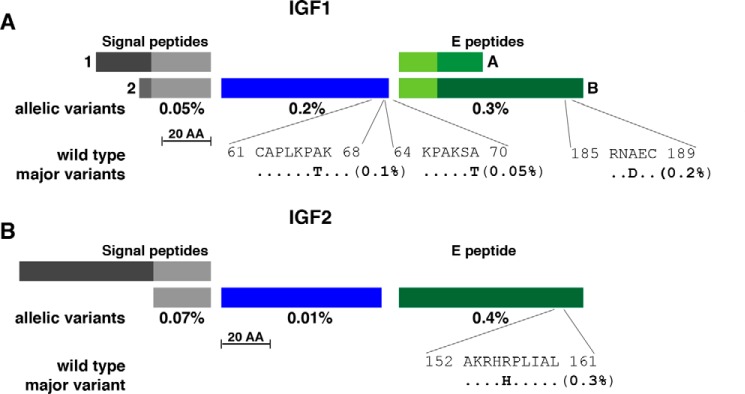
Figure 1.
Figure 1.
Population variation in human IGF1 and IGF2. A, schematic of human IGF1 protein precursors, including two alternative signal peptides, a 70-residue mature IGF1 and the two COOH-terminal extension (E) peptides. Signal peptides 1 and 2 consist of 48 and 32 amino acids (AA), respectively, and E regions A and B of 35 and 77 residues, respectively, with the 16 NH2-terminal amino acids being identical. The overall population prevalence of variant alleles for each segment of pre-pro-IGF1 is listed below the map, and the location of the three most common variants is depicted in single-letter amino acid code. B, diagram of human IGF2 protein precursors, including alternative signal peptides, a 67-residue mature IGF2 and the COOH-terminal E peptide. The two signal peptides consist of 80 and 24 amino acids, respectively (the former has not been determined experimentally), and the E region is composed of 89 residues. The overall population prevalence of variant alleles for each segment of pre-pro-IGF2 is depicted below the map, and the location of the most common variant is shown. For A and B, the scale bar represents 20 amino acids.
Figure 2.
Figure 2.
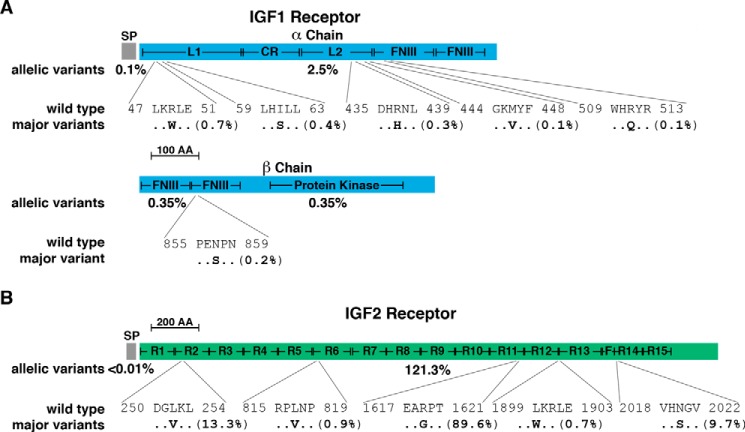
Population variation in human IGF1 and IGF2 receptors. A, diagram of the human IGF1 receptor precursor, including the 30-residue signal peptide (SP) and the α and β chains of the mature 1337-amino acid (AA) IGF1 receptor protein. The α chain consists of 706 amino acids, and the β chain, 627, with 4 residues lost upon proteolytic cleavage of the precursor protein. Major domains of the mature receptor are indicated (L1 and L2, large domains 1 and 2; CR, cysteine-rich; FNIII, fibronectin type III elements 1–4; Protein Kinase, tyrosine kinase region). The overall population prevalence of variant alleles for each part of the receptor precursor is listed below the map (variation in the tyrosine kinase region is indicated separately), and the location of the six most common variants is depicted in single-letter amino acid code. B, schematic of the human IGF2 receptor precursor, including the 40-residue SP and the 2451-amino acid mature protein. Different domains of the mature receptor are indicated (R1–15, repeating units; F, fibronectin type-II element). The overall population prevalence of variant alleles for each part of the molecule is pictured below the map, and the location of five most common variants is shown. The scale bar represents 100 amino acids in A and 200 in B.
Figure 3.
Figure 3.
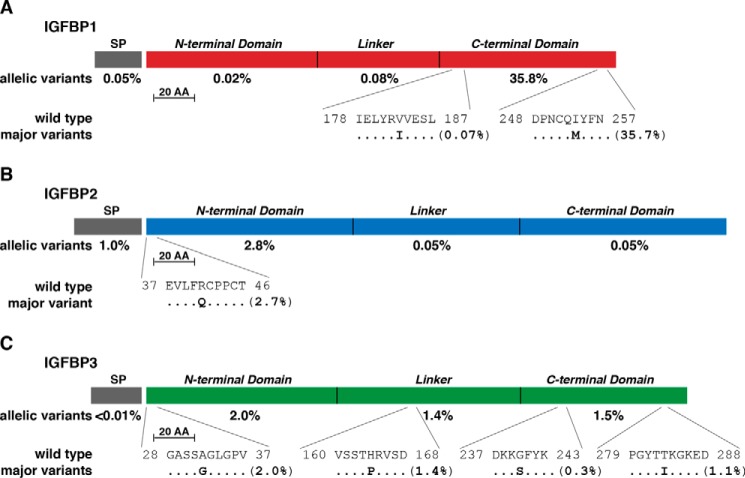
Population variation in human IGFBPs 1–3. A, diagram of the human IGFBP1 precursor, including the 25-residue SP and mature 234-amino acid (AA) IGFBP1. The overall population prevalence of variant alleles for each part of the molecule is listed below the map, and the location of the two most common variants is depicted in single-letter amino acid code. B, diagram of the human IGFBP2 precursor, including the 36-residue SP and mature 289-amino acid IGFBP2. The overall population prevalence of variant alleles for each part of the molecule is listed below the map, and the location of the most common amino acid variant is depicted in single-letter code. C, diagram of the human IGFBP3 precursor, including the 27-residue SP and mature 264-amino acid IGFBP3. The overall population prevalence of variant alleles for each part of the molecule is listed below the map, and the location of the four most common individual variants is depicted in single-letter amino acid code. The scale bar represents 20 amino acids for A–C. Protein segments for all three IGFBPs include NH2-terminal, linker, and COOH-terminal domains.
Figure 4.
Figure 4.
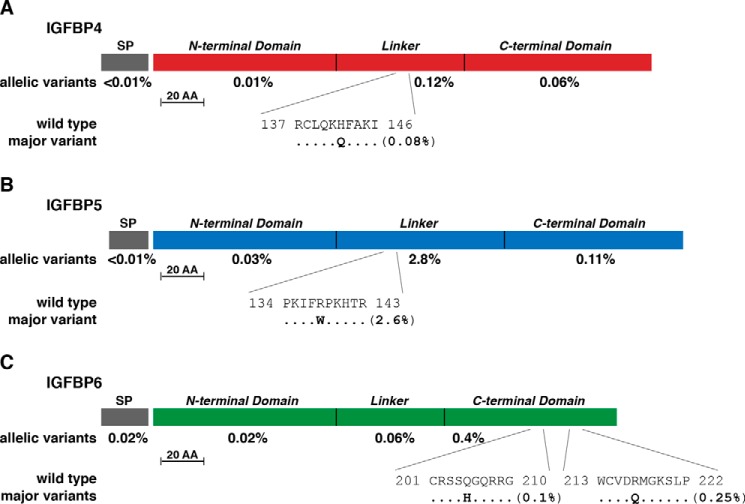
Population variation in human IGFBPs 4–6. A, diagram of the human IGFBP4 precursor, including the 21-residue SP and mature 237-amino acid (AA) IGFBP4. The overall population prevalence of variant alleles for each part of the molecule is listed below the map, and the location of the most common variant is depicted in single-letter amino acid code. B, diagram of the human IGFBP5 precursor, including the 20-residue SP and mature 252-amino acid IGFBP5. The overall population prevalence of variant alleles for each part of the molecule is listed below the map, and the location of the most common amino acid variant is depicted in single-letter code. C, diagram of the human IGFBP6 precursor, including the 24-residue SP and mature 216-amino acid IGFBP6. The overall population prevalence of variant alleles for each part of the molecule is listed below the map, and the location of the two most common individual variants is depicted in single-letter amino acid code. The scale bar in A–C represents 20 amino acids. Protein segments for all three IGFBPs include NH2-terminal, linker, and COOH-terminal domains.
Figure 5.
Figure 5.
Population variation in human IGFALS. Diagram of the human IGFALS precursor showing alternative 64 and 27 amino acid (AA) signal peptides (SP) (the former has not been determined experimentally) and the 578-amino acid mature protein. The cysteine-rich domains (CR1 and CR2) and the leucine-rich region are indicated in mature IGFALS. The overall population prevalence of variant alleles for each part of the molecule is listed below the map, and the location of the two most common variants is depicted in single-letter amino acid code. The scale bar represents 50 amino acids.

References

    1. Le Roith D., Bondy C., Yakar S., Liu J. L., and Butler A. (2001) The somatomedin hypothesis: 2001. Endocr. Rev. 22, 53–74 - PubMed
    1. LeRoith D. (2008) Clinical relevance of systemic and local IGF-I: lessons from animal models. Pediatr. Endocrinol. Rev. 5, 739–743 - PubMed
    1. Pollak M. (2012) The insulin and insulin-like growth factor receptor family in neoplasia: an update. Nat. Rev. Cancer 12, 159–169 - PubMed
    1. Gems D., and Partridge L. (2013) Genetics of longevity in model organisms: debates and paradigm shifts. Annu. Rev. Physiol. 75, 621–644 - PubMed
    1. Stewart C. E., and Rotwein P. (1996) Growth, differentiation, and survival: multiple physiological functions for insulin-like growth factors. Physiol. Rev. 76, 1005. - PubMed

LinkOut - more resources