


Does the FIFA 11+ Injury Prevention Program Reduce the Incidence of ACL Injury in Male Soccer Players?
- PMID: 28389864
- PMCID: PMC5599387
- DOI: 10.1007/s11999-017-5342-5
Does the FIFA 11+ Injury Prevention Program Reduce the Incidence of ACL Injury in Male Soccer Players?
Abstract
Background: The FIFA 11+ injury prevention program has been shown to decrease the risk of soccer injuries in men and women. The program has also been shown to decrease time loss resulting from injury. However, previous studies have not specifically investigated how the program might impact the rate of anterior cruciate ligament (ACL) injury in male soccer players.
Questions/purposes: The purpose of this study was to examine if the FIFA 11+ injury prevention program can (1) reduce the overall number of ACL injuries in men who play competitive college soccer and whether any potential reduction in rate of ACL injuries differed based on (2) game versus practice setting; (3) player position; (4) level of play (Division I or II); or (5) field type.
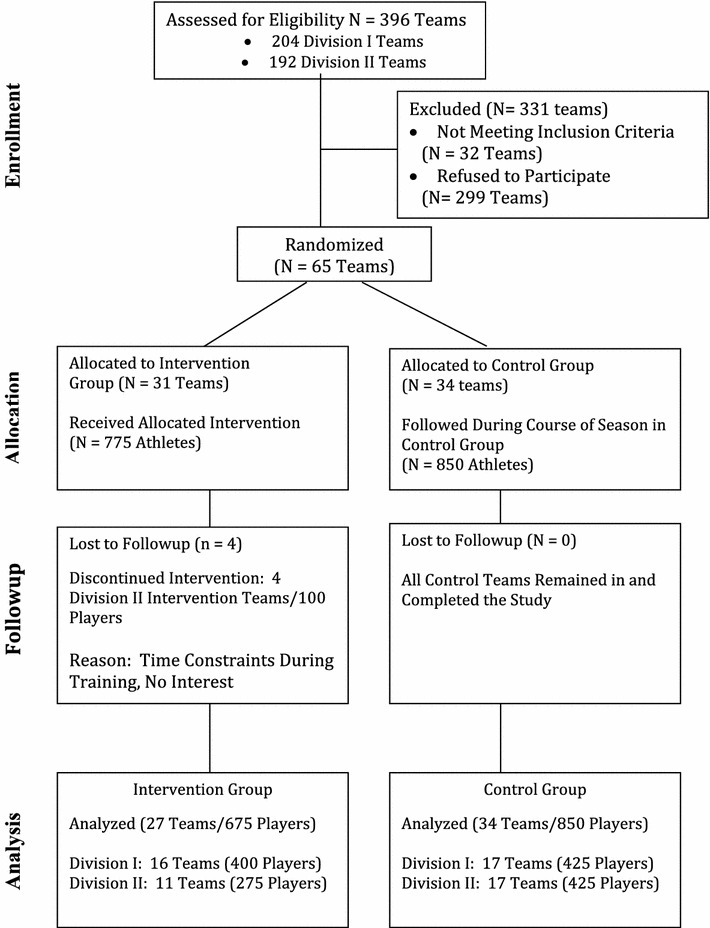
Methods: This study was a prospective cluster randomized controlled trial, which was conducted in 61 Division I and Division II National Collegiate Athletic Association men's soccer teams over the course of one competitive soccer season. The FIFA 11+ is a 15- to 20-minute on-the-field dynamic warm-up program used before training and games and was utilized as the intervention throughout the entire competitive season. Sixty-five teams were randomized: 34 to the control group (850 players) and 31 to the intervention group (675 players). Four intervention teams did not complete the study and did not submit their data, noting insufficient time to complete the program, reducing the number for per-protocol analysis to 61. Compliance to the FIFA 11+ program, athletic exposures, specific injuries, ACL injuries, and time loss resulting from injury were collected and recorded using a secure Internet-based system. At the end of the season, the data in the injury surveillance system were crosshatched with each individual institution's internal database. At that time, the certified athletic trainer signed off on the injury collection data to confirm their accuracy and completeness.
Results: A lower proportion of athletes in the intervention group experienced knee injuries (25% [34 of 136]) compared with the control group (75% [102 of 136]; relative risk [RR], 0.42; 95% confidence interval [CI], 0.29-0.61; p < 0.001). When the data were stratified for ACL injury, fewer ACL injuries were reported in the intervention group (16% [three of 19]) compared with the control group (84% [16 of 19]), accounting for a 4.25-fold reduction in the likelihood of incurring ACL injury (RR, 0.236; 95% CI, 0.193-0.93; number needed to treat = 70; p < 0.001). With the numbers available, there was no difference between the ACL injury rate within the FIFA 11+ group and the control group with respect to game and practice sessions (games-intervention: 1.055% [three of 15] versus control: 1.80% [12 of 15]; RR, 0.31; 95% CI, 0.09-1.11; p = 0.073 and practices-intervention: 0% [zero of four] versus control: 0.60% [four of four]; RR, 0.14; 95% CI, 0.01-2.59; p = 0.186). With the data that were available, there were no differences in incidence rate (IR) or injury by player position for forwards (IR control = 0.339 versus IR intervention = 0), midfielders (IR control = 0.54 versus IR intervention = 0.227), defenders (IR control = 0.339 versus IR intervention = 0.085), and goalkeepers (IR control = 0.0 versus IR intervention = 0.0) (p = 0.327). There were no differences in the number of ACL injuries for the Division I intervention group (0.70% [two of nine]) compared with the control group (1.05% [seven of nine]; RR, 0.30; CI, 0.06-1.45; p = 0.136). However, there were fewer ACL injuries incurred in the Division II intervention group (0.35% [one of 10]) compared with the control group (1.35% [nine of 10]; RR, 0.12; CI, 0.02-0.93; p = 0.042). There was no difference between the number of ACL injuries in the control group versus in the intervention group that occurred on grass versus turf (Wald chi square [1] = 0.473, b = 0.147, SE = 0.21, p = 0.492). However, there were more ACL injuries that occurred on artificial turf identified in the control group (1.35% [nine of 10]) versus the intervention group (0.35% [one of 10]; RR, 0.14; 95% CI, 0.02-1.10; p = 0.049).
Conclusions: This program, if implemented correctly, has the potential to decrease the rate of ACL injury in competitive soccer players. In addition, this may also enhance the development and dissemination of injury prevention protocols and may mitigate risk to athletes who utilize the program consistently. Further studies are necessary to analyze the cost-effectiveness of the program implementation and to analyze the efficacy of the FIFA 11+ in the female collegiate soccer cohort.
Level of evidence: Level I, therapeutic study.
Keywords: Anterior Cruciate Ligament; Anterior Cruciate Ligament Injury; Artificial Turf; National Collegiate Athletic Association; Soccer Player.
Figures
Comment in
-
CORR Insights®: Does the FIFA 11+ Injury Prevention Program Reduce the Incidence of ACL Injury in Male Soccer Players?Clin Orthop Relat Res. 2017 Oct;475(10):2456-2458. doi: 10.1007/s11999-017-5412-8. Epub 2017 Jun 14. Clin Orthop Relat Res. 2017. PMID: 28616755 Free PMC article. No abstract available.
References
-
- Albright JC, Carptner JE, Graf BK. Knee and Leg: Soft Tissue Trauma. Rosemont, IL, USA: American Academy of Orthopaedic Surgeons; 1999.
Publication types
MeSH terms
Grants and funding
LinkOut - more resources
Full Text Sources
Other Literature Sources
